How to Hire Mobile App Development Company in Dubai
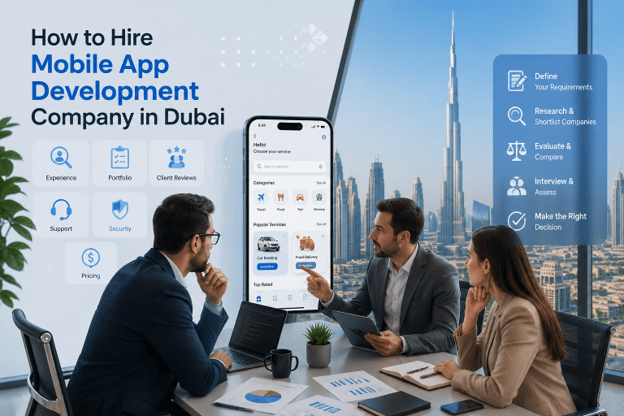
Mobile platforms are fast becoming the top-frontline warzone for customer engagement in the Middle East due to the digital economy's tremendous developments in the region. Here in Dubai , with a governmental agenda such as the Dubai National Vision 2030 that is putting citizens and businesses ahead, companies and new startups in areas like Dubai are quickly moving towards a mobile-first environment. The implementation of this transformation hinges significantly on seasoned technology partners such as Developer Bazaar Technologies, a worldwide acknowledged leader in engineering for cross-platforms, who can integrate the components and systems at scale and with continuous quality to deliver high-performing results. The effective use of tech has an exact method, and comprehending local regulations and laws, in addition to the specific monetary commitments, is expected to produce regional systems. It offers a detailed analysis and insight into the identification, analysis and selection process of the mobile application developers, which helps deliver long-term viability in the business marketplace in Dubai.
Dubai's Landscape of Mobile App Development.
There is an unprecedented growth in the regional software market, with more than 97 per cent of the country's population using a smartphone. This very digitalised society demands localised, fast and smooth interfaces working on regional 5G networks. This has led to the rise in the overall need for complete mobile app development in Dubai for various core industries such as financial technology (FinTech), luxury retail, property, and government sectors.
Quite often, mature regional markets serve as the focal point for local businesses that wish to set up mobile operations. UAE mobile app developers have been known for creating high standards in digital product design in the Gulf Cooperation Council (GCC) region, for example. But as Dubai's internal ecosystem grows, it has turned to developing teams at home that are familiar with the special considerations of Dubaii regulations and cultural user behaviour needs as well as the design challenges of dual-language environments. When leveraging specialised mobile app development companies in Dubai, businesses can understand how to achieve a balance between global engineering solutions and local consumer behaviour.
Cost Analysis: Budgeting for App Engineering in Dubai
Detailed knowledge of the capital needed to build digital products is an important factor in corporate budgeting. The investment cost is dependent on features, structure, data integration and security compliance.
The Cost to Develop a Mobile App in Dubai
The overall investment can vary depending principally on the depth of application architecture. It takes approximately 2 to 4 months to launch, and investing between ADE 36,400 and ADE 109,200 has been the norm for a simple setup that involves 3 to 6 static screens, standard user authentication, and basic push notification functionality.
The budget range stands at ADE 109,200 to ADE 291,200 for platforms that must be localized in both Arabic and English, included full regions for payment, such as QPay, and added the GPS mapping function. Custom backends, systems with personalization engines based on artificial intelligence, and mandatory links with Metrash2 or Hukoomi systems are common additions to complex enterprise applications and can push enterprise scaling beyond ADE 291,200 and even beyond ADE 728,000 if the scope of work is extended.
The Total Cost of Developer Acquisition
There are a variety of ongoing costs for employing app developers in Dubai besides the application itself. The financial commitment changes considerably, depending on the type of job structure that is selected:
Freelance Personnel: The freelance personnel usually get paid from ADE 50 to 150 per hour. The model is very cost-effective for simple proof-of-concepts (POCs) but may not have strong long-term structural maintenance and data security protection guarantees.
In-House Personnel: The monthly cost to maintain a permanent in-house engineer is between ADE 15,000 and 35,000 per specialist. This ensures day-to-day control but can be very expensive when it comes to visa sponsorship, physical provisioning of workstations and recruitment fees.
Dedicated Agency Teams: When using a dedicated agency team, budgets can be as low as ADE 40,000 up to ADE 250,000 or higher per project. This way, you will be able to get the benefits of a predictable budget coupled with institutional reliability, providing access to complete-cycle engineering, quality assurance, and project management.
Step-by-Step Guide to App Developer Hiring Dubai
It is important to have a systematic approach when it comes to finding and keeping top-tier engineering talent. The technical team should be checked for not only syntax efficiency but also regional data localization laws.
Determine the Architectural Scope: The enterprise needs to develop a clearly defined product specification document before entering the market. This involves outlining whether the application needs real-time databases, geolocation tracking, machine learning algorithms, or intricate payment gateways.
Choose the Engagement Framework: Organizations will need to determine if they want to create an internal engineering team, hire independent freelancers, or work with an existing information technology company. When it comes to mission-critical systems, relying on a dedicated digital engineering company is usually the preferred option to prevent delays in delivery.
Assess Technical Adaptability: For hiring Dubai app developers, candidates should be assessed as per their real-time engineering skills. This involves checking their experience using AWS Arabia for local data residency, automated testing tools, and right-to-left (RTL) interface design.
Audited examples on regional application storefronts: Successful deployments on regional application storefronts are documented in Audit Portfolios and Regional Case Studies, which are verified. Businesses need to check the work of the candidate to ensure they have developed resilient and responsive platforms that are capable of supporting high concurrent user volumes.
Testing and validating regulatory compliance knowledge: Dubai has tight rules in line with electronic commerce, data privacy, and online banking. It is important for the sourced teams to be familiar with the guidelines set by the Communications Regulatory Authority (CRA) and the frameworks by the Ministry of Transport and Communications (MOTC) before the launch to avoid liability issues after the launch.
Set up Post-Launch Maintenance SLAs: Mobile operating systems get updated on a regular basis, and users provide feedback that calls for feature updates. A Service Level Agreement (SLA) needs to be in place in hiring strategies for ongoing optimization and security patching and server management.
Why Choose Developer Bazaar Technologies?
By engaging an award-winning AI software development firm to complete a large-scale digital transformation initiative, risks to the execution process and time-to-market are minimized. In the challenging environment of the Middle East, Developer Bazaar Technologies provides organizations with a dependable engineering partner.
Large global experience base: They have a large pool of active certified engineering experts and have deployed over 1000 scalable web and mobile applications across various industries around the world.
Proven Middle Eastern Content Expertise: The company's deep knowledge of the Middle Eastern market enables it to implement complex systems for leading enterprise customers across the region, making sure that every application fully meets the language localisation needs and end-user preferences of the Middle East.
Complete Code Ownership, Full Legal and Data Protection: All strategic partnerships are secured by legally binding Non-Disclosure Agreements (NDAs) as well as intellectual property transfers.
Committed Long-Term Assistance: The firm offers up to 1 years of structured post-launch assistance plus 24/7 real-time operational monitoring to guarantee constant application availability and best performance.
Frequently Asked Questions (FAQs)
Q1. How long does it take to develop a bespoke app in Dubai?
A1. The engineering time for a simple application using standard features is typically 8-16 weeks. Custom API integration and dual-language systems are found in mid-tier platforms, which can take from 4-7 months to develop, and complex enterprise platforms can take 8-12 months for development.
Q2. What are the development cost issues related to right-to-left (RTL) Arabic text requirements?
A2. Correct localization in Arabic demands mirroring of the user interface, customization of font rendering systems, and special software testing on various device types. When considering the initial design of the architecture, it will save the cost of visual modifications later on.
Q3. Is there a possibility of an enterprise resorting to cloud infrastructure outside of Dubai?
A3. Under local data protection laws, applications handling sensitive user data or financial transactions must often comply with strict data residency rules. By using the cloud data centers in the region, including AWS Dubai, or regional cloud zones in Dubai, it guarantees legal compliance.
Q4. Why do you prefer to work with an agency rather than a freelancer?
A4. A full-service team of UI/UX designers, backend engineers, frontend developers, and quality assurance testers is provided by agencies with a single project manager. This team-based organization reduces communication issues and guarantees maintenance support, which is not always promised by freelancers.
Conclusion
There are several key points to consider when launching a modern digital platform in the context of Dubai, such as having a well-structured approach, understanding of native platform dynamics, and accurate development estimation. When hiring top tech talent, user experience design capabilities, regional compliance understanding, and coding abilities must all be taken into account. With engineering teams that are experienced with mobile development, enterprises can realise a clear competitive advantage and sustainable growth by linking project objectives with mobile developers who can provide secure and very responsive platforms within the rapidly expanding market of Dubai.

