How to Launch Without a Tech Team: The Non-Coder’s Guide to MVPs
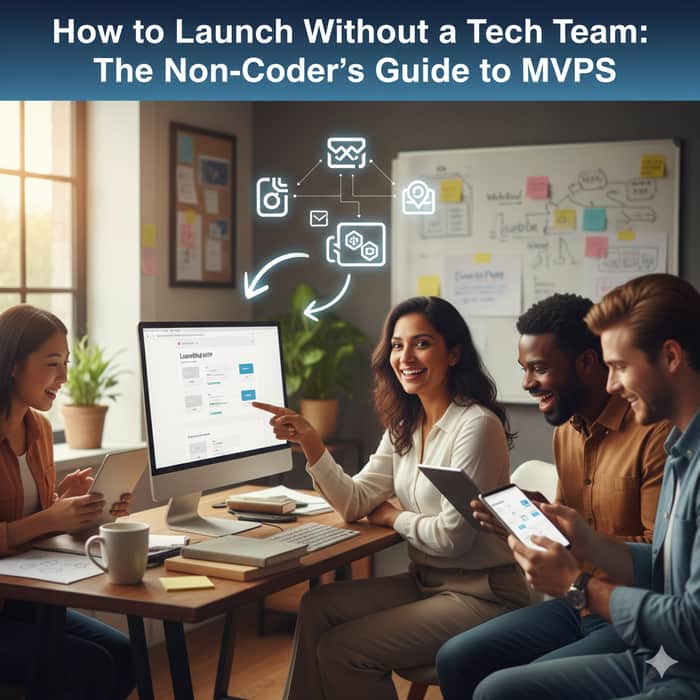
Many founders believe that building a tech product requires a team of developers. The truth? You don’t need to know how to code—or hire a full tech team—to launch a Minimum Viable Product (MVP).
Non-coders can validate ideas, build functional prototypes, and even launch products quickly, without expensive development delays. Here’s how smart founders do it.
- Embrace No-Code Tools
No-code platforms have revolutionized startup building. With them, non-technical founders can:
Build web apps with Bubble or Webflow
Create mobile apps with Glide or Adalo
Automate workflows using Zapier or Integromat
These tools let you focus on solving user problems instead of worrying about technical implementation.
- Define Your Core MVP
Even with no code, the MVP should be lean and focused:
Identify the primary problem you’re solving
Choose one key feature that addresses it
Skip all “nice-to-have” features until validation
This keeps your build simple, fast, and cost-effective.
- Validate Before You Build
A common mistake is building first, asking questions later. Non-coders can validate ideas using:
Landing pages to measure interest
Surveys or polls to understand audience pain points
Pre-sales or early sign-ups to prove demand
Validation ensures that your time and energy go into a product people actually want.
- Rapid Prototyping
Even non-coders can create interactive prototypes that feel real:
Use Figma to design clickable mockups
Combine no-code tools to simulate workflows
Show users a product they can interact with before building fully
Prototypes give credibility to your idea and attract early adopters—or even investors—without writing a single line of code.
- Leverage Expert Guidance
Going solo is possible—but working with experts accelerates results:
Prioritize the features that matter most
Avoid common no-code pitfalls that slow progress
Build an MVP fast, stress-free, and ready for users
I’ve helped multiple founders launch MVPs without a tech team in less than 14 days, ensuring their ideas reach the market quickly and efficiently.
Take Action: Launch Without Limits
You don’t need a tech team to make your startup happen. What you need is focus, the right tools, and expert guidance.
Connect with me today and I’ll help you turn your idea into a working MVP—even if you can’t code a single line. Let’s launch your product fast, smart, and stress-free.

The hardest thing about B2B is that you're often selling to someone who didn't budget for your category. They need the result you provide but never planned to pay for it.
The products that win here usually create a new budget line (by being categorically new) or steal from existing budget by making the ROI comparison obvious. Which of those are you trying to do?
This is a great breakdown for non-coders who want to ship something real — and it highlights a core tension I see in no-code launches:
The weakest part of many MVPs isn’t the lack of code — it’s not being clear on what signal proves the idea matters before building more features.
In my experience, the best no-code MVPs focus on:
Curious — when you recommend launching without a tech team, what early signal do you think matters most to decide whether to double down vs pivot?
Spot on. The 'build first, ask questions later' trap is where most non-technical founders lose their budget. No-code tools are incredible for speed, but they only work if you've mapped out the right user journey first. We’ve been seeing a lot of founders lately pairing no-code builds with strategy partners like Cognimuse—it helps them ensure that while they’re building fast, they’re actually building something the market wants. Focus is definitely the superpower here!
If you are interested let's connect on my email for further talk 😀
quratulaincreatives@gmail.com
Appreciate the response.
I agree — no-code is a speed multiplier, not a substitute for clarity. Where I’ve seen founders get into trouble isn’t tooling choice, but treating speed as validation.
One pattern I’ve noticed: the most reliable early signal isn’t just “will someone sign up,” but whether they change behavior without being prompted — e.g. coming back unasked, bypassing their old workflow, or pulling others in organically.
Tools can help accelerate that, but they don’t create it. If the signal isn’t there, faster shipping just gets you to the wrong answer sooner.
Curious if you’ve seen any non-obvious behavioral signals emerge before founders thought they were ready to double down.
Totally with you — no-code amplifies speed, but it doesn’t create the validation signal on its own. Faster builds just get you to an answer sooner, not necessarily the right answer.
One thing I’ve seen separate good from great early MVPs is behavioral signals over vanity metrics — e.g.:
Users come back without incentives
They actually complete the core job (not just click a button)
They invite others or share organically
They ditch their old tool or workflow for yours
These show real value, not just curiosity.
Curious — when you look at early traction, do you weight repeat use or unprompted actions more heavily than sign-ups or demo requests?