How to make GEO content that AI cites and users read
SEO has not really changed in the last ten years. Schema markup, clean meta, sane headers, internal links, backlinks from places that matter. That part still works. What changed is the second layer on top of it: GEO - getting cited by the model, and then actually read by the human who clicked through.
And GEO has a different bar. The model is not ranking ten blue links. It is picking sentences to quote. If your content is generic slop with no offline background behind it, it will not get cited - and if it does, the user who lands on it will bounce in five seconds. So the job is two-sided: write something an LLM finds worth quoting, and something a person finds worth reading once they arrive.
The reason is simple. Models are biased toward content that sounds like it came from someone who has actually done the thing. Specific numbers. Named tradeoffs. A workflow described in operational detail. Objections raised and answered. That is the signal. Everything else is spam dressed up as a blog post.
GEO is SEO + content built on the words your audience actually uses
This is the part most "GEO guides" skip. You cannot write content the model wants to cite if you are guessing at the vocabulary of your buyer. You need their words, their framing, their objections - not your internal product language.
Concretely, a piece of content earns citations when it does three things at once:
Matches the question the user typed into the model. Not your keyword. Their phrasing of the pain.
Answers it with specifics no other page has. Numbers, steps, named edge cases, a heuristic that only someone in the trenches would know.
Sounds like a person, not a content team. Models penalize the generic average. The closer your text is to the median SEO article on the topic, the less quotable it is.
The compounding effect is that the same content that gets cited by AI also tends to rank in traditional search, because Google has been pushing the same direction for years: helpful, experience-backed, specific. GEO is not a new discipline. It is SEO with the bar raised on substance.
Where most GEO content fails
Most attempts at GEO fail the same way: founder sits down, asks an LLM to "write a thoughtful article about X", lightly edits, publishes. The model produces a clean essay that says nothing. No offline background. No real example. No friction. It reads fine and gets cited by nothing.
The hard part is not writing. It is grounding. Without real-world input - your customer's actual complaint, your own production data, a workflow you ran and broke - the output is a confident summary of other confident summaries. That is the definition of slop, and both Google and the models are getting better at filtering it out.
So the work splits in two:
Input work: collect the raw material. What is your audience actually venting about? In their words. With their framing. With the objections they raise before they buy.
Output work: frame your own experience, numbers, and story against that raw material so the piece reads as a direct answer to a real question.
Skip the input work and you are guessing. Skip the output work and you have research notes, not content.
A practical workflow for GEO content that gets cited
Here is the shape of a workflow that actually produces citeable pieces:
Pick one specific pain. Not a topic. A pain. "How to stop Reddit posts from getting removed" is a pain. "Reddit marketing tips" is a topic. Models cite pains, not topics.
Pull the audience's real language around that pain. Forums, comment threads, support tickets, sales calls. Capture verbatim phrasings, recurring objections, and the failure modes they describe.
Map your own experience onto it. What did you try? What broke? What numbers came out? What did you change? If you do not have firsthand experience on that exact pain, pick a different pain.
Write the piece as an answer, not an essay. Open with the blunt claim. Explain the mechanism. List the concrete steps. Name the tradeoffs. Close when you are done.
Keep the schema, meta, headers, and internal links clean. GEO does not replace SEO hygiene. It sits on top of it.
The output of this loop is a piece that reads like someone who actually solved the problem wrote it - because they did. That is what gets quoted by AI answers, and what keeps the user on the page once they click through.
Where Achiv fits
The bottleneck in that workflow is step 2 - pulling the audience's real language - and step 3 - framing your experience against it. That is the work that takes hours, and the work most founders skip.
Achiv runs Reddit Intelligence over the communities where your buyers are already venting. It clusters their pains and objections in their own words, surfaces which subreddits carry the strongest signal for each cluster, and turns that into a grounded brief: here is what they are asking, here is how they phrase it, here is the angle that resonates.
From there, the writing part is yours. You feed in your experience, your story, your facts and numbers, and the tool frames them into a piece built on the vocabulary your audience actually uses. Not generic AI prose. Not a feature page in disguise. Content that has offline background behind it, framed against demonstrated demand.
Then the same loop on Reddit itself: comments and posts grounded in real pains, written in the register of the specific subreddit, validated against its rules before submission. Reddit threads that rank in Google and get pulled into AI answers are not accidents. They are the same GEO discipline applied to a different surface.
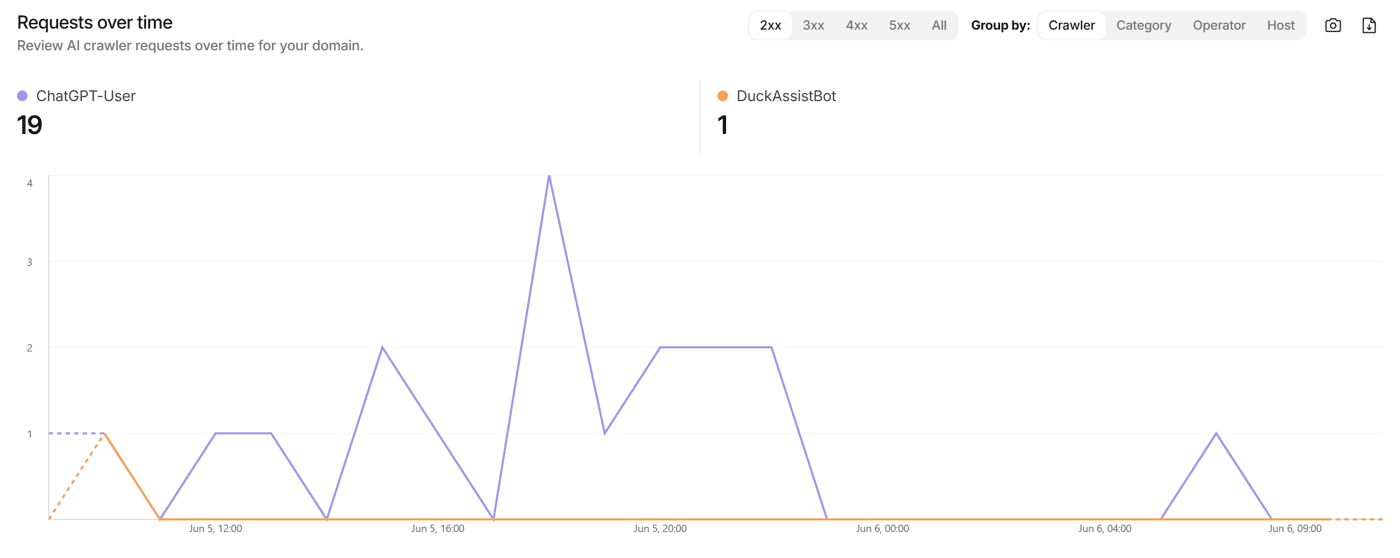
Screenshot: CloudFlare - AI Assistants visiting Achiv daily to cite only ~30 articles crafted with Achiv (not the highest number I had so far).
The takeaway
GEO is not a new game. It is the old game with a higher floor on substance. Schema and backlinks still matter. What changed is that the content sitting on top of that technical foundation has to be worth quoting - by a model, and by a person.
Two things to get right:
Ground every piece in your audience's actual words. Not your internal vocabulary. Theirs.
Ground every piece in your own offline experience. Numbers, failures, decisions, tradeoffs. The things only you can write.
Do both and the content gets cited and read. Skip either and you are publishing slop into a market that already has too much of it.


That's the real thing most GEO "experts" are really missing - you can generate 100s posts that AI will likely cite, but what's next? User landed with that post will bounce instantly because of your effortless, boring content.
we had exactly this problem when hired GEO agency. They've generated a ton of content, brought some leads with 0 additional revenue. Average engagement time ~15 seconds.
This is what Achiv is trying to solve. Your GEO content must be worth reading and cited by AI at the same time.