How to power a shed with solar: watts, battery size and cost (what our store's search data taught us)
We run a small online solar store, Eco Solar Kits. We found out that most of people don't need a solar company. They need three numbers and a way to check them. Here is the guide we wish those searchers found first.
The three numbers that decide everything
- Peak watts (inverter size). The most power running at the same moment. A drill, a light and a radio together might be 700W. A table saw alone can pull 1,800W, and more than double that for a second at start-up.
- Daily watt-hours (battery size). Total energy per day. A 60W fan running 5 hours is 300Wh.
- Peak sun hours (panel size). Most of the US sees 3-6 hours, and fewer in winter.
Get these right and choosing a kit is easy.
Step 1: List what you'll actually run
- 2 LED shop lights - running watts: 40W; typical use: 4 h; energy/day: 160Wh
- Phone and laptop charging - running watts: 60W; typical use: 3 h; energy/day: 180Wh
- Box fan - running watts: 60W; typical use: 5 h; energy/day: 300Wh
- Mini fridge - running watts: 70W (cycles); typical use: 24 h; energy/day: 500-900Wh
- Tool battery chargers - running watts: 100-200W; typical use: 2 h; energy/day: 200-400Wh
- Circular or miter saw - running watts: 1,200-1,800W; typical use: 20 min; energy/day: 400-600Wh
- Window AC (5-8k BTU) - running watts: 450-700W; typical use: 6 h; energy/day: 2.7-4.2kWh
- Small air compressor - running watts: 1,000-1,500W (3x at start); typical use: 30 min; energy/day: 500-750Wh
Two things catch people out:
- Motors surge. Saws, compressors, fridges and AC units need 2-3 times their running watts for a split second when they start. Your inverter has to cover that.
- Heat is expensive. A 1,500W space heater running for 4 hours uses 6kWh, which is more than most home backup batteries hold. Don't plan on electric heat from a shed battery.
Step 2: Inverter size
Add up everything that might run at once, then add 20%.
- Lights, charging and a fan: 300-600W
- Corded hand tools: 1,500-2,400W
- Table saw, compressor, window AC or 240V tools: 3,000-6,000W, split-phase (120/240V) if you need 240V
Step 3: Battery size
Battery Wh = daily Wh x days of reserve / 0.8 / 0.92
The 0.8 means you don't drain the battery to zero every day, and the 0.92 covers inverter losses. A hobby workshop using 1,200Wh a day, with one cloudy day of reserve, needs about 1,630Wh. A 2kWh power station covers it.
Step 4: Panel size
Panel watts = daily Wh / (sun hours x 0.75)
The 0.75 covers heat, dust, wiring and panel angle. With 1,200Wh a day and 4 sun hours, you need about 400W of panels. In a northern winter with 2 sun hours, the same load needs about 800W, or a generator top-up on dark weeks.
Face the panels south, tilt them to roughly your latitude, and keep them out of tree shade.
Portable solar generator vs a wired kit
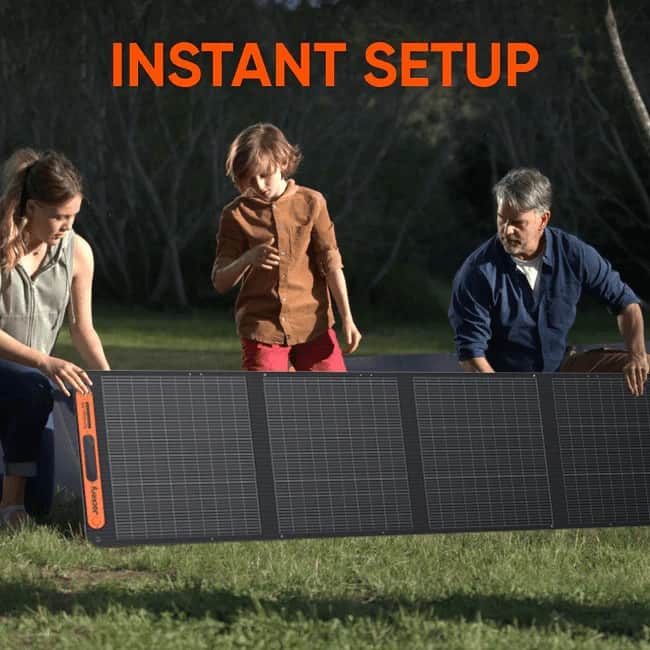
Solar generator (power station + panels): battery, inverter and charger in one box. You plug the panels in and plug your tools in, with no wiring. It can also come inside during an outage. It makes sense up to about 3-4kWh a day.
Wired off-grid kit (wall inverter + rack battery + roof panels): feeds real outlets through a small sub-panel. You get more capacity per dollar, 240V, and room to expand. This is a permanent install, so hire a licensed electrician.
What it costs (real prices, Sept 2026)
- Lights and charging - daily energy: <300Wh; example setup: Jackery 300 v2 + 40W panel; price: ~$360
- Garden shed, fan and chargers - daily energy: 0.5-0.9kWh; example setup: Jackery 1000 v2 + 200W panel; price: ~$790
- Hobby workshop, corded tools - daily energy: 1-2kWh; example setup: Anker SOLIX C2000 Gen 2 + 400W panel; price: ~$1,500
- Workshop with fridge and window AC - daily energy: 3-4kWh; example setup: Anker SOLIX F3800 + 400W panel (120/240V); price: ~$2,600
- Permanent wired 120V shed - daily energy: 4-5kWh; example setup: 5kW inverter + 5.12kWh battery + 1.2kW panels; price: ~$3,150
Beyond that, you're really building a small cabin system with 10kWh or more of storage, which starts around $5,500.
For comparison: trenching a new electrical line from the house, plus permits and sometimes a panel upgrade, can cost as much as a mid-size solar kit, and you still pay the power bill.
Mistakes we see most
- Cold batteries. LiFePO4 can't charge below 32°F. In cold climates, buy a self-heating battery or insulate the corner it sits in.
- Long, thin cables. They waste power. Keep panels on or right next to the shed.
- Buying the exact size you need today. An inverter one size up costs less than replacing it next year.
- Assuming no permit. A portable setup usually doesn't need one. A hardwired sub-panel or roof mount often does.
Quick FAQ
How many panels do I need for a shed? One 40-100W panel for lights and charging. About 400-600W for a hobby workshop.
Can a solar generator run power tools? Yes, if the inverter covers the start-up surge. 2,000-2,400W handles most hand tools. Table saws and compressors want 3,000W or more.
Can I run AC in my shed on solar? A small window unit, yes, with 3kWh or more of battery and 800W or more of panels.
If you want to compare real setups side by side, we keep our shed solar kits in one place, from small solar generators to wired off-grid kits.
Happy to answer sizing questions in the comments.
