How to reach $4.2M ARR while pursuing a mission | Ghost 👻
Listen Up! IH - Episode 37
“Ghost is being made for love, not for profit.”
👆That’s a line from John O’Nolan’s intro video for Ghost’s Kickstarter campaign from back in 2013.
John is the founder of Ghost.org a publishing platform for independent writers and creators to make money from their work.
Ghost’s tagline reads: “Turn your audience into a business”.
It’s an open startup, so anyone can look at their revenue on their open page.
As of January 2022, Ghost’s revenue is $4.2M+ ARR.
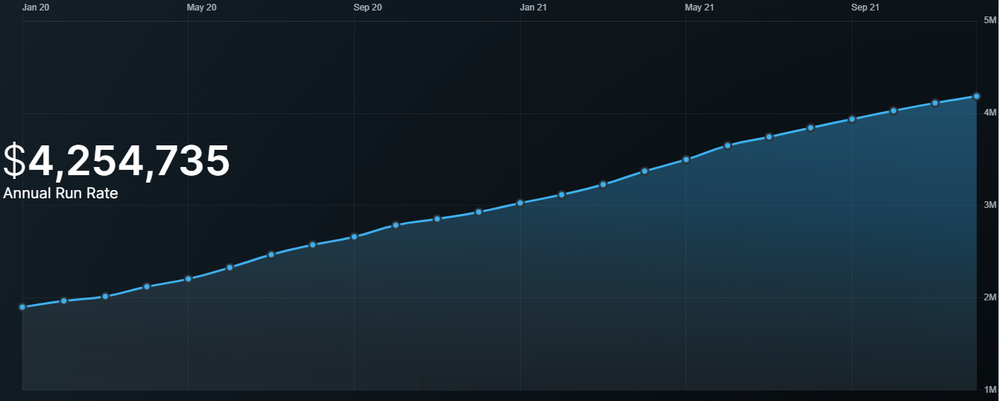
source: Ghost’s open page.
Ghost’s goal in 2021, was to help the creators on the platform generate more revenue than Ghost itself.
This is a feat very few creator platforms can boast of.
But Ghost did achieve it.
Creators on Ghost made $10.2M in revenue in 2021 -
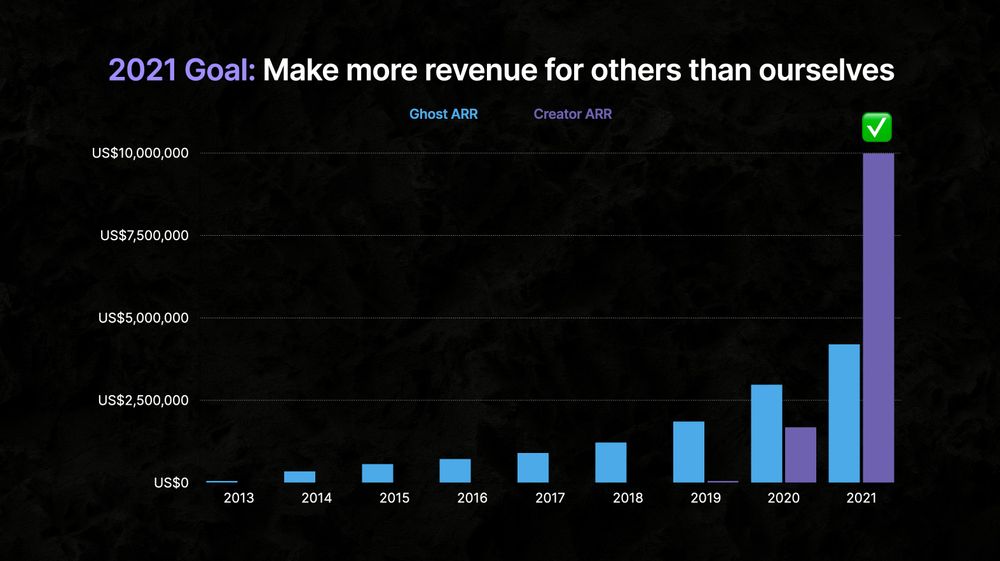
(source: John’s Tweet)
There’s a lot to learn from the Ghost story👇
Ghost: The Origin Story👻
John started Ghost back in 2013 with the idea to build a platform solely focused on publishing content.
And made it open-source.
He had been designing and building sites on WordPress since 2005.
WordPress had started as a simple blogging platform for anyone to publish content. But within a few years, it turned into a full-blown CMS platform.
By 2011-12 it was getting used more for marketing sites and brochures.
WP was no more focused on straightforward content publishing. (Its founder famously called WP the operating system of the web)
That frustrated John.
So on November 5th, 2012, John made a few mockups and published a blog post titled - WordPress is so much more than just a blogging platform.
This is the Ghost intro Tweet:
That blog post was at the top of HackerNews and was discussed by almost every publication in the WordPress community.
Within a week it went viral and raked in 250,000 views.
In 3 months John was ready with a prototype. 30,000 people had signed up on the Ghost mailing list by then.
That’s when he launched the prototype on Kickstarter to raise funds for the project.
He knew that it only made sense to build the complete product if people were willing to pay for it.
John’s goal with the Kickstarter campaign was to raise $30,000 but he ended up raising 10X of that.
Check out the campaign page on Wayback machine: Ghost: Just a Blogging Platform.
(The 3-minute video for the Kickstarter campaign is worth a watch as it clarifies John’s motivations for working on this product)
50% of the screens in that prototype video are just screenshots.
John knew that he could build those features, later on, didn’t want to spend that time without validating the idea.
It was a true Minimum Viable Product.
A Remix Product🔃
Ghost in 2022 is a sophisticated content publishing platform. A place where creators can monetize their creations with ease.
But when it started, it was envisioned as WordPress Lite.
These were the initial mockups that John came up with in his notebook:
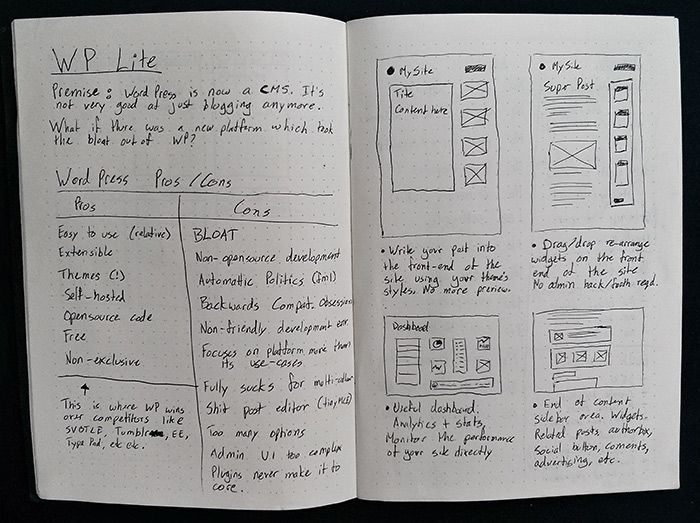
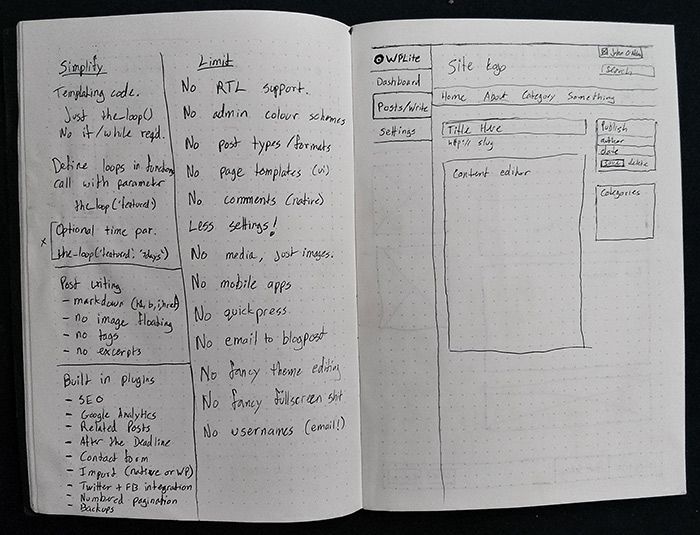
Some of the ideas in those mockups did make it into the final product. And many were discarded.
Most of these ideas were a combination of concepts from various other platforms such as Geckoboard, Mou, Sparrow, Svbtle, Tumblr, Squarespace, and many others.
As John likes to say - “Everything is a Remix”
This is true for product development more than we realize.
This is a common pattern across many successful indie hacker products.
- Like Tally is an improvement on Google forms and Typeform, with a user experience closer to Notion. (Read more about how Tally reached $8.5K MRR)
- Tuple was inspired by Screenhero. (Read more about how Tuple reached $8K in revenue before even a product)
- And Hypefury solved the issue of scheduling Twitter threads that Buffer wasn’t focusing on. (Read more about how Hypefury crossed $23K MRR in just 1 year)
A Unique Business Model🪙
Ghost is set up as a non-profit foundation so that it can stay true to its users instead of shareholders or investors.
It’s open source and decentralized.
The company can never be bought or sold.
100% of the revenue is re-invested into the product and the community.
They call it sustainable open-source:
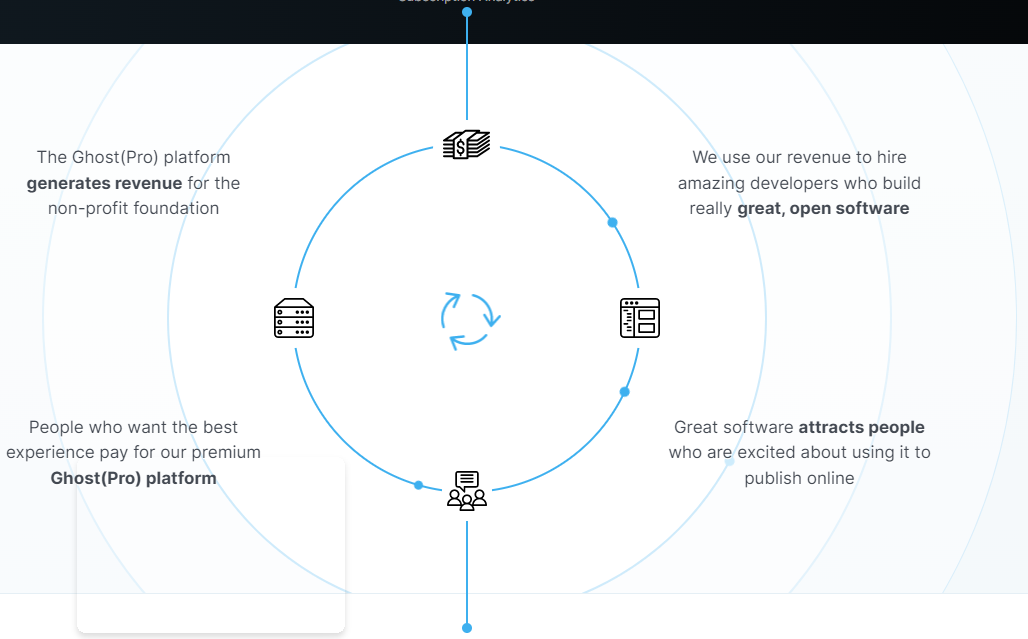
A unique model like this ensures that John and the team aren’t looking for a big pay-off in the future.
They aren’t building the business with an intention to sell to investors.
According to John, the goal to sell the company at a later date can lead to compromises with the product.
It can lead to technical debt that can compound at scale.
This business model means that they are focused on building the best product for their users - Writers and Journalists.
And that their users know that Ghost is going to be there in 10 years, and not shut down, or change business models to please investors. (Something that a platform like Medium does a lot)
John strongly believes that such open platforms need to exist to support independent journalism.
And that’s his mission.
In the Kickstarter launch video, John particularly mentions that the intention is not to sell the business to Facebook one day.
He also says:
“We are not just making this because we want to sell it, we are making this because it needs to exist”
“Ghost is being made for love, not for profit.”
And he stood by those words because the way Ghost is structured right now, there’s no way for him to sell the company and make big profits from it.
Standing out from the Crowd 🥇
Ghost competes in a crowded market.
There are more blogging platforms today than ever before. Its competition includes old platforms like WordPress and recent ones like Substack.
To succeed as a bootstrapped business, Ghost’s strategy is to have a unique positioning and fight the competition by differentiation.
Ghost can’t compete with Substack on advertising and PR - Substack is backed by powerful VC firms like a16z, so everything they do gets in the news. (Including small feature announcements)
But it can compete on the value proposition it offers to the users.
Ghost takes a 0% cut from its users’ revenue.
It offers fixed-price plans based on features and audience size.
This means that creators can scale their business without their costs scaling proportionately.
Substack takes a 10% cut from its users’ revenue.
As newsletter revenue grows, Substack’s 10% fee can balloon up to thousands of dollars.
Stacking up against Substack 📜
Lenny Rachitsky is one of the most popular writers on Substack.
6 weeks after launching a paid version of his newsletter, Lenny posted a Twitter thread with all his learnings.
This Tweet stands out from the thread:
Clearly, 10% platform fees can be hard on creators.
But Lenny is a big Substack fan, and actively promotes it over any other email platform.
He posted a Tweet highlighting how Substack’s discovery feature has helped him get subscribers. And that justifies the 10% fee.
(It’s important to note that according to Lenny’s investments page, he is an investor in Substack.)
Ghost doesn’t help it’s creators with discovery.
Creators must grow their newsletters on their own. But the fact that Ghost charges 0% fee is a substantial incentive for creators to choose Ghost over Substack.
The Ghost blog does a good no-nonsense comparison of Ghost and Substack.
This is also a good example of a well-executed SEO strategy, this blog is the 2nd result when you search for “Substack alternatives” on Google.
Substack is a great way to kick start a publication and get your initial subscribers.
But as they grow, most creators realize that it makes financial sense to move on to an alternative like Ghost.
This is exactly what the reader-supported news site The Daily Poster did back in May 2021:
Ghost follows a more traditional SaaS model, it's a tool that can be used by independent creators.
While Substack sees itself more as a platform for independent writers.
That’s the fundamental difference between the 2 companies.
The Future of Ghost 🔮
John doesn’t want to build a large conglomerate with thousands of employees, instead, he wants to enable hundreds of other independent businesses around Ghost.
3 types of businesses that benefit from the Ghost ecosystem:
- There are 12k creators directly making money from Ghost.
- Apart from that, there’s a growing marketplace of Ghost themes and addons.
- There are even productized services that help people set up and run their Ghost sites.
The Ghost marketplace is a good place to find custom themes, integrations, and experts.
Limited team size:
Ghost’s current team size is 27.
John doesn’t want to grow the team beyond 50-60 people. He wants it to be a close-knit team that knows each other meaningfully.
John’s Advice 🤗
John’s advice to other Indie Hackers is to stop thinking and start building.
Not care so much about every feature or getting the best quality in the first iteration.
Get the right combination of Idea + Execution + Story.
“Build more stuff more quickly at a lower quality than you need. If it’s the right idea where people can buy into the story, it will succeed.”
“Shut the fuck up and go and build something!”
Right ✅
Key Lessons from the Ghost journey 👇
- Growth Strategies📈
- Useful insights📊
- Traffic Channels🔢
- Landing Page Lessons📃
- Related Trends and Opportunities💸
Growth Strategies📈
Ghost has seen steady growth over the years, let’s look at their growth strategies -
- Audience First - Before building the full product, John had a viral blog post on HackerNews, 30,000 people on a mailing list, and a successful Kickstarter campaign. He had validated the need for the product before building it.
- Big Product Launches - Every time Ghost releases a new version, it makes a huge splash across podcasts, newsletters, and other platforms. Which brings in new users.
Example: The last product hunt launch with Ghost 4.0 got more than 2000 upvotes. And Ghost was PH’s product of the month for March 2021. - Product Led Growth - Creators that use Ghost can opt in to show a banner at the bottom of their emails that says - “publish with Ghost”. It acts as a word of mouth channel.
- Referral Marketing - Ghost offers its customers a 30% referral commission for recommending it to other creators. One of the biggest Ghost users is productivity YouTuber Ali Abdaal. And he drops his Ghost affiliate link in almost every video he makes around writing or blogging or making websites.
Useful Insights📊
Insights that indie hackers can apply in their own business.
-
Every idea needs a great story. Your ideal customer will not buy the product, they will buy your story. Idea + Execution + Story. Ghost has all 3 going for them.
-
Find your unique skew to the market/problem. Ghost solves the same problems as Substack. But it can hold its own because it attracts a very different kind of user.
And has a unique value proposition.
-
Validate before you build too much. Build just enough to show it to potential users and validate the idea.
-
Get continuous user feedback. The Ghost team runs a private Discord community with its users. Where it can get immediate feedback from them about the product.
-
Use creative constraints - Ghost has benefited a lot from the unique constraints that John started with - “What if I can never sell this company?” Or “No more than 50 employees” or “Only focuses on publishing and journalism”
-
Charge more. John has said - “I would never create a business ever again which charges less than $10/month”.
Traffic Channels🔢
Let’s look at Ghost’s primary traffic channels:
Ghost receives around 594K visits every month:
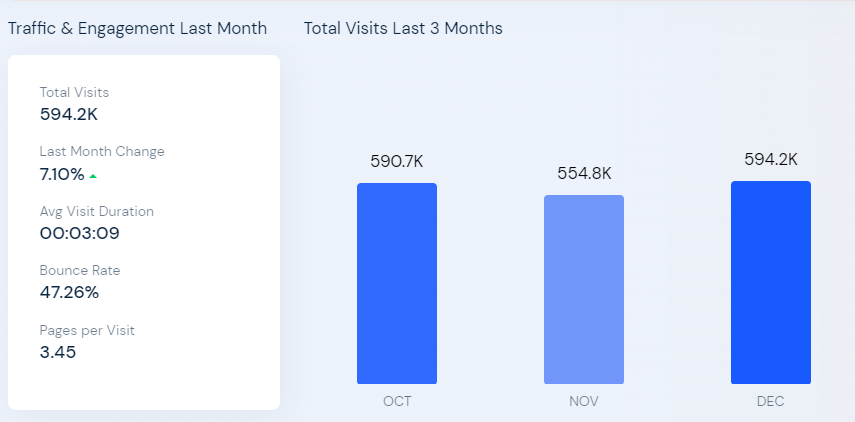
Traffic breakdown:
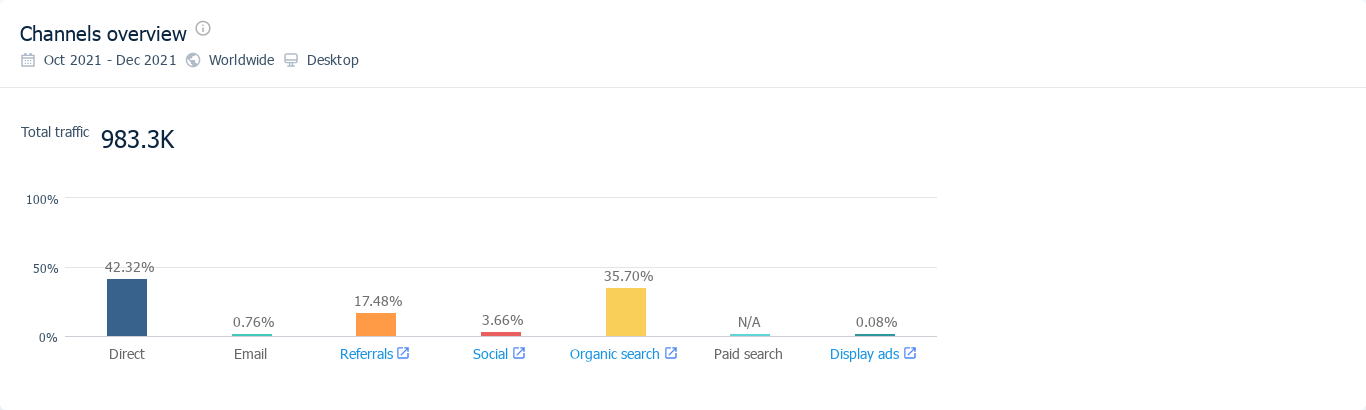
Direct: 42%
Organic search : 35.7%
Referrals: 17.48%
Social: 3.6%
Channels overview:
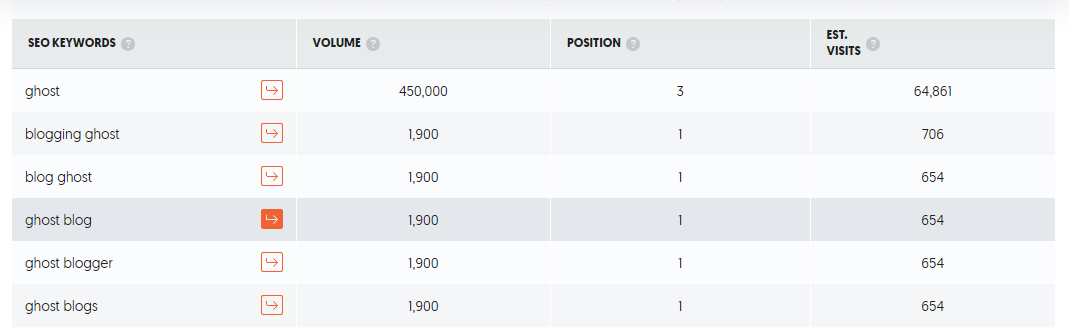
- Even though organic search contributes to 35% of their traffic, most of the keywords they rank for are versions of “ghost blog”.
- Check their Ubbersuggest report for SEO analysis.
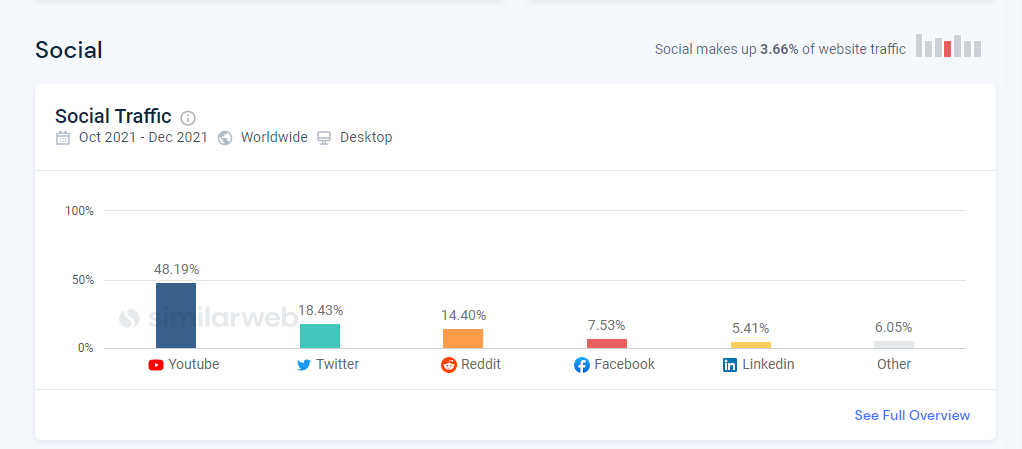
- 48% of Ghost’s social traffic is from YouTube.
- Most likely from Ali Abdaal’s videos like this one 👉 Why everyone should have a website in 2021.
- Twitter and Reddit are also substantial sources:
Landing Page Lessons📃
Let’s see what we can learn from Ghost’s landing page - ghost.org
- “Turn your audience into a business” is a perfect headline that explains the purpose of the product.
- The dynamic text in typewriter style addresses the “why” of their target audience - “Launch Your Own Newsletter/Community/Netflix etc.”
- A screenshot of the Ghost dashboard is highlighted right below the tagline. The dashboard helps put the monetization features in focus. That’s what Ghost’s ideal customer cares about the most.
- Next, social proof is from indie writers like Steph Smith and Albert Henk van Urk is there right below the dashboard screenshot.
- Rest of the copy and visuals on the landing page talk about the benefits to its customers, instead of features, the copy is impactful with words like:
- “Make it yours”, “your own platform on the web”
- “transform clicks into contacts” “Understand what’s working”
- “Powerful integration” and “Built to last”
- “No investors, no bullshit”
- The CTA button says - “Get started now - free” which makes it a no-brainer for anyone to start a free trial.
- The copy at the bottom with the CTA is very impactful - “Last week, 4,702 brand new publications got started with Ghost. Today, it's your turn.”
Related Trends & Opportunities💸
- Ghost’s recent growth has aligned with the larger trend of the rising creator economy. Where independent creators are finding unique ways to make a living off their creations.
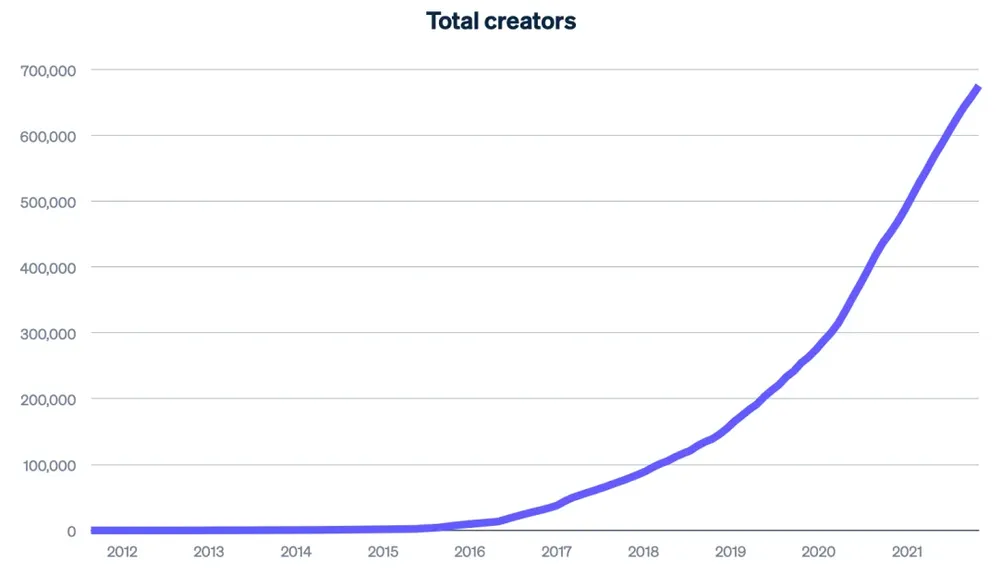
- According to a Stripe report, across 50 platforms, creators have earned more than $10B in revenue.
- In 2021, the total number of creators onboarded by apps using Stripe has grown 48% year over year.
- Gumroad helps creators monetize their skills. A graph of creator revenue on the platform -
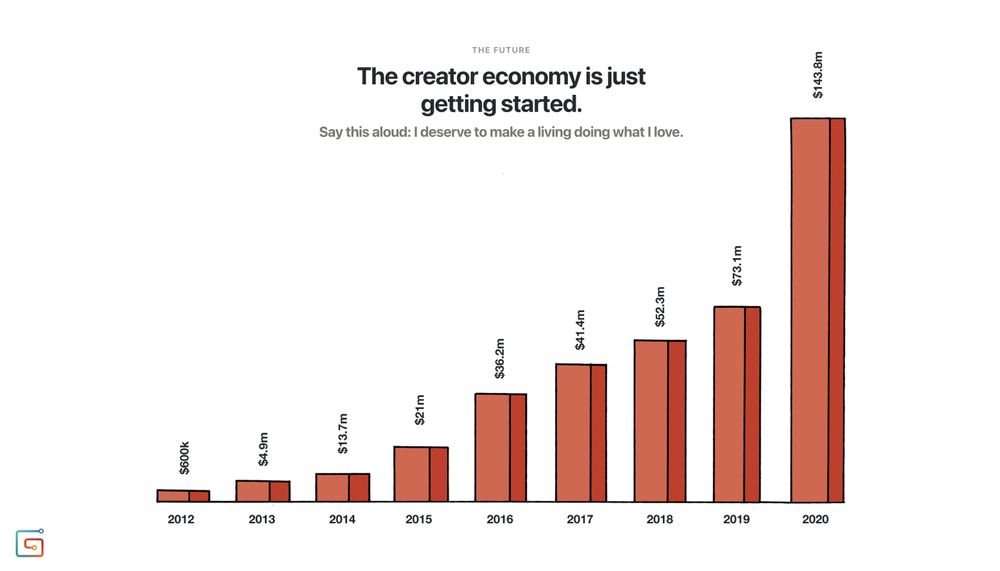
Source: Gumroad Tweet
- Opportunities will lie in building tools for these creators. This market map is a good picture of all the types of tools that can be built to support the creator economy:
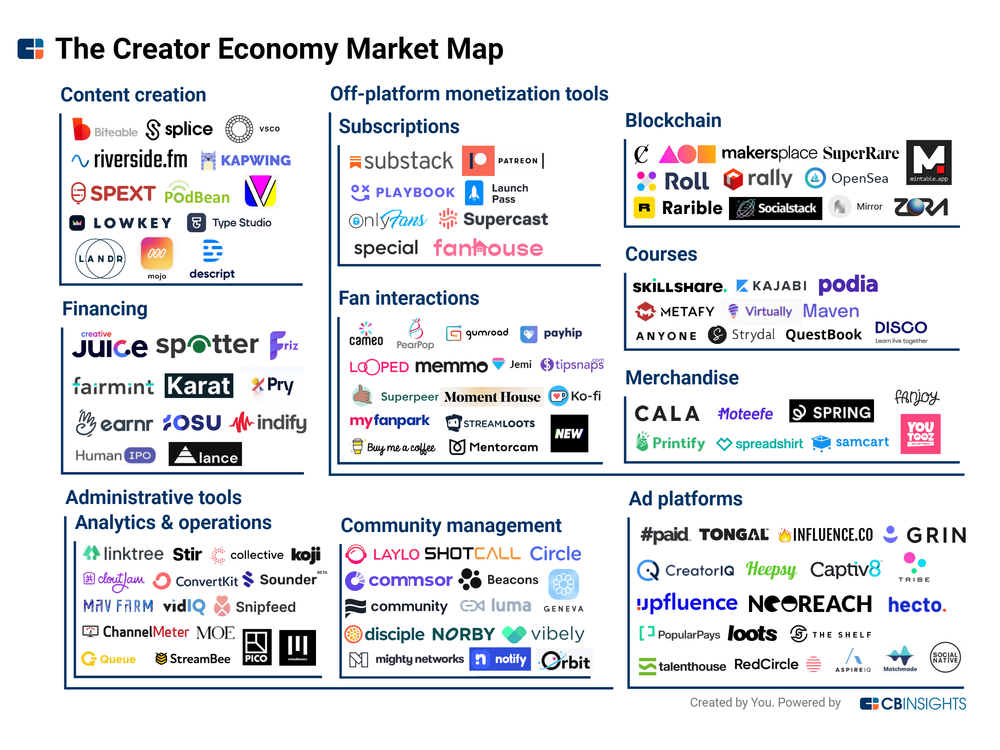
Source: CB Insights
Related Profiles 🤝
Indie Hacker projects profiled on this newsletter before, that serve the creator economy:
- Riverside - Podcasting tool (Read more)
- Carrd - Landing page builder (Read more)
- Hypefury - Twitter automation (Read more)
- Sheet2Site - Google sheet Website builder (Read more)
- Veed - Video editor (Read more)
- ConvertKit - newsletter automation (Read more)
- Gumroad - Creator monetization (Read more)
- Clost Tools - Poshmark automation. (Read more)
Related Links🔗
- Constraints, Longevity, and Avoiding Competition with John O'Nolan from Ghost | IH Podcast #227
- Pursuing a Mission While Bootstrapping to Millions with John O'Nolan of Ghost | IH Podcast #139
- Ghost Kickstarter campaign.
- Project Ghost | John’s Blog
- Creator Economy Report #73 | Trends VC
Thank you for reading🙏
I hope you found value in this post, would love to get some feedback about the newsletter from you. If you have 2 minutes please answer these 3 simple questions.
ICYMI : The last post was about the form builder Tally
Every week, I share the most actionable insights and inspiring tips from successful Indie Hackers FOR aspiring Indie Hackers
Ideas + Insights + Inspiration for building profitable internet businesses💪
Sign up to Listen Up! IH and join 1800+ spirited Indie Hackers who read this newsletter every week.
Cheers,

great, great, breakdown @ayushchat!
I've also analyzed their growth and found these tactics and channels:
I would definitely say that their Kickstarter campaign was their main early growth strategy. And then he built his audience on Twitter.
One key thing to add also, John had a crazy good understanding of the community prior to building Ghost, as Deputy Head of Design at Wordpress.
Yes, thanks Daniel.
Totally agree with what you're saying.
John's past experience was a big advantage for their success.
This is true for many indie hackers actually. They see success in projects related to their previous work and area of expertise.
That was a hell of a post. Thanks for writing that!
Thanks Elliot, it was a lot of fun doing this deep dive 😃