How to spot high-intent customers in 5 minutes, for free.
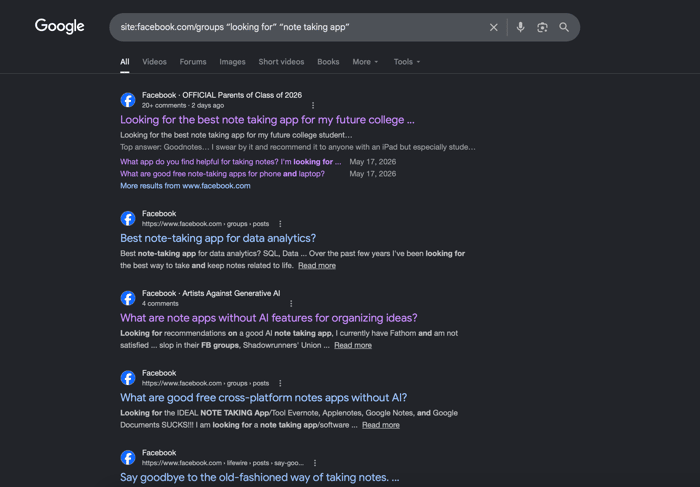
I am creating a multimodal AI note taking app and tried different strategies cold emails, random posting, product directories. Some work better than others, but I do not have sufficient time or money to waste on things that don't convert.
I needed a way to find high-intent users without spending all day hunting for them.
Then I combined "chasing people" with "starting listening to them". When someone takes the time to post online looking for a specific software recommendation or complaining about a competitor, they aren't just browsing, they are a day one user standing there with their wallet out.
So, I came across this ridiculous low-effort trick, using Google to scan public social channels for active pain triggers. It takes around 5 minutes to find real, ready to convert users. And it is completely free.
Here is the exact cheat sheet I use, tailored for a note taking app (which is my product type):
Note: You can modify these strings with your actual industry or product, and add a city or country if you have a specific target market.
- Facebook Groups (Search public feeds directly)
You don't need to waste time joining thousands of spammy groups; you can search indexed public group discussions straight from Google.
Broad query: site:facebook.com/groups "looking for" "notetaking app"
Geo-targeted / Local target: site:facebook.com/groups "looking for" "notetaking app" "New York"
- Reddit (Targeting active discussions & frustrated users)
Reddit is an absolute goldmine for catching people right when they are dissatisfied with a competitor’s update, lag, or price hike.
The direct ask: site:reddit.com "looking for" "note taking app"
The competitor switch: site:reddit.com "alternative to" "Competitor" "note taking"
- Hacker News (Targeting developers, power users, and tech professionals)
HN threads are incredibly high-intent for software tools, especially when users are discussing productivity workflows or complaining about complex enterprise software.
Show HN/Ask HN discussions: site:news.ycombinator.com "recommend" "note taking"
Competitor frustration: site:news.ycombinator.com "alternative to" "Competitor 1" OR "Competitor 2"
- LinkedIn (Professional / B2B intent)
If your product targets founders, researchers, or executives who need structured notes, target public feed posts.
site:linkedin.com/posts "looking for a" "notetaking" "recommend"
site:linkedin.com/groups "how do you manage notes"
- Quora & Independent Tech Forums
Quora: site:quora.com "what is the best note taking app"
Niche forums: site:discourse.group OR site:vbulletin.net "best app for notes"
Experiment with the keywords, filter queries by most recent date. Don’t run these manually every day. Take your winning search strings and plug them into Google Alerts with the deliverability set to "As it happens." You’ll get an email notification the exact minute a high-intent prospect posts a question online.
Pro-tip to keep your inbox clean: In your email provider (like Gmail, godaddy, etc), create a dedicated folder/label named "High-Intent Leads." Then, set up an email filter so every time an email arrives from googlealerts-noreply@google.com, it skips your primary inbox and automatically goes straight into that folder. This keeps your main workspace free while organizing all your fresh, daily leads in one easy to review spot.
That's it for now. If you feel like a "thank you" is not enough, please subscribe to the app 😉:
Web app: https://www.mindnote.online
Android app: https://play.google.com/store/apps/details?id=com.mindnote.app&pli=1
iOS: https://apps.apple.com/app/mindnote-ai-notetaking-app/id6757657079

Useful framework. The part I would add is a small intent score before replying, otherwise it is easy to treat every search result as equal.
I would score a thread higher when the person has three signals at once:
For example, "best note taking app?" is weak intent. "I am tired of moving meeting notes from Zoom to Notion every day, is there a tool that does this cleanly?" is much stronger.
The query finds the room. The scoring keeps you from replying to people who are only browsing.
Thanks for the contribution! 👌
this is actually quite helpful and I don't know why I didn't think of it.
this resonates. one signal i find super useful for b2b saas is when someone is already cobbling together 3-4 tools and complaining about the duct tape. they basically wrote your sales pitch for you. the 5-minute thing is great, but i'd add: look at what they tried before. if it's nothing, they're tire kickers. if it's a zapier mess plus two trial accounts, that's your buyer. how do you separate the curious from the actually desperate in your filter?
Thanks for the contribution.
Definitely.
To answer your question on how to separate the curious from the actually desperate in the filter: Look for friction and fatigue. The curious ask broad, conceptual questions ("What's the best tool for X?" or "Has anyone tried Y?"). They are hunting for information. But the desperate are using extra keywords: ASAP, help, limitation, high pricing, tired, waste. There are generic and specific terms. Still, I’m haven’t figure out everything yet. Probably will share, as soon as I do.
Filtering intent by language choice is a sharp observation. Broad, conceptual inquiries signal simple curiosity, while high-friction keywords pinpoint users with immediate, painful problems.
Honestly "get them to try" is usually a selection problem wearing an activation costume. If you incentivize the trial itself — discounts, "just try it" — you pull people motivated by the incentive, not the product, and they bounce. What's worked better for me is making the thing they unlock something they already wanted, so finishing the step self-selects for real interest. (Building in this space right now — happy to share what I'm seeing if useful.)
Cool! That is a great insight.
This is a really useful framework. The shift from chasing people to listening to them complain about competitors is one of those obvious-in-retrospect insights most founders miss.
One thing worth adding for a multimodal note-taking app: voice input as a capture method. A lot of people abandon note-taking apps not because the app is bad, but because typing is too slow for the thought they are trying to catch. The best notes come from moments of insight, and that moment is gone by the time you open the app and start typing.
I built DictaFlow to solve exactly that. Hold a hotkey, speak the note, release, and the text appears wherever your cursor is. It works across any app, including note-taking tools. For a multimodal notes product, native voice capture could be a real differentiator from Notion, Roam, and Obsidian, which are still keyboard-first.
Are you handling voice input in your app? Curious if it is on the roadmap.
Totally agree on the voice input aspect. Typing really can be too slow when you're trying to capture a sudden thought before it slips away.
Thanks for sharing.
MindNote already supports STT. For Dictation, Live Meetings and virtual meetings (Google meets, zoom and Microsoft teams) as well.
Good luck with your product.
This is pure gold, Tom! Shifting from "chasing users" to "listening for active pain triggers" is the ultimate growth hack for bootstrapped founders. Google Dorks are criminally underutilized for organic lead generation.
Gregory made an excellent point in the comments about the 60-second contact moat. We use a very similar intent-listening framework at ShipMitra to find e-commerce brands frustrated with big logistics aggregators. If someone is on Reddit venting about "fake weight discrepancies" or "failed pickups," they are already 90% converted. Dropping a generic sales pitch completely kills the lead. But if you reply with a hyper-specific solution to their exact logistical or operational bottleneck, the conversion rate skyrockets.
Also, your tip about setting up Google Alerts to automate this into a dedicated Gmail folder is a massive timesaver. For a lean team, it basically acts as a free, automated inbound pipeline. Thanks for sharing these exact search strings—definitely bookmarking this!
Saved. The reframe from "chase" to "listen for intent" is the real unlock — you're not interrupting anyone, you're showing up where someone already raised their hand.
Two refinements from running this in my own niche:
Google indexes Reddit and FB groups slowly and incompletely, so the freshest (highest-intent) posts often aren't crawled yet. I pair the dork with each platform's native search sorted by "new" — the dork catches the evergreen threads, native-new catches the "posted an hour ago, wallet out" ones Google hasn't seen.
On the show-up part: leading with a genuinely useful answer, and naming the tool only when it actually fits, consistently beats "hey check out my thing." The thread itself becomes the marketing, because the next person Googling that same pain lands on your helpful reply.
Curious which channel converts best for you — my hunch is Reddit beats everything for software intent, but LinkedIn might win on willingness to pay.
Thanks for contributing. Your refinements are great!
To answer your question: Reddit is indeed amazing. I think all directories and socials are great: LinkedIn, IG, Twitter, TikTok, quita, etc.
Reddit got me almost 100 new users in less than 4 hours, thanks to a post.
This hit harder than expected. Been doing cold outreach for weeks burned a lot of time and energy on something that wasn't converting.
Tried your reddit queries this morning. Found a thread from yesterday with people asking the exact question I could help with. Left one comment.
The thing nobody tells you about distribution: "shooting blind" feels productive but isn't. First time in weeks I felt like I was actually fishing where the fish are.
Saved. Thank you.
That is absolutely incredible to hear! 🎉
Strong post. One thing I'd add: once you find the "wallet-out" complaint, the next bottleneck is the page you send them to.
For Mindnote, I'd test pages like:
That is usually where qualified traffic either turns into a trial or disappears on a generic homepage.
I shared the full 7-page structure I use here if useful:
https://www.indiehackers.com/post/i-built-a-7-page-acquisition-cluster-for-a-saas-heres-the-full-structure-free-to-copy-2ea575f08a
If you want, I can sketch a mini-cluster for Mindnote for 39€.
Thanks for sharing! That platform looks really interesting and could definitely be useful for business development efforts down the road as things scale. I'll keep it on my radar for a later stage but in the meantime, you might want to look at https://flowmarket.social/chat, which can help find B2B partners and customers through an AI agent.
Good luck!
The 5-minute framework is clever - do you find this works better for B2B or service-based businesses? Customer qualification is the hardest part of scaling.
The 5-minute qualification framework is interesting - do you find this works better for B2B or B2C? I could see it being really effective for service-based businesses.
I think it works great for both, you just tweak the framing.
For B2B, just add the word "team" somewhere in your queries to shift the focus to organizational bottlenecks. It’s definitely a bit more difficult with the longer sales cycles, so if you find a lead that's genuinely ready to purchase, that's absolute gold.
For B2C in a broad niche like mine, it's way easier. I just need some Google or Apple ads users find the app, download it, and subscribe entirely by themselves.
It's definitely effective for service businesses too, you are certain about bringing value before you waste time on a 30 mins. on a demo call!
these site: queries pull good leads but they decay fast — Googles been shrinking what it indexes from facebook groups + reddit comments since around Q1 2026. for reddit specifically, ive had better luck with pushshift-style APIs that catch posts as theyre made instead of waiting 2-7 days for google to index them. someone complaining today is way warmer than someone who complained 2 weeks ago. wallet-out window in my niche (devops/AI tooling) tends to close within 48 hours.
Nice insight. Thanksfor sharing.
This works and it's been working since Google indexed forums. The trap is that everyone reading this is going to do it the same way: scrape the signal, paste a templated DM, and wonder why their reply rate is 2 percent. The signal isn't the moat. What you do in the first 60 seconds of contact is. The founders I see closing from this method don't pitch in the first message. They reply with something so specific to that person's exact complaint that it's clearly not automation. Slower, fewer touches, way better conversion.
Spot on, thanks for the great insight! It is definitely difficult to maintain that level of manual personalization at scale.
Solid cheat sheet — the "search public group feeds via Google instead of joining them" trick is genuinely underused.
One question back at you: when you reach out to these high-intent posters, do you comment publicly in the thread or DM them? I've seen public-helpful-first convert better than cold DM, but curious what's working for you.
Both, depending on the context.
Taking a screenshot of the post and sending a DM referencing it works surprisingly well, at least to start a conversation and get a reply.
But replying publicly is powerful too, because it gives you the opportunity to answer other people’s questions in the thread as well. Sometimes one helpful public comment can generate multiple inbound conversations instead of just one.
Thanks for sharing it! I knew about this type of info search as "Google Dorks" but I didnt expect we can use it like that! Saved!
Thanks. Glad it was useful!
This is actually gold.
Most founders waste time chasing users.
You figured out how to listen for intent instead.
People publicly searching for alternatives or complaining about competitors are already halfway converted.
Simple strategy. High leverage. Zero ad spend.
Really smart distribution play
Really appreciate that. 🙌
Wow you are smart! This is next level.
Thanks!
I actually used it and it works! I got ai to create a play book.
Wonderful!
This is a good distribution angle because you are not guessing who might care. You are finding people already showing pain, competitor frustration, or active buying intent.
But I think the stronger insight here is not just the Google search trick. It is that note-taking apps are extremely crowded, so the product needs to win on a clearer wedge than “AI notes.” High-intent discovery helps, but when those users land, the product still has to feel sharper and more ownable than another note app.
That is where I’d pressure-test the name. Mindnote is clear, but it also sits very close to the generic note-taking category. Since you are building a multimodal AI note workspace across web, Android, and iOS, the brand may need to feel broader than notes alone.
Xevoa .com would fit that direction better if the product becomes more of an AI workflow and memory layer, not just a note-taking app. The current name explains the category, but a stronger brand could make the product feel more serious before users compare it against every other AI notes tool.
If you are already pushing distribution, I’d think about this before more users, app listings, and content start locking the product into the Mindnote frame.
In this example, the clear pain point is note taking instead of the workflow. I know that you want to bring your product "organically", but in this case, you are not listening to the pain point.
If this is an automated message, you need to tailor better so it brings actual value to the customers by solving their real pain points.
P.s. the website is not working.
Good luck!
Fair criticism. You are right that I should have anchored the comment more tightly to the actual pain point in your example.
For that search case, the user is clearly looking for help with note-taking itself, so the better angle would be showing how Mindnote solves that specific note-taking pain before trying to broaden it into workflow or memory.
Appreciate the direct feedback. Also thanks for flagging the website issue — that is probably the first thing to fix before any positioning or naming discussion matters.
Good luck with the launch.
Same setup in healthtech. The signal we needed: when a bill we were tracking moved from committee to floor vote, specifically for anything touching data privacy or clinical software. goffer.ai monitors those bill IDs and keywords, SMS on floor votes, Gmail labels for everything else. The compliance team gets a weekly digest of everything that moved, the product team gets the SMS for floor votes only. That split routing reduced the volume enough that alerts get read instead of archived. Before that separation, everyone was getting everything and nothing was getting acted on.
One filter I would add is whether the pain already has an owner and a next step.
A lot of "looking for a tool" posts are still research. The stronger signal is when someone describes a broken workflow: who is waiting, what happens if it slips, what they already tried, and what decision they need to make next.
That turns the search from "people who might like this category" into "people whose current process is leaking time or revenue right now."
Very Informative
This is gold. I never thought of using Google as a lead scanner for social platforms. Just tried the Reddit search trick for my own product and found active threads instantly. The Google Alerts tip to automate it is the real game changer here — setting that up right now. Thanks for sharing this!