How to Translate Raw Manga to English
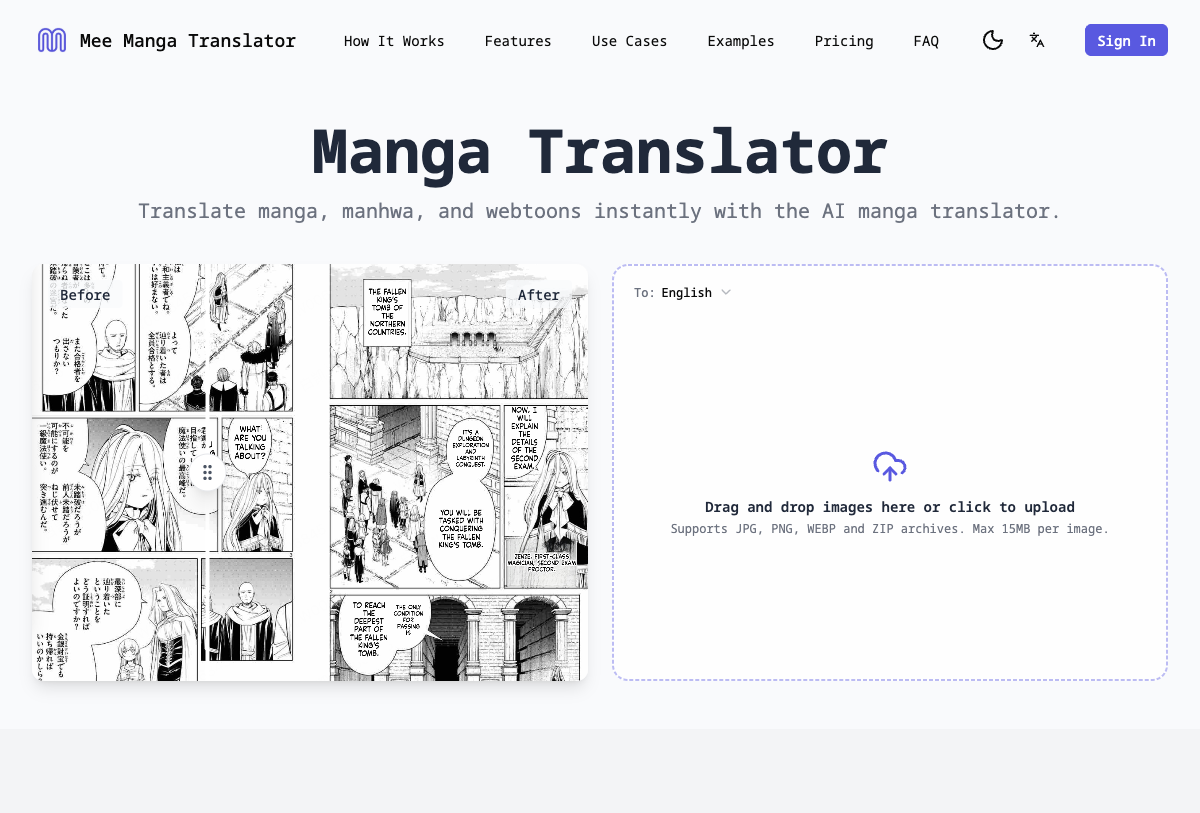
A few years ago, I was stuck in the same loop as every manga fan outside Japan: finish the latest translated volume, hit a cliffhanger, then wait months for the next release. The raw chapters were already online; I just couldn’t read them. That gap is where Mee Manga Translator started—not to replace human translators, but to turn a raw page into readable English in seconds.
This post explains why translating manga is harder than it looks, and how AI tools now handle most of the work for casual readers.
The old way: why manga translation is harder than it looks
Professional translators make it look easy, but the workflow is involved. Jennifer O’Donnell breaks her process into seven distinct steps: plan, read ahead, review the style guide, draft, edit, proofread, submit. For a 160-page manga due in four weeks, that is roughly 10–12 pages per day plus editing.
The hardest part is not vocabulary; it is the constraints. As Jo Miller explains on Quora, English has to fit inside speech bubbles designed for Japanese. Casual lines like わかった become “Got it,” not “I understand.” Honorifics like 兄貴 (aniki) carry a mood that “bro” cannot capture. Japanese onomatopoeia like ウロウロ have no direct English sound.
Then there are the curveballs. Miller once spent a day deciphering モルゲン before realizing a character was German and had simply said “Morgen.” AI still misses that kind of context—but most casual readers just want a readable draft, not a perfect translation.
What “good enough” looks like
Most people searching how to translate raw manga to English want to read the newest raw chapter, catch up on an unlicensed series, or browse a doujinshi. The bar is readable English, correct speaker order, and text that fits the bubbles without wrecking the art. That is what AI manga translators are good at today.
How AI manga translation works
Modern AI manga translators automate the same three-stage pipeline:
- OCR detects bubbles, narration, and sound effects.
- Context-aware translation converts text to English while preserving tone, honorifics, and slang.
- Rendering paints the English back into the original bubbles.
The best tools do all three in one pass. Upload a page, choose English, download the image. ZIP uploads handle full chapters.
How to translate raw manga to English with Mee
Mee Manga Translator is built to make the pipeline simple: upload, translate, download.
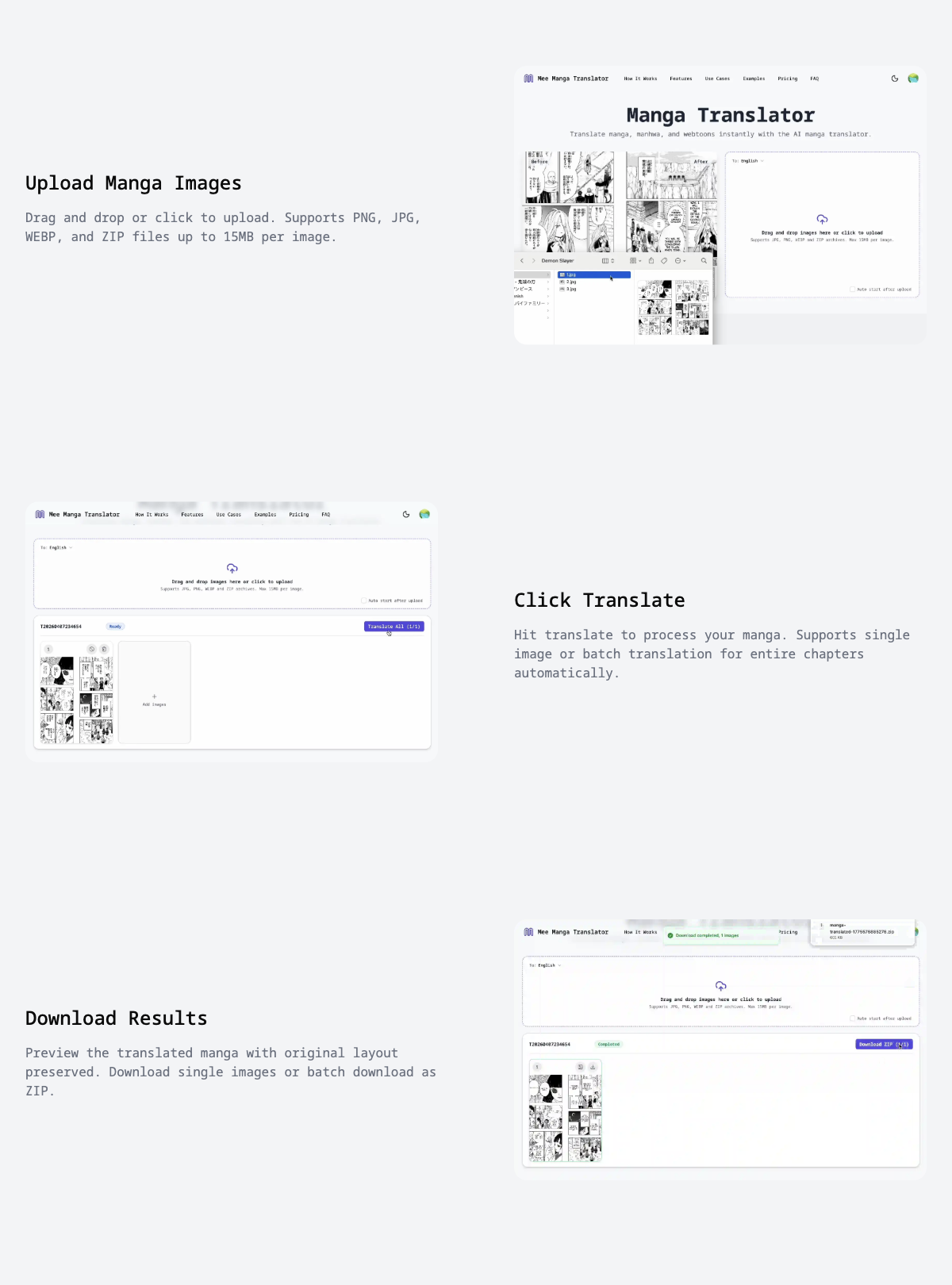
- Upload. Drag and drop JPG, PNG, or WEBP images, or upload a ZIP/CBZ for an entire chapter.
- Translate. Set the target language to English and hit translate. The system detects bubbles, narration, and vertical text automatically.
- Download. Preview and download single images or a batch ZIP. Artwork is preserved; only the text layer changes.
The whole thing takes seconds per page.
What makes the output readable
- Vertical text support. Manga uses top-to-bottom Japanese writing. A proper manga translator handles it and renders natural horizontal English.
- Layout preservation. The art stays untouched; only the text layer changes.
- Batch consistency. Full-chapter translation keeps character voice and terminology consistent.
- No watermarks. Clean exports matter for archiving or sharing.
The honest limitations
AI manga translation is not magic. It works best on standard dialogue and clear scans. It can miss obscure cultural references, unusual handwriting, mood-driven sound effects, and tiny text in crowded panels.
If you are planning a professional release, you still need a human translator, editor, and typesetter. The AI gives you a fast, readable draft; the human turns it into art. For personal reading, “readable draft” is usually the goal—and that is where the tool shines.
Lessons from building a niche indie product
The biggest lesson: niche products win when the workflow is painful and users are already searching for a fix. Search volume for how to translate raw manga to English proves the demand. The challenge was making something fast and simple enough that a casual fan would use it instead of waiting six months.
What helped:
- No install required. A web app beats a Chrome extension for first-time users.
- No watermark on free exports. Removes friction when people compare tools.
- SEO landing pages. Dedicated pages match specific search intent.
A Chrome extension for translating directly on supported sites is next.
Try it on a page you have been waiting to read
If you have a raw manga page or chapter ZIP saved somewhere, upload it to Mee Manga Translatorand see what the AI produces.
For serious translation work, keep jisho.org, Weblio, the Jaded Network SFX database, and Jennifer O’Donnell’s manga translation process guide bookmarked.
For everyone else who just wants to read the chapter tonight, AI has finally caught up.
