How to treat your projects like investments (with SEO)
How do I treat my projects the same way that I treat my investments, Specifically how can I put things in place that will work for me while I work on other stuff.
It’s no secret that building is hard, but for a builder, marketing is even harder, and eventually twice as important.
Since I don’t have a lot of money to spend on my side projects, I use a set of tricks and hacks for marketing which guarantee long-term growth at low or no cost. The key to a successful hack is 2 things:
- Very low cost (<$0.05 CPC)
- Very low effort (<3 hours)
So what processes can I put in place once, that will gradually give me >10x returns in the future?
The answer is SEO, scheduled posts, twitter automation, marketing projects, and understanding my funnel. These are all pretty big topics on their own so I’m splitting them up and just talking about SEO right now.
Why SEO
I find that many see SEO as a daunting task, and get scared away by either the terminology or the relatively long timelines. I was the same way. What changed?
I realized the power of SEO. There is literally no cheaper, better channel to optimize for, and this is true for almost any business.
It boils down to the following:
If people are literally searching Google for what your business can provide, they are ready to convert, and your business needs to be right there.
So I spent 2 weeks hardcore learning about SEO, and the real fundamentals that will get you ranked take less than an hour.
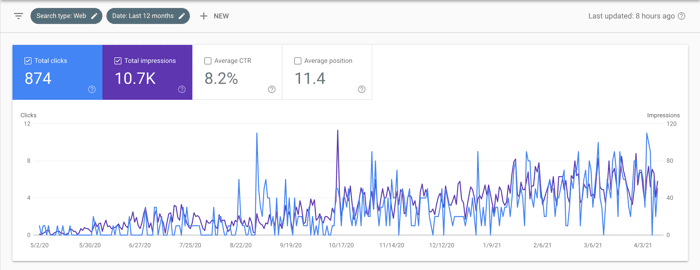
Before getting started, SEO is a long game, if you’re a young business, your iteration cycle can be less than a day as you can implement feedback in a few hours, but SEO iteration cycles are on the scale of a month. The first image in this post is the SEO chart for the past 12 months of Sendblue.co
It took 6 months to get to a point where high-intentioned users came to the site and clicks from Google consistently came in.
As you can see, there are points where the general trend of impressions and clicks either spikes or drops (see 7/20/20 - drop and 10/17/20 - spike) These were results from iterations a few days prior, which were made by studying the performance for the previous months.
874 clicks for the past 12 months seems really low for a year though, doesn’t it? Yes. But as I mentioned, SEO is a long game, 90% of those clicks came from the last 6 mo, and 50% of those clicks came from the last 3. It’s an investment that has the ability to grow your business exponentially. These clicks are also 100x more likely to convert than any other channel. >25% of them at least started the free trial.
The Fundamentals that will take you less than 1 hour
- Put a Sitemap.xml on your page
- Sign up for google search console and register your sitemap with the search console
- Write a decent title and meta description for your website.
- (Optional) add Open graph tags, twitter cards etc
Put a Sitemap.xml on your page
This is a crazy easy step for most businesses, just hop over to https://www.xml-sitemaps.com/ and sit back while they crawl your site and generate it for you. Most website creation sites will then let you upload this sitemap or they will generate their own on your behalf anyway.
The only caveat here is if you have a very complicated site with routes that change by the day or based on what is available (such as an e-commerce site), for this I would spend 30 minutes researching wildcard paths and sitemap priorities and do it manually.
Sign up for the google search console and register your site with it
I’d say this is the most important step. Registering your site with Google fast-tracks their crawler to come check out your website. Google’s crawler will otherwise have to happen across your site by finding a link to it elsewhere. This step also lets you track and iterate on your webpage performance.
- Go to https://search.google.com/search-console/about and hit start now. Go through the onboarding flow for your website. This will require messing with DNS settings a little bit, but nothing crazy.
- Tell Google where the sitemap for your website is, Google will parse it and then tell you if there’s anything wrong. Fixing all the errors Google gives you is crucial to ranking.
- Wait. It will take a while before you start seeing Google rank your site, but they will do it (assuming there are people searching for what you’re offering).
Write a decent title and meta description for your website.
Now comes the fun part.
- Pick 1 or 2 competitors and head over to ubersuggest.com, enter their domains and see what keywords they are ranking for.
- This is your time to shine. Either: find a keyword with 100-1000 searches per month with an “easy” ubersuggest ranking difficulty and use that, or: come up with a keyword that they ARE NOT ranking for yet and search ubersuggest for it. If that has an easy ranking difficulty that could be your in into the industry.
- With the keyword you determined in the previous step, write a title and meta description for your site. Pro tip: Front-load title + description with relevant keywords, use keyword synonyms, and make it generally clear and clickable.
- Upload these to your site, the Google search here is: “How to set title and meta description in javascript/wordpress/webflow/etc.”
(Optional) add Open graph tags, twitter cards etc
It’s debatable whether these actually help SEO so these are optional, but any solid business has them as well. This is the stuff that makes your business expand into a card with an image on twitter, in iMessage, and anywhere on the web really.
This is beyond the scope of this post but the two google search terms here are:
“How to set up Open Graph in Wordpress/Webflow/javascript/WhateverPlatformYouUse”
“How to set up Twitter Cards in Wordpress/Webflow/javascript/WhateverPlatformYouUse”
Trailing activities
Once you’ve set up the fundamentals, it’s time to wait. I know it sucks, and I know it feels like a waste of time, but trust me. While you work on improving your product, talking to customers, getting product-market-fit, Google is slowly learning about what kind of people are looking for what you can offer. This is where your last task comes in:
Once a month, revisit the google search console and see how your site is doing. Going back to Sendblue.co - google offers a great report view where you can see what people are clicking on. See below:
https://pasteboard.co/JXakFNs.png
Your job is to study these keywords, see what people are clicking on, and iterate.
Every month when I get back on the search console I look at what people are searching, and if google is ranking me for those things.
If Google is ranking me for something (impressions), then I ask: are people clicking on my page? If so, are people staying on the page?
If the answer to any of the above questions is no, I play around with the copy high up on the site and in the title/meta description and let it sit for a month (btw, this is where google ads can massively increase your testing rate) (1 mo -> 5 days iteration period)
The first 3-6 months of iterations might be complete shots in the dark, but just remember to critically think what people would search for if they were looking for your business, and keep testing until you hit something. Remember: Google’s job is to show people what they are looking for, and they’re pretty damn good at it.
If you want to hear about how I use scheduled posts, twitter automation, marketing projects, and funnel knowledge to automate my marketing process follow me on Twitter, I am trying to post like this once every week so I can improve my writing process. I’m excited to hear if I missed anything or if anything was unclear so please leave any feedback below!

Great advice, and really easy to take to my own project! Thanks :)
You mention that google ads made your iteration time shorter – can you explain that a bit more?
I'm happy you found it useful!
So Google ads lets you get a ton of volume early on which gives you info on which keywords work/don't work in way less time than a month. You can also A/B test different keywords and be far more data driven, making decisions faster and more accurate.
Note that the goal at this point is not to get sign ups but rather see which keywords lead to most sign ups. Once you find that you can set the site up to optimize for that:
One thing you don't want to forget is to check the ranking difficulty for keywords. This will be key to decreasing the amount of active time you have to spend post setup getting backlinks and such.
If your goal was to spend money to make money then keep buying ads and optimizing
If your goal was to rank in the organic results, then you can basically just wait now (1-6 months depending on how good of a job you did picking keywords), Google will start sending traffic your way.
Great write up! I’d also add that SEO is a great investment for growing your Twitter. My funnel is fully set up so everything comes back to my Twitter.
100%. SEO can help almost anyone gain exposure for their work!