How to Verify Visual Information Before You Trust It.
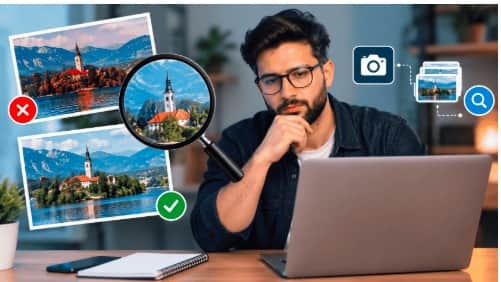
Remember, in 2026, when image scams are so common, you can't blindly trust any visual just because it seems convincing.
A photo can be built from nothing, or an old one can be relabeled for today's headline, and you won't catch it just by looking harder.
And honestly, no one wants to be stuck with checking, nor spend hours analyzing, a single image like a forensic expert.
But what if I tell you you don't have to do all this to stay aware of the visual scams online?
However, all it takes is learning the right ways and staying consistent, and in no time you will be able to catch almost everything that's trying to fool you.
6 Smart Ways To Effectively Verify Visual Information Online
Here are some smart ways that can surely help you distinguish between the authentic and the fake visuals so you never fall for one again. Thus, keep on reading.
1. Conduct Image Search
Honestly, one of the fastest and easiest ways to verify an image online is to conduct an image search.
Instead of typing a text query into a search engine, you can search using the image itself. An advanced image search tool can scan billions of visual sources to find possible matches and related images.
This can help you discover useful information, such as where the image first appeared, which websites are using it, and whether similar versions exist online.
For example, if a photo is claimed to be from a recent event but a reverse image search shows that the same image appeared in an article ten years ago, that is a clear red flag.
2. Check the Metadata
Every digital photo carries hidden data called EXIF metadata: the date it was taken, the device used, and sometimes GPS coordinates.
And honestly, these details can tell you a lot about the authenticity of the image.
So, what you need to do is use tools like Jeffrey's Exif Viewer or the metadata panel in Photoshop to read the metadata instantly.
And if someone claims a photo was taken this morning in London but the metadata says otherwise, that's your answer.
One catch: platforms like Instagram and WhatsApp strip metadata on upload, so absence of data doesn't prove anything either way.
Treat it as one clue, not the whole case.
3. Look at the Small Details
No doubt AI now has advanced enough that it can create nearly flawless-looking images in seconds.
Yet still, even today, AI-generated images struggle to seamlessly create a few details.
So, all you need to do is just look closely at these spots, and you'll know whether an image is real or generated by AI:
Hands with the wrong number of fingers or joints that bend oddly
Shadows falling in different directions on the same object
Text on signs or labels that turns into gibberish up close
Jewelry or accessories that don't match between one ear and the other
Backgrounds that repeat the same pattern in an unnatural loop
Although none of these alone proves fakery, trust me, sometimes two or three together surely do. Or to make this task even more efficient, you can take help from an AI image checker. This tool looks for the patterns usually found in the AI-generated visuals, and lets you know whether the picture is original or AI creation.
4. Trace the Original Source
An image can be real and still misleading if you don't know who posted it first.
So, before sharing, check who uploaded it, whether that account has a track record, and whether the caption matches what's actually happening in the frame.
Misinformation usually spreads through repost chains, where the fifteenth account to share an image has no idea where it came from.
So, if you don't want to be a part of this loop, make sure to find the first post before sharing it further.
If you can't find it, that's a reason to hold off, not a reason to assume the worst.
5. Cross-Check Against Reporting You Trust
If the image is about a real event, accident, protest, or natural disaster, check if trusted news outlets are reporting the same story and showing the same images.
News organizations like Reuters, AP, and reliable local newsrooms usually verify information before publishing it.
If you cannot find the story on any trusted news site, it does not automatically mean the image is fake.
However, it means you should be more careful and verify the image before sharing it with your followers.
6. Watch for Emotional Manipulation
Images designed to make you angry or afraid spread faster than calm, accurate ones.
But trust me, that's not a coincidence. However, that's a tactic. Specifically used by scammers to manipulate you and make you believe the lie instead of the truth.
Remember, the true source never does this. They lay out facts and let the information speak for itself, rather than creating urgency or fear.
So, if a photo hits you with an instant gut reaction, that's the moment to pause, not to hit share.
Ask what the image wants you to feel and why.
A cropped photo of a crowd can look like a riot or a celebration depending on where the frame cuts off. But when you look at the wider version, the meaning often completely changes.
So, it is in your hands whether you get fooled by the scammers or take your time to check before trusting and sharing it.
Final Words
