How to write headlines that convert for your landing page [Graphic]
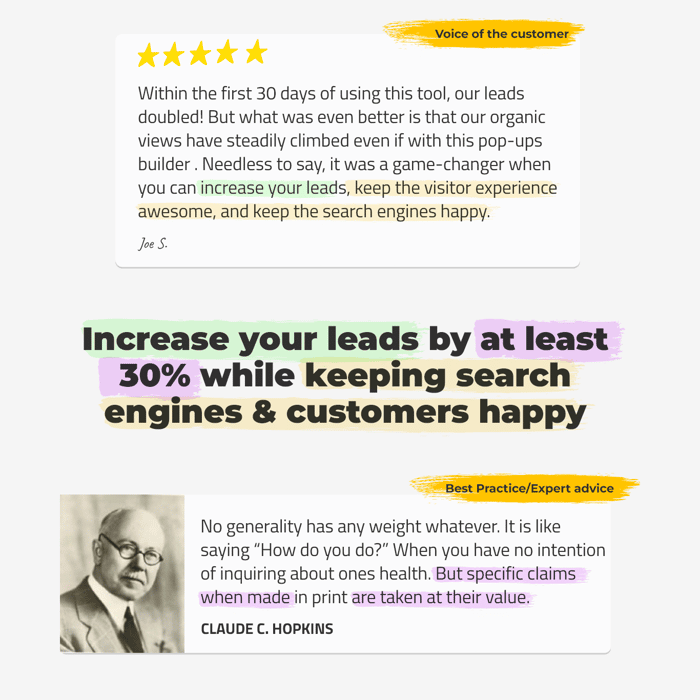
Voice of customer research:
Desire: Increase leads
Objections: "Is this going to affect my SEO?" / "Is this going to affect the UX?"
Best Practices:
Be specific: Increase leads by 30% (This is where you dig into the real data to figure out that percentage)
Headline crafted! What's next? Test!

To be honest this type of headline immediately raises suspicion in my mind. Because it sounds like a number pulled out of thin air. I'd say instead try to explain how you actually promise to achieve it.
If someone uses a random number just because specificity is good, they lied, that's wrong. They should to Marketing Jail.
However, if you have the data to prove it, why not? For example, you help 30 customers set up the tool (in this example a popup builder), and then they report back their conversion uplifts. You calculate the average.
Here's another good example of a specific claim:
“Boost your website conversions by 15% in under 15 minutes” (useproof.com)
TLDR; You are right, if they lie (a number pulled out of thin air), that's bad. I don't recommend it.
---
If you're still not comfortable with using that method (an impact number), you can try a different way. Here's another example:
"Join 100,000+ Entrepreneurs Who Use ClickFunnels To Easily Get Their Products And Message Out To The World!" (Clickfunnels)
100,000+ is huge. But it doesn't have to be that way. An indie hacker can write something like "147 people have already joined us to {reach the desired outcome}".
You can experiment with the concept.
The main idea is to pull insights from your customers' own words and from best practices/expert advice. Sometimes the customer can be your copywriter (meaning we use their own words).