How Varun Mohan Turned Windsurf AI Into a $1.3B Powerhouse — His Real Story
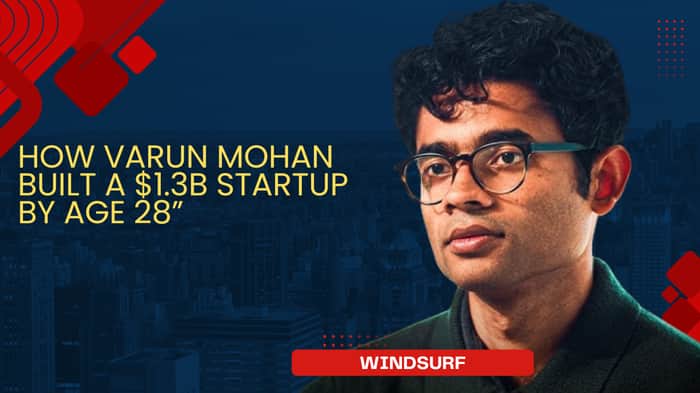
When you hear the tale of a startup reaching a $1.3 billion valuation, it often sounds like a fairy tale. But for Varun Mohan, CEO and cofounder of Windsurf AI, it was a journey built on hard decisions, ruthless pivots, and a philosophy of “fail faster, think deeper.”
“Startups are basically like getting slapped in the face over and over again.”
“If everything is working, you’re operating at less than the potential of the company.”
“Failure means you’re taking enough bets.”
These aren’t just motivational lines — they’re the mental framework he applied at every turn.
From MIT to ExaFunction: The First Chapter
Varun graduated from MIT in 2017 and joined Nuro, an autonomous vehicle company, getting an early taste of how deep learning could reshape industries. Afterward, in 2021, he co-founded ExaFunction, focusing on GPU virtualization and compiler technology.
Within the first year, ExaFunction landed a few million dollars in revenue with a small team (about eight people).
But Varun sensed that the company’s ceiling was limited. He says:
“Even if we were succeeding by some metrics … we didn’t understand how to 10-100× sales.”
The turning point arrived mid-2022, when GPT-3.5 proved how transformative generative models could be. ExaFunction’s infrastructure approach suddenly looked less differentiated in a world leaning toward application-level AI.
So Mohan and his cofounder made a daring call: kill the current business and reorient everything.
“We had raised over $28 million … to start from scratch overnight.”
“Once you believe something is not going to be big … you have no other option but to change your mind and do something new.”
That decision wasn’t easy — it risked disgruntling employees or losing momentum. But Mohan believed in transparency. Over a weekend he and his cofounder solidified the pivot strategy and “told the team on Monday.” The message was clear: “The new thing is where we believe the future is.”
Codeium: The Bridge to Windsurf
After pivoting, they launched Codeium, an AI coding assistant built as extensions for major IDEs. Working with their own models and infrastructure, they scaled rapidly:
Within two months, they built an MVP and launched it publicly.
They hit hundreds of thousands of users quickly, proving demand.
Soon, enterprise clients began knocking — large codebases, custom needs, security constraints — companies like J.P. Morgan Chase showed interest.
UrAppTech’s blog highlights how Codeium’s early success difference came from fast iteration, precision in user feedback loops, and pushing AI deeper into the coding experience (not just autocomplete, but context-aware suggestions).
But Varun felt Codeium was still not controlling enough of the stack. He wanted to shape how developers build, test, deploy — not just help them write lines of code. Thus, the idea of Windsurf AI — an agentic IDE that could modify and build full applications — took shape.
“At that point we believed a lot of the value would accrue to companies that build apps — like Google or Amazon in the early internet era.”
“We decided to build our own IDE. That has taken off very quickly.”
Vision, Execution & Philosophy: Keys to Scaling
Windsurf didn’t grow by luck. Mohan applied some core philosophies:
- Set Astronomical Goals, with Tractable Milestones
He doesn’t just aim to improve incremental features — he set the audacious target of reducing development time by 99%. But to avoid being aimless, he broke it into intermediate goals:
“We picked a tractable goal: build a basic VS Code extension with autocomplete, using our model.”
This allowed early validation, user feedback, and credibility before tackling the harder parts.
- Rapid Failure & Intellectual Honesty
Mohan believes failure is a feature, not a bug.
“If you’re going to do something hard, it’s important to have intermediate steps to validate your hypothesis.”
“Be honest with yourselves about the viability of your idea and be willing to pivot quickly.”
He sees it as unhealthy to cling to failing ideas just because you’ve already committed resources. Kill what doesn’t scale, double down on what can.
- Lean, Urgent Culture
Even as the company grew, Mohan aimed to run Windsurf like a startup.
“We run the company fairly lean … for a given amount of ambition, we are the smallest company we could possibly be.”
“Everyone should have too much to do. That forces rapid prioritization.”
Hiring is only done when the team is overwhelmed — not “just to grow.”
- Team, Culture & Decision Authority
He personally continues interviewing every new hire to ensure alignment with core values. Transparency, culture fit, and intellectual honesty remain non-negotiable.
Mohan frames the company’s core tension as:
“You need irrational optimism to believe you can do something big. But you also need uncompromising realism to kill bad ideas quickly.”
That balance keeps Windsurf agile and grounded.
- Living the Product
One of the most striking tactics: everyone at Windsurf uses the product daily. Engineers build features using Windsurf. This internal “dogfooding” accelerates feedback loops and empathy for user pain points.
“If no one at the company likes a part of the product, it's unlikely people outside will like it either.”
The Outcome: One Million Developers & Beyond
Today, Windsurf is more than a tool — it’s a platform. The results are striking:
Over 1 million developers have used the product.
Hundreds of thousands of monthly active users.
The user base is growing exponentially.
They serve large enterprises working with millions of lines of code.
The valuation? Roughly $1.3 billion — a reflection of belief from both markets and investors in what Windsurf can become.
References:
https://www.youtube.com/watch?v=9c3oNP8yiKs
https://www.urapptech.com/blogs/windsurf-ai-coding-assistant
