How Vector Databases Are Powering Smarter Mobile Apps in 2026
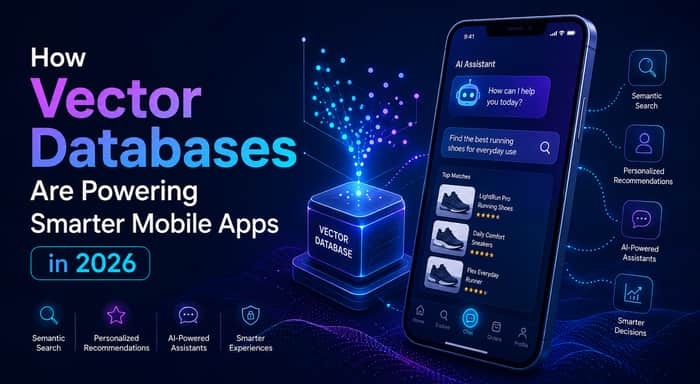
Mobile apps are becoming more intelligent. Instead of simply responding to taps, menus, and keyword searches, modern applications can understand user intent, recognize patterns, generate personalized recommendations, and interact with users through natural language.
Behind many of these capabilities is a technology that developers are increasingly adopting: vector databases.
Vector databases make it possible for applications to store and search information based on meaning rather than relying only on exact keywords. When combined with artificial intelligence, embeddings, large language models (LLMs), and retrieval-augmented generation (RAG), they can turn conventional mobile apps into more context-aware and personalized experiences.
In 2026, vector databases are becoming particularly relevant for developers building AI-powered mobile applications, marketplaces, recommendation platforms, search applications, and on-demand services.
What Is a Vector Database?
A vector database is a specialized database designed to store and search vector embeddings.
An embedding represents information—such as text, an image, a product description, or a user preference—as a numerical vector. Instead of treating two pieces of text as completely different because they use different words, vector search can determine that they have a similar meaning.
For example, consider these two searches:
- "Find a ride to the airport."
- "I need transportation to the airport."
A traditional keyword search may treat them differently because the words are not identical. A vector database can recognize that the underlying intent is similar.
This makes vector databases particularly useful for applications where understanding meaning matters more than matching exact words.
Why Are Vector Databases Important for Mobile Apps?
Traditional mobile applications generally depend on relational databases to store structured information such as users, orders, products, payments, and transactions.
Those databases remain essential, but AI-powered applications often need another layer of intelligence.
A vector database can help an application answer questions such as:
- Which products are semantically similar?
- What services are relevant to this user?
- Which previous conversations are related to the current question?
- Which content matches the user's intent?
- Which restaurants or products are similar to something a customer previously liked?
This creates a more intelligent search and recommendation experience.
For example, a food delivery or ride-hailing application could understand that a user searching for “healthy dinner under $20” may be interested in salads, low-calorie meals, vegetarian bowls, or other relevant options—even if those exact words do not appear in restaurant listings. Similarly, a ride-hailing app could understand a request such as “I need an affordable ride to the airport with enough space for luggage” and use semantic search to identify suitable vehicles, ride options, or drivers based on the user's intent rather than relying only on exact keywords.
How Vector Search Works
The basic process is relatively straightforward.
First, application data is converted into embeddings using an embedding model. These embeddings are numerical representations of the information.
The vectors are then stored in a vector database.
When a user performs a search, the application converts the user's query into another vector. The system compares that vector with stored vectors and identifies the closest matches.
A simplified architecture looks like this:
User Query → Embedding Model → Vector Search → Relevant Data → Mobile App
For AI assistants, there can be another step:
User Query → Embedding → Vector Database → Relevant Context → LLM → AI Response
This second approach is commonly associated with retrieval-augmented generation (RAG).
Vector Databases and RAG
RAG is one of the most important applications of vector search.
Large language models can generate impressive responses, but they do not automatically have access to a company's private, current, or application-specific information.
RAG allows developers to retrieve relevant information from an external data source before asking the AI model to generate a response.
For example, imagine a mobile banking application with an AI assistant.
A customer asks:
"Why was I charged this fee?"
The application can retrieve relevant transaction information, account policies, and support documentation from its databases. The AI model can then use that information to provide a contextual response.
This approach can make AI assistants more useful without requiring developers to train a new model every time application data changes.
Smarter Search Inside Mobile Applications
One of the most obvious use cases is semantic search.
Traditional search often depends on keywords. Semantic search focuses on the meaning behind the query.
This can be valuable in applications with large amounts of content.
Consider an e-commerce application. A user searches for:
"comfortable shoes for walking all day."
A keyword-based system may focus on products containing "comfortable," "walking," or "shoes."
A vector-powered search system can potentially identify products based on their descriptions, attributes, reviews, and semantic similarity.
The result can be a more natural search experience.
Personalized Recommendations
Recommendation engines are another major opportunity.
Mobile applications can create embeddings representing products, services, content, or user interests. The system can then compare those vectors to identify relevant recommendations.
For example, a streaming application could analyze a user's viewing behavior and identify content with similar characteristics.
A marketplace could recommend services based on previous searches.
A food delivery application could suggest restaurants and dishes that are semantically similar to a user's previous choices.
The key advantage is that recommendations don't necessarily have to rely only on rigid categories.
AI-Powered Mobile Assistants
Vector databases can also become part of the memory and knowledge layer of an AI-powered mobile assistant.
Suppose a productivity application allows users to save notes, documents, tasks, and conversations.
Instead of forcing the user to remember exactly where something was stored, they could ask:
"Show me the notes I saved about the new product launch."
The application can convert the request into an embedding, search related information, and return the most relevant content.
This changes the interaction model from searching through an app to asking the app for information.
Vector Databases in On-Demand Apps
Vector technology has interesting applications in on-demand platforms as well.
A multi-service application can use semantic search to understand natural-language requests.
For example:
"I need someone to fix a leaking kitchen pipe today."
Instead of requiring the customer to select several categories and filters, an AI-powered system could identify the intent and find relevant plumbing services.
Similarly, a ride-booking application could use natural-language interactions to understand requests, while a marketplace could match customers with providers based on service descriptions and historical preferences.
The vector database does not replace the application's transactional database. Instead, it can work alongside it as an intelligence and discovery layer.
Popular Technologies Developers Can Explore
Developers have several options when implementing vector search.
Popular technologies and platforms include:
- Pinecone for managed vector search infrastructure
- Qdrant for vector similarity search
- Weaviate for vector databases and AI applications
- Milvus for large-scale vector search
- pgvector for adding vector capabilities to PostgreSQL
- OpenSearch for search and vector capabilities
The right choice depends on the application's scale, existing infrastructure, query requirements, hosting strategy, and development team's expertise.
For smaller applications, using vector capabilities within an existing PostgreSQL environment can sometimes simplify architecture. Larger AI-heavy applications may require dedicated vector infrastructure.
Challenges Developers Need to Consider
Vector databases are powerful, but they are not a universal replacement for traditional databases.
One challenge is data quality. Poor or outdated source information can lead to poor search results.
Another consideration is embedding quality. Different embedding models can produce different results depending on the application's content and language requirements.
Developers also need to consider:
- Vector indexing strategies
- Search latency
- Infrastructure costs
- Data synchronization
- Privacy and security
- Access control
- Model selection
- Database scaling
- Relevance evaluation
For applications handling sensitive information, developers must also carefully control which data is converted into embeddings and who can retrieve it.
Vector Databases vs Traditional Databases
It is important to understand that vector databases generally complement traditional databases rather than replace them.
A conventional database is excellent for structured queries such as:
Find all orders where status = "delivered".
A vector database is better suited to questions such as:
Find products that are semantically similar to this description.
Modern applications may therefore use both.
A typical architecture could contain:
PostgreSQL/MySQL → Users, Orders, Payments, Transactions
Vector Database → Embeddings, Semantic Search, Similarity
LLM → Natural-Language Understanding and Generation
Mobile App → User Interface
This combination can create a powerful architecture for AI-native applications.
What's Next for Vector Databases?
As AI becomes more deeply integrated into mobile applications, vector databases are likely to become an increasingly important part of application architecture.
The technology is moving beyond simple semantic search. Developers are combining vector retrieval with multimodal AI, recommendation systems, RAG, AI agents, and personalized experiences.
Future mobile applications may not simply search databases when users interact with them. They may understand the user's intent, retrieve relevant information, reason over that information, and take actions through application APIs.
That means the database layer itself is becoming part of the AI experience.
Final Thoughts
Vector databases are helping developers build a new generation of mobile applications that can understand meaning, context, similarity, and user intent.
Their biggest value isn't simply faster searching. It is the ability to connect application data with modern AI systems.
For developers building mobile apps in 2026, technologies such as vector databases, embeddings, RAG, LLMs, and AI APIs are becoming important building blocks for smarter search, personalization, recommendations, and AI assistants.
The most successful applications won't necessarily use AI simply because it is trendy. They will use technologies such as vector databases where they solve a genuine product problem—helping users find information faster, receive better recommendations, or interact with software more naturally.
For app developers , that makes vector databases less of a niche database technology and more of an important component in the evolving architecture of intelligent applications.
