How we broke past 5k MRR
Our MRR was stuck at $4K for 4 months. ProfitWell predicted it would drop. Here's the exact playbook that pushed us past $5K instead.
In February, ProfitWell projected our revenue would drop to $4,100.
I'd been watching our MRR flatline for months. $4,503. $4,350. $4,388. $4,350 again. Every month we'd add new customers, lose roughly the same number, and end up right where we started.
But a prediction that we'd actually go backwards? That was the ticking point.
I run PostNitro.ai — an AI-powered carousel and content creation tool for social media. We help creators and marketers build carousels, infographics, and social content. We'd grown from $0 to $4K MRR over the previous year (352% growth), which felt great.
Then the growth just stopped.
Our churn rate was sitting at 23%. Let that sink in. Nearly a quarter of our entire revenue base was walking out the door every month. We were bringing in $800-1,100 in new MRR, and losing $700-1,000 to churn. The bucket was leaking almost as fast as we could fill it.
I decided to stop building features and fix the business. Here's every change we made, with real numbers.
1. We nuked the free plan (and discovered we were being exploited)
The conventional wisdom: You need a free tier. It's your top of funnel. Let people try the product, fall in love, then upgrade.
Our reality: The free plan was a parasite.
We had a limit of 5 downloads per month on the free plan. Seemed reasonable — enough to experience the product, not enough to freeload forever.
Then I ran a query on our database.
Here's what I found. Our top free plan users by download count:
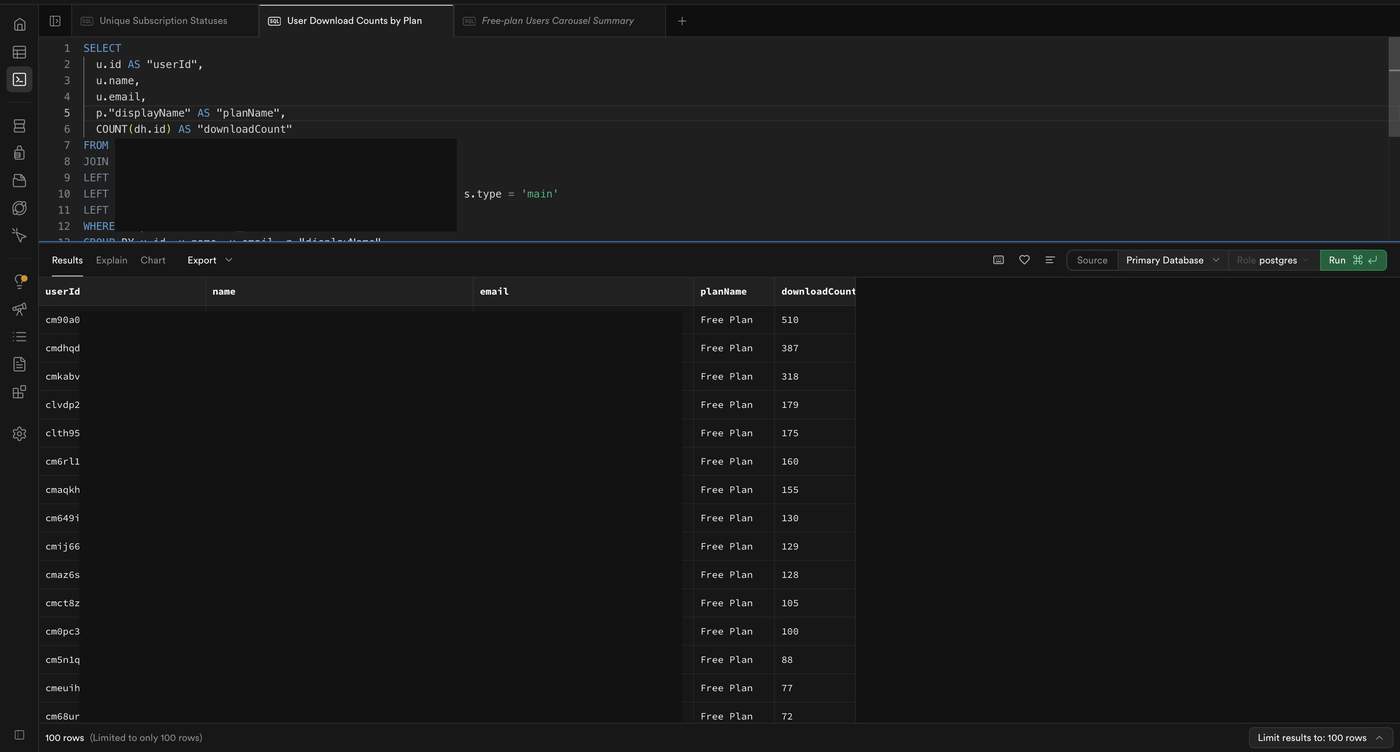
There were 100+ rows like this.
These users had somehow bypassed our monthly download checks and were happily using PostNitro — our servers, our AI credits, our bandwidth — without paying a cent. One person downloaded 510 pieces of content for free. That's more usage than most of our paying customers.
The real cost of "free":
Every free download burned AI credits (we use AI for content generation), server resources, and support time. These users were also clogging up our support channels with feature requests and bug reports — all while contributing $0 in revenue.
Worse, they were polluting our metrics. Our "conversion rate" looked terrible because the denominator was inflated with people who were never going to convert. We were making decisions based on numbers that were lying to us.
What we changed:
We set a lifetime limit of 5 downloads. Not per month. Total. Five downloads, ever.
If you need more than 5 pieces of content, you need the product. If you need the product, you should be paying for it.
The result:
The freeloaders disappeared overnight. But here's the part I didn't expect — conversion actually improved. The people who were genuinely evaluating PostNitro hit the 5-download limit, realized it was worth paying for, and upgraded. The limit created urgency that our old "unlimited time, limited monthly downloads" model never did.
Lesson for founders: Go pull your free tier usage data right now. You might be shocked at who's living on your product for free. And if your free plan is generous enough that people can avoid paying indefinitely, it's not a funnel — it's a charity.
2. We raised prices 50% and got better customers
The change: Starter plan from $10/month to $15/month.
What I expected: A drop in signups and angry emails.
What actually happened: Almost nothing negative. The signup rate barely changed. Nobody emailed to complain. But the quality of new customers shifted noticeably.
Here's my theory on why: at $10/month, we were below the "impulse buy" threshold for most people. They'd sign up on a whim — "it's only $10, why not" — use the product twice, forget about it, and churn 30 days later.
At $15/month, there's just enough friction that you pause and think: "Do I actually need this?" The people who answer yes are more intentional. They set up their brand, create content regularly, and stick around.
The numbers that matter:
Our new MRR per month tells the story. Before the pricing change, we were bringing in $800-$1,000/month in new revenue. After:
November 2025: +$1,056 (75 new customers)
December 2025: +$810 (49 new customers)
January 2026: +$1,091 (63 new customers)
February 2026: +$1,279 (69 new customers)
March 2026: +$1,589 (85 new customers)
March was our best acquisition month ever — $1,589 in new MRR from 85 customers. At $10/month pricing, we'd have needed 159 customers to hit that same number.
Lesson for founders: If zero people complain about your pricing, it's too low. A 50% price increase doesn't lose you 50% of customers. It loses you the bottom tier who were going to churn anyway.
3. We used psychology to improve annual conversions
The change: Annual pricing went from "20% off" to "2 months free."
This sounds like a marketing tweak. It's actually a lesson in human psychology.
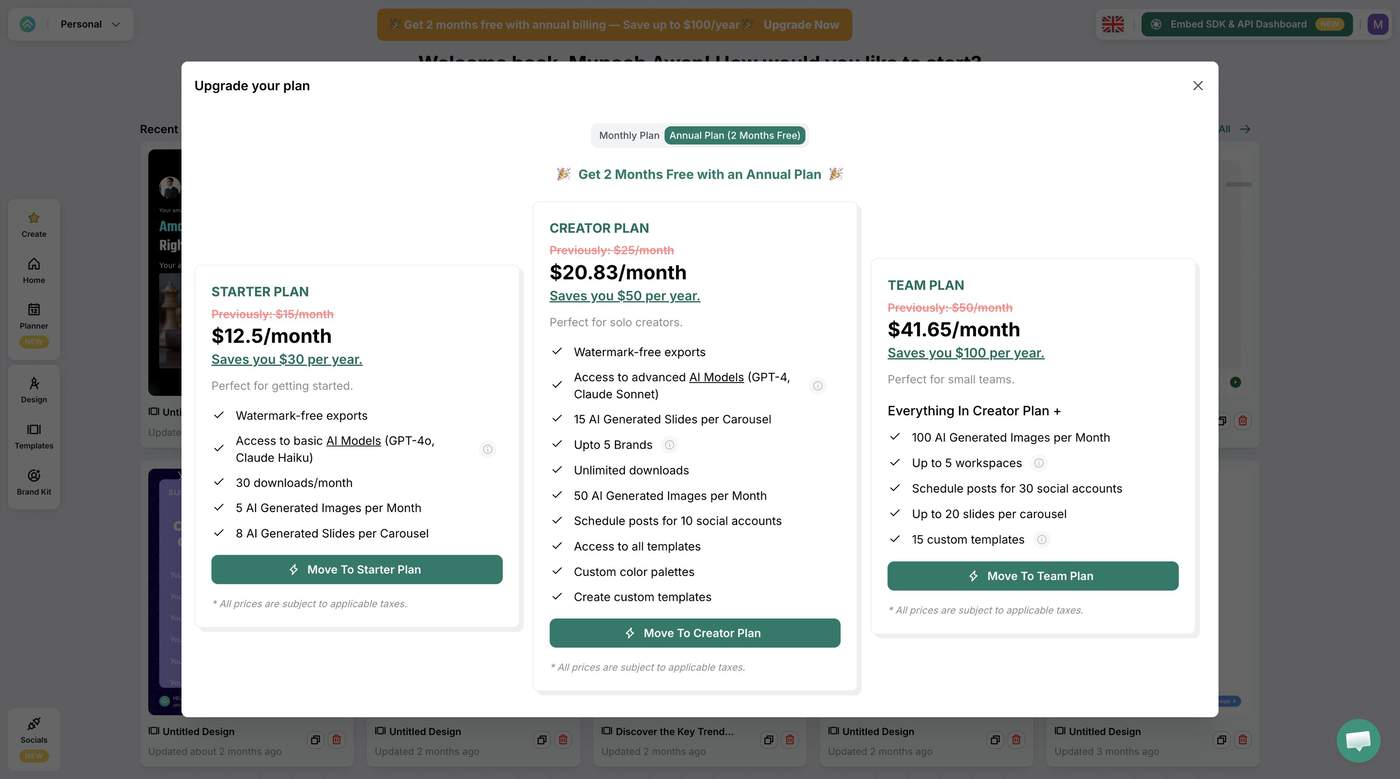
"Save 20%" requires your brain to do work. You see $15/month, then you need to calculate: what's 20% of $15? That's $3. So $12/month? What's that annually? $144? The original would be $180? So I save $36?
By the time someone's done with that mental math, they've already scrolled past your pricing page.
"Get 2 months free" is instant. Zero calculation needed. You immediately picture two months where you're using PostNitro and paying nothing. Two free months. That's tangible. That's something your brain can feel.
Here's the thing — "2 months free" is actually a smaller discount than 20% off. Two months free on an annual plan means you pay for 10 months instead of 12, which is roughly a 17% discount. We reduced the discount by 3 percentage points and conversion to annual plans improved.
Why this matters beyond just annual plans:
This principle — clarity over cleverness — applies everywhere in your SaaS:
"Unlimited exports" beats "10,000 exports/month" (even though 10,000 is functionally unlimited for 99% of users)
"Try free for 14 days" beats "Freemium with limited features"
"Create 50 carousels/month" beats "5,000 AI credits/month"
Every time you make someone do math or interpret jargon, you lose a percentage of potential conversions. Clarity is a conversion lever that most founders completely ignore.
4. We built a 30-day onboarding workflow (our highest-ROI change)
Before: Sign up → welcome email → silence → churn.
That's not onboarding. That's abandonment.
After: A 30-day automated email sequence broken into three phases.
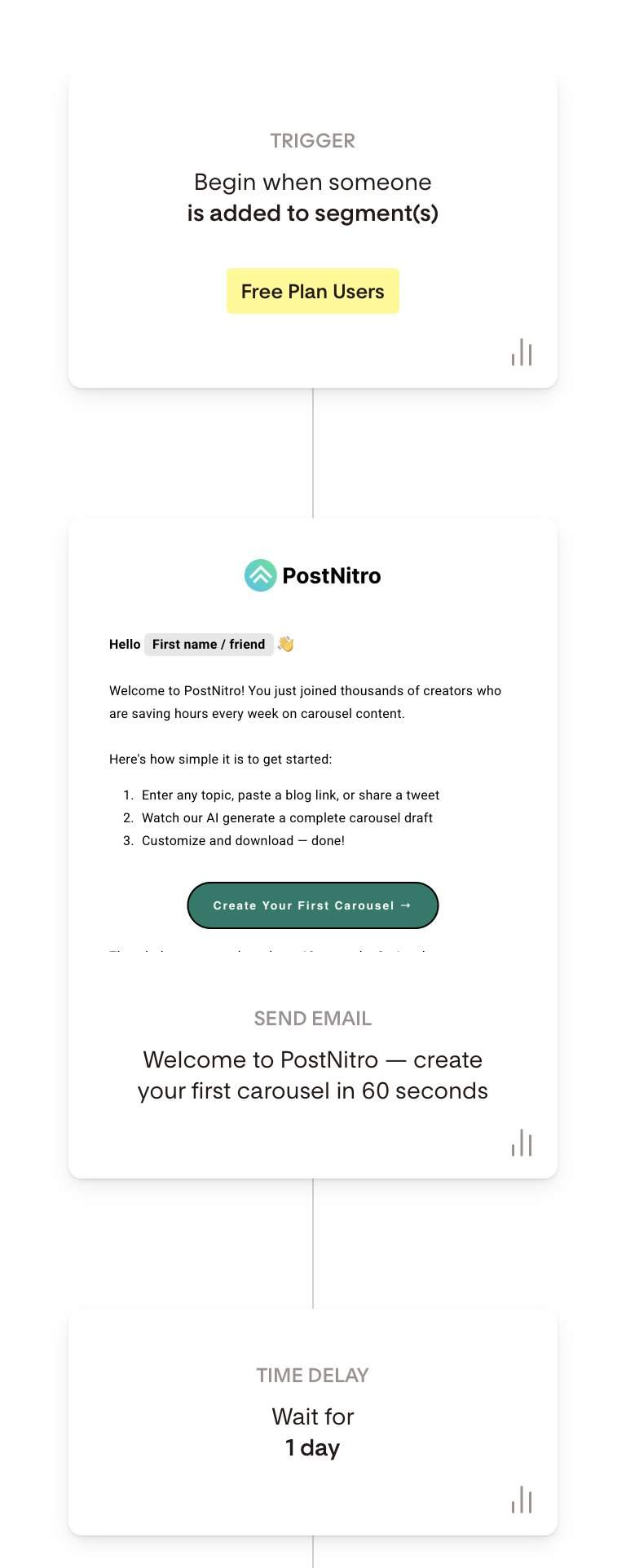
Phase 1: Product Knowledge (Days 1-7)
The goal here is simple: get the user to their first "aha" moment before they forget they signed up. Studies show that if a SaaS user doesn't experience core value within the first 3-5 days, the probability of them churning skyrockets.
Our sequence walks them through:
Creating their first carousel (day 1 — within hours of signup)
Exploring AI-generated content options (day 2-3)
Setting up their brand kit so content matches their style (day 4-5)
Trying different content formats — infographics, multi-slide posts (day 6-7)
Each email is action-oriented. Not "hey, did you know we have this feature?" but "here's how to create a LinkedIn carousel in 2 minutes — try it now."
Phase 2: Use Case Education (Days 8-20)
By now they've used the product. The goal shifts from "show them how" to "show them why this should be a habit."
We share:
How other creators are using PostNitro in their workflow
Templates for different content types and platforms
Examples of high-performing carousels made with the tool
Tips on content strategy (not just product tips — actual value)
This phase is about building a routine. If someone creates content with PostNitro 3-4 times in their first month, they're very unlikely to churn.
Phase 3: Conversion Push (Days 21-30)
For users on the free tier or trial, this is where we make the case:
Show what paid features they're missing
Share results from paying users
Offer a direct line to support if they have questions
Make upgrading feel like the obvious next step, not a sales pitch
The results:
Email replies. Actual replies. People responding to automated emails saying "thanks, this was helpful" or asking questions about specific features. Some users came back to the platform specifically because an email in the sequence reminded them PostNitro existed.
Our email engagement went from basically zero to meaningful conversations. And those conversations turn into retained customers.
What's next: I'm expanding this to a 3-month workflow. The first 30 days handle activation and initial conversion. But months 2-3 are where you build the habit and lock in long-term retention. I'm also building separate workflows for users who cancel and users whose subscriptions expire — but I haven't executed on those yet because we need to fix how our user segments are set up first.
Lesson for founders: If your onboarding is a single welcome email, you're leaving money on the table. A well-built email sequence is the highest-ROI marketing asset you can build. It costs almost nothing to run and compounds forever.
5. We shipped features that make switching painful (in a good way)
While fixing the business side, we kept shipping product. But with a specific lens: every feature should make PostNitro harder to leave.
Content Scheduling (shipped)
We launched scheduling for TikTok, Instagram, Threads, and LinkedIn. This was the most important product decision we made.
Before scheduling, PostNitro was a content creation tool. You'd make a carousel, download it, then go to Buffer or Later or Hootsuite to schedule it. We were one step in a multi-tool workflow, which made us very easy to replace.
With scheduling, PostNitro became the entire workflow. Create your content AND publish it from the same app. If you switch to a competitor now, you're not just switching your content creation — you're rebuilding your entire publishing workflow. That switching cost is real.
AI Knowledge Base (shipped)
We built a user and product knowledge base that feeds into our AI content generation. You give PostNitro information about your brand, your audience, your product, and the AI uses all of it when generating content.
This does two things. First, the content quality improves dramatically — it actually sounds like you instead of generic AI output. Second, every piece of brand information a user adds is an investment in PostNitro specifically. That data doesn't transfer to a competitor. The more they teach our AI, the more they'd lose by switching.
AI Image Generation (shipped)
Carousels and infographics need visuals. Before, users had to go to Canva or search for stock photos. Now they generate images directly inside PostNitro. One less reason to open another tool. One more reason to stay.
Chat-Style Content Creation (in progress)
We're currently building a chat interface for content creation — talk to the AI like you'd talk to a designer. "Make me a LinkedIn carousel about our product launch" and it builds it. This is the direction the whole product is heading: full automation of the content creation workflow.
The strategic lens: Every feature we ship now gets evaluated through one question: does this make PostNitro more embedded in someone's daily workflow? If yes, build it. If not, it can wait.
6. We went from "marketing when we remember" to an actual system
Our marketing before these changes was embarrassing. Post on social media when someone remembers. Write a blog post every few weeks. Hope for organic growth.
Here's what we structured:
SEO & Content: Subscribed to Outrank so we have a full month of content planned in advance. Blog posts, backlinks, keyword strategy — all mapped out. No more scrambling to publish something.
Social Media: Posts from three accounts — the PostNitro product account, my personal account, and employees' accounts. Consistent daily presence. This is especially effective on LinkedIn and Twitter/X where the algorithm rewards frequency.
Influencer & Launch Marketing: We partnered with an influencer for a Product Hunt launch around our content scheduling feature. PH launches still drive meaningful traffic when done right.
Affiliate Program: Set up through Affonso. Some users were already promoting PostNitro organically, so we started adding affiliate commissions to their subscription accounts as a thank-you. It's a small thing, but it turns happy customers into active promoters.
Email Marketing: The 30-day onboarding workflow (covered above) doubled as our most effective marketing channel. Turns out consistently showing up in someone's inbox with useful content is better marketing than any social media strategy.
Nothing here is innovative. It's all the basics. The difference is we actually execute on all of them consistently now instead of doing one thing for a week and forgetting about it.
The numbers: what actually happened
Remember ProfitWell predicting a drop to $4,100?
Here's our actual MRR trajectory:
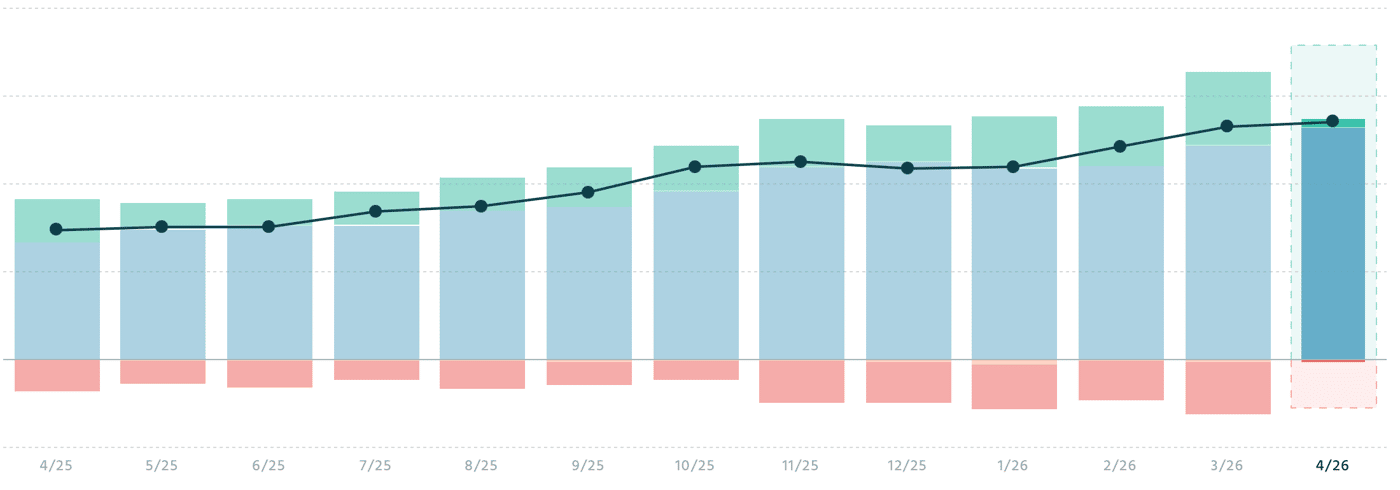
*April is in progress, projected to close at $6,055.
Key stats:
MRR: $4,465 → $5,409 (21% growth, projected 36% by end of April)
ARR: crossed $64,900, projected to hit $72,600
Customer base: grew to 335
Best acquisition month ever: March with +$1,589 new MRR and 85 new customers
Existing customer revenue (expansion): grew from $4,377 → $5,269
The MRR chart that was a flat line for months finally has a slope. And looking at the bar chart, you can actually see the shift — the green bars (new revenue) getting taller while the business sustains the churn underneath.
What hasn't improved yet:
I'll be honest — churn is still high. We're still losing $900-1,100/month to voluntary and delinquent churn combined. The churn rate has come down from 23% (when MRR was lower) simply because the denominator grew, but the absolute dollar churn hasn't meaningfully decreased.
The cancellation workflow and expired user re-engagement sequences are planned but not live yet. That's the next lever to pull.
The playbook (TL;DR for founders)
If you're stuck in the $3-5K MRR plateau, here's the order I'd tackle things:
1. Audit your free plan. Pull the data. Don't guess. Are free users converting or just consuming? If they're consuming more than expected, your limits aren't working. Switch from monthly limits to lifetime limits. Make free feel like a trial, not a permanent tier.
2. Raise your prices. The customers you lose from a price increase are the ones who were going to churn anyway. The customers who stay (and the new ones who join at the higher price) are more committed and more valuable.
3. Rewrite your pricing page for clarity. Kill percentages. Kill jargon. "2 months free" beats "17% off." "50 carousels/month" beats "5,000 credits." If a potential customer needs a calculator to understand your pricing, you've already lost them.
4. Build a real onboarding sequence. 30 days minimum. Phase 1: get to the aha moment (week 1). Phase 2: build the habit (weeks 2-3). Phase 3: convert or retain (week 4). This is the highest-ROI thing you'll build.
5. Ship features that increase switching costs. Not just features users want — features that make your product harder to leave. Integrations, data lock-in, workflow embedding. The more of someone's process lives in your tool, the more painful it is to migrate away.
6. Do the boring marketing consistently. No growth hack will save you. SEO, social presence, email marketing, affiliates. Pick 4-5 channels and show up every single day. Consistency beats creativity.
Honest reflection
We're not out of the woods. $5K MRR is not life-changing revenue. Churn is still eating us. We have planned workflows we haven't executed yet. There are days where it still feels like running on a treadmill.
But the trajectory has changed. After months of flatline — and a prediction that we'd start declining — we've built a system where growth is outpacing churn consistently. Not by a huge margin, but consistently. And consistent beats dramatic every time in SaaS.
The biggest mindset shift was this: I was so focused on building product that I forgot to build the business. The product was already good enough for people to pay for. The pricing, onboarding, marketing, and free tier just weren't set up to let that happen.
If you're in the same spot — good product, flat revenue — stop building features for a month. Fix the business around the product instead. It might be the highest-leverage month you'll ever spend.
I'm building PostNitro.ai in public. If this was useful, I share updates like this regularly. Happy to answer any questions in the comments.

