How We Built a Custom Air Quality Monitor Using ESP32
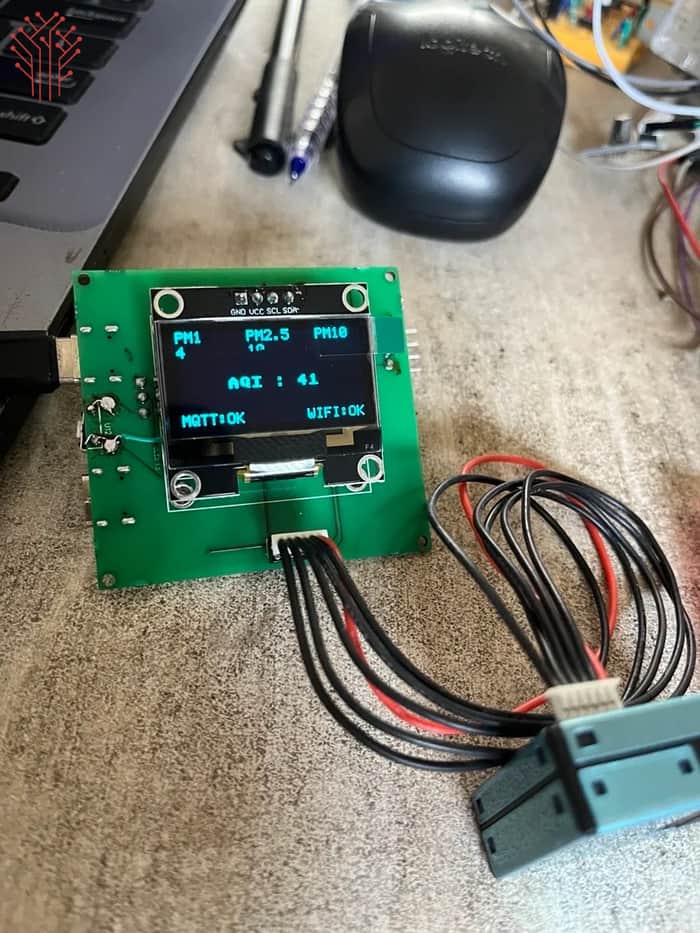
Air quality monitoring has become increasingly important in offices, industrial spaces, and indoor environments. We recently worked on a custom ESP32-based air quality monitoring system designed to provide real-time environmental data with wireless connectivity and remote monitoring capabilities. it can monitor the air quality with smart automation, wireless connectivity.
The goal of the project was simple:
Build a compact and reliable device capable of monitoring air quality parameters continuously while keeping power consumption and hardware cost under control. we also wanted to make a simple, smart IoT device for industrial use, office use and indoor side.
The hardware stack included:
- ESP32 for Wi-Fi connectivity and processing
- Air quality sensors for detecting environmental changes
- Temperature and humidity monitoring
- OLED display for local readings
- Cloud dashboard integration for remote access
One of the biggest challenges during development was sensor stability and calibration. Early prototypes produced inconsistent readings because environmental sensors are highly sensitive to airflow and placement. We had to redesign the enclosure and adjust the sensor positioning multiple times before achieving stable results.
Another challenge was maintaining reliable Wi-Fi communication in environments with unstable connectivity. We optimized the firmware to automatically reconnect and recover from network interruptions without requiring manual resets.
A major learning from this build was that embedded IoT products require much more real-world testing than expected. Small factors like enclosure ventilation, sensor heat, and power noise can significantly affect readings.
The project also helped us improve our workflow for rapid prototyping and firmware debugging while building scalable IoT solutions for industrial monitoring use cases. Experiences like these are one reason why working in an IoT Development Company in India https://digitalmonk.biz/iot-development-company-in-india/ can expose teams to a wide variety of real-world deployment challenges.
Would love to hear how others here handle sensor calibration and long-term reliability in ESP32-based IoT devices.
