How we built a governance layer for AI Velocity Pods — and why it made us faster, not slower
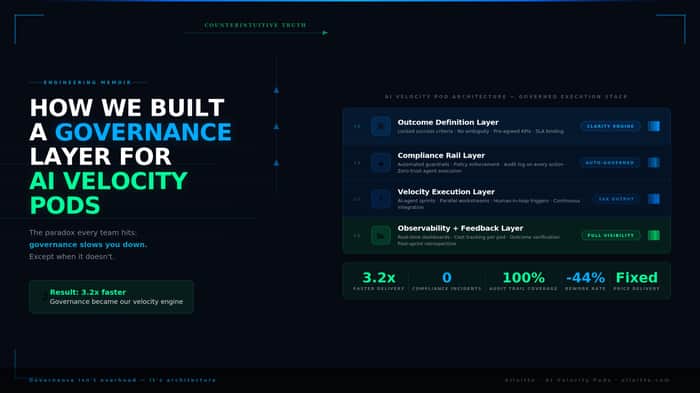
Most people hear "governance" and think: meetings. Approval queues. Things that slow you down.
I used to think the same thing.
We built Ailoitte as an AI-native product studio. Our model — what we call AI Velocity Pods — puts small, specialized teams (usually 2–4 people) on discrete product outcomes with fixed timelines and fixed prices. We've shipped 300+ products across 21 countries this way.
Early on, we resisted adding any formal process to how our AI agents operated. We wanted to move fast. Governance felt like the enemy of velocity.
We were wrong. And figuring out why we were wrong is what I actually want to share here.
The problem that forced our hand
About 18 months ago, we had six pods running simultaneously across different clients. Each pod had its own AI workflows — code agents, QA agents, documentation agents, and testing pipelines. None of them were connected.
That was fine until one of our QA agents flagged a false positive in a production pipeline. Nobody could immediately figure out which agent had generated the output, what prompt it had run on, or why it had made that call. Debugging took three times longer than it should have.
We had a distributed AI system that nobody had designed. We'd built it one pod at a time, one use case at a time, and it had grown into something hard to reason about end-to-end.
That's agent sprawl. And if it can happen to a 30-person AI-native studio, it can definitely happen to a funded startup with six engineers and a pile of Claude API credits.
The three things we actually changed
I want to be specific here because most "governance" advice is either too abstract or too enterprise-heavy to be useful for indie builders and small teams.
1. We built an agent registry — basically a spreadsheet that became a Notion table
Every agent that touches production data or external APIs has a row. It includes:
- What it does
- What is it connected to
- Who owns it (a human point-of-contact)
- When it was last reviewed
- The explicit escalation path if it fails
When you have 4 agents, this feels like overkill. When you have 40, it's the only thing standing between you and a debugging nightmare.
2. We added human checkpoints at decision gates — not everywhere, just where it matters
We don't gate every agent action. That would actually slow us down. But any agent that touches user data, sends external communications, or triggers a payment flow has a defined human review step before it proceeds.
The rule of thumb we landed on: If the failure mode is embarrassing or irreversible, put a human in the loop. Everything else can run autonomously.
This sounds obvious in retrospect. But in the speed of shipping, most teams skip it.
3. We changed how we measure agents — from task completion to outcome movement
"The agent ran successfully" is not a useful metric. It tells you the agent did something. It doesn't tell you whether that something mattered.
We started tracking outcome metrics before building agents:
- For a QA agent: Did the bug detection rate improve?
- For a documentation agent: Did developer onboarding time decrease?
- For a code review agent: Did PR cycle time shrink?
When you define the metric first, you naturally build fewer agents — because you realize some of the things you were planning to automate won't actually move anything. And the agents you do build are easier to govern because you know exactly what "working" looks like.
What this did to our delivery speed
Here's the counterintuitive part: adding these three practices made us faster.
Not because governance magically accelerates work, but because the debugging overhead that was silently eating our time disappeared. When an agent fails, we know immediately who owns it, what it's supposed to do, and what metric we're checking. We hit the root cause in minutes, not hours.
Our median delivery across startup MVPs is 38 days. The industry average for comparable scope is 120+. A lot of that gap is smart AI tooling. But a meaningful chunk of it is the absence of rework — and rework goes down dramatically when you know exactly what your agents are doing and why.
The honest caveat
None of this works if you implement it as theater.
A registry with stale rows and no real owner is worse than no registry — it creates false confidence. A governance checklist that everyone ticks without reading is just noise.
The version that actually helps is the version that's maintained with the same discipline as your codebase. Agents get reviewed when they change. The registry gets updated when a pod ships. Metrics get checked on a real cadence, not just at project retrospectives.
If I were starting over
I'd build the registry before the first agent. I'd define the outcome metric before writing the first prompt. I'd add the human checkpoint before I had a reason to wish I had one.
The overhead at the start is maybe two hours. The overhead of retrofitting it later — after something has gone wrong in production — is much, much higher.
Governance isn't the enemy of velocity. Ungoverned complexity is.
We're Ailoitte — AI-native product engineering, 300+ products shipped, fixed-price and outcome-based. If you're building an MVP and want to talk about how we structure these pods, check out our AI Velocity Pods page for the full breakdown.
Tags: #IndieHackers #AIGovernance #ProductDevelopment #LessonsLearned #DevOps #Solopreneur #BuildingInPublic

This is a useful framing because it treats governance as debugging infrastructure, not paperwork. One split I keep coming back to is separating the strategist loop from the proposal loop. The strategist layer decides which outcome matters next; the proposal layer packages one concrete action with evidence, tool scope, approval boundary, and logging. That makes the human checkpoint less vague: you are not approving an intent like “improve retention,” you are approving a specific action against current state. I think the missing piece in a lot of agent setups is what happens when state changes after approval: customer replied, data changed, another workflow handled it, etc. Do you expire approvals or re-check state before every external action?