How we cut average product delivery from 120 days to 38 days using AI Velocity Pods (lessons from 300+ products)
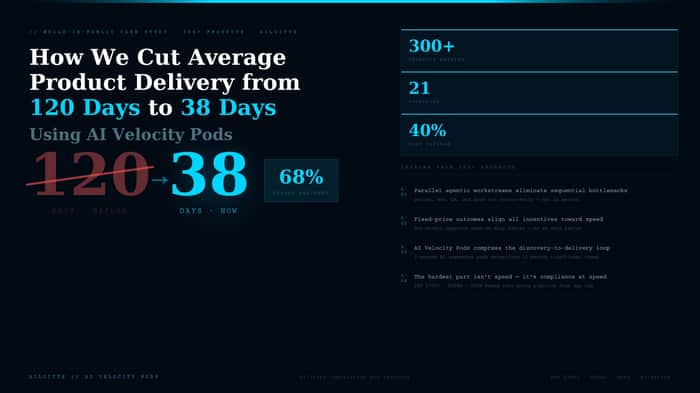
Eighteen months ago, our average product delivery time was around 120 days. Not because we were slow, but because traditional agency delivery is structurally slow. Discovery, design, dev cycles, QA, rework, stakeholder loops. All normal. All compounding.
Today, our median is 38 days. Across 300+ products, 21 countries. I want to share what actually changed, not the marketing version, the operational one.
1. The first thing we got wrong: treating AI as a speed tool
We initially added AI to existing workflows. Copilots for developers, AI-assisted code review, faster doc generation. Delivery improved marginally. Maybe 15–20%.
The real change came when we stopped asking, "How do we use AI to go faster?" and started asking "what does delivery look like if AI does the first pass on everything?"
That reframe built what we now call AI Velocity Pods — small human teams (2–4 people) governing purpose-built AI workflows. The humans don't execute the implementation. They design agent workflows, set scope boundaries, review outputs, and make judgment calls AI can't make yet.
2. The second thing: governance matters more than raw AI capability
This was counterintuitive. We assumed better models = better outcomes. Turns out the bigger variable is governance structure.
- Loose briefs: Projects where we let agents run with loose briefs produced 40%+ more bugs and significant duplication.
- Strict governance: Projects where we defined scope boundaries, required change summaries, and ran automated QA gates before human review — those shipped clean.
Our agentic QA pipeline now runs before any human reviewer touches a PR. Regressions are caught at the agent layer, not the client demo.
3. The third thing: fixed-price aligned everyone's incentives
Hourly billing punishes efficiency. If an agent completes a sprint item in 2 days instead of 6, billing hourly means we earn less. There's no structural incentive to pass that gain to clients either.
Switching to fixed-price outcome contracts changed the equation. We profit when we ship faster and smarter, not longer. Clients get budget certainty. The model is documented in detail on our AI Velocity Pods page if you want to dig into how the contracts work.
What 300+ products taught us
The teams that succeed with agentic delivery share three traits:
- They invest in workflow design before execution.
- They treat governance as a product (not overhead).
- They pick outcome contracts that align incentives.
The teams that struggle are still running agents like faster copilots — loose prompts, fast acceptance, minimal review structure.
If you're a founder evaluating dev partners or building your own AI-native dev process, the startup MVP velocity model we've built is worth a look. Scoped, fixed-price, 38-day target — designed specifically for pre-seed and seed teams who need to move without burning runway.
What's your current delivery timeline looking like, and what's the biggest operational bottleneck you're hitting?
Tags: #ai, #saas, #productivity, #startup, #lessons-learned
