How we cut average product delivery from 120 days to 38 days, what actually changed
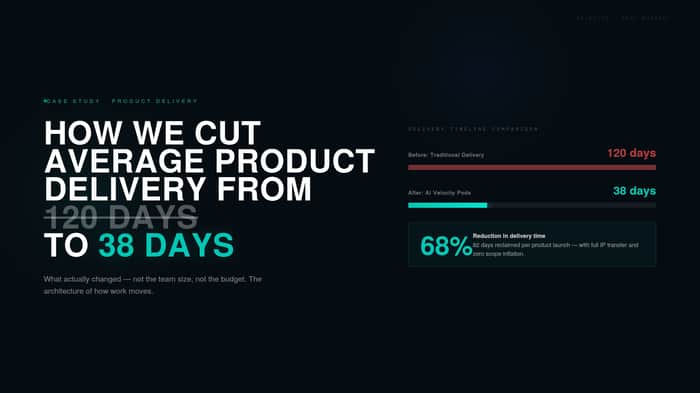
We've been building software products for a while. And for most of that time, 90–120 days was just... the number. That's how long a serious product engagement took. We knew it. Clients knew it. Everyone adjusted their expectations accordingly.
Then we started getting it done in 38 days, consistently. Not on simple projects. On real, scoped products, with QA, documentation, deployment, the whole thing.
I want to share what actually changed, because the honest answer surprised even us.
It wasn't the tools.
Everyone assumes the answer is "we started using AI tools and got faster." That's partially true, but it's the wrong frame. We were using Cursor and Claude before the numbers changed. The tools helped at the individual task level. They didn't move the delivery timeline by 82 days.
What moved the timeline was structure.
1. We stopped hiring juniors onto client projects
This sounds obvious in retrospect. But the traditional agency model quietly depends on junior engineers; they're cheaper, you can staff more headcount, and the billing math works out.
The problem is that junior engineers on client projects are learning on the client's dime. They require supervision, their PRs require more review, and they generate more revision loops downstream.
We moved to pods of 3–6 senior engineers only. No one on a project who isn't capable of owning architectural decisions.
- The result: The cost per engineer goes up, but the total cost to the client goes down because you're not paying for coordination overhead and rework.
2. We made QA continuous instead of terminal
- The old model: Build for 8 weeks, then enter a "QA phase." Find issues. Fix issues. Re-test. Enter a revision loop that adds 3–4 weeks to every engagement.
- The new model: Agentic QA scripts run against every PR, checking business requirements (not just syntax).
Issues surface in hours, not weeks. There's no discrete QA phase because quality is enforced throughout. The end-of-project revision loop essentially disappears. This change alone recovered 3–4 weeks per engagement.
3. We switched to fixed-price, fixed-scope contracts
When you bill hourly, there's no structural incentive to be fast. Slow delivery is just more revenue. We noticed this was creating a subtle but real drag on our own internal culture; nobody was explicitly sandbagging, but nobody was optimizing for delivery speed either.
Fixed-price contracts changed everything. When the contract is outcome-tied, the only way our economics work is if we ship efficiently. Speed stopped being a nice-to-have and became a survival requirement. That shift in internal incentive drove a dozen smaller operational changes we wouldn't have made otherwise.
4. We built the AI workflow layer as infrastructure, not ad hoc tooling
Most teams use AI tools individually, one engineer using Copilot here, another prompting Claude there. The gains are real, but they don't compound across the team.
We built an integrated workflow:
- Governed LLM pipelines
- Agentic QA
- Context-aware coding environments
- Automated documentation generation
The workflow itself is the force multiplier. A new engineer joining a pod plugs into a system that's already running at high velocity, rather than having to assemble their own tool stack.
What the 38 days actually look like:
- Days 1–5: Bounded discovery sprint (scope clarity as a contract requirement, not a hope).
- Parallel Track: Environment and architecture setup runs in parallel with discovery, not after.
- Development: Continuous agentic QA from day 1.
- Feedback: Client feedback loops are async and documentation-driven, not weekly status calls.
- Deployment: Shipped with automated testing coverage already firmly in place.
There's no magic phase where everything suddenly accelerates. Every stage is just... not bloated.
What this means for anyone building a product:
If you're a founder considering a development partner, the question to ask is not "how many engineers will you put on my project?" It's "what is your average delivery timeline for a comparable scope, and what specifically makes it that fast?"
If the answer describes contract structure, team composition, and workflow architecture, that's a real answer. If the answer is "we're very experienced", keep asking.
We've written up the full model here: ailoitte.com/ai-velocity-pods
Happy to answer questions in the comments, especially from anyone who's been through a painful 120-day engagement and is trying to figure out what went wrong structurally.
> About Ailoitte: We are an AI-native product engineering company. We build outcome-based engineering pods for CTOs and founders.
Tags: #growth-stories #product-management #dev-ops #artificial-intelligence #agile

This is a rare post that actually breaks down where delivery time really goes — and it’s not engineering, it’s coordination debt.
Senior-only pods + continuous QA + fixed-scope incentives essentially remove three hidden bottlenecks: rework loops, ambiguous ownership, and delayed validation.
The most important shift here is treating AI workflows as infrastructure, not tooling. That’s where compounding gains happen — especially when QA, documentation, and validation are embedded into the pipeline instead of appended later.
I’ve been working on similar systems while contributing to open-source ML/dev tooling — focusing on reproducibility, config-driven pipelines, and agentic QA layers that reduce feedback cycles from weeks to hours.
One thing I’d be curious about: how you’re handling requirement drift mid-cycle without reintroducing friction into the system.
If you’re expanding these velocity pods or refining the workflow layer further, I’d be interested in contributing on a paid basis — particularly around pipeline architecture, QA automation, and dev experience systems.
https://topstar-ai.github.io
WhatsApp: +1 (361) 332-6512
Coordination debt" is the right frame. Engineering time is measurable; coordination overhead is invisible until it compounds.
On requirement drift mid-cycle: we use a hard change buffer , any scope shift goes into next sprint by default unless it breaks the core outcome definition. That friction is intentional. Makes clients think twice before calling everything "urgent."
The infrastructure vs. tooling distinction is key. Tools are additive. Infrastructure is load-bearing. Teams that treat AI as tooling get 10–15% gains. Teams that redesign pipelines around it get 5x.
This is one of the few posts that actually explains where the 80+ days go — and it’s not in coding, it’s in coordination, ambiguity, and delayed feedback loops.
The shift to senior-only pods + continuous QA + outcome-based contracts is exactly what removes “invisible drag” from delivery systems. Especially the point about QA not being a phase — that alone kills most timelines.
I’ve been working on similar workflow layers while contributing to open-source ML/dev tooling — focusing on reproducibility, config-driven systems, and integrating AI into structured pipelines rather than ad hoc usage. The biggest gains always come from system design, not individual productivity.
Your “AI workflow as infrastructure” point is key. That’s the real moat — not tools, but how they’re orchestrated across the team.
If you’re expanding these velocity pods or exploring deeper workflow automation, I’d be interested in contributing on a paid basis — especially around pipeline design, agentic QA, and dev experience systems.
WhatsApp: +1 (361) 332-6512