How We Cut Average Product Ship Time From 90 Days to 38 Days Using Governed AI Workflows (Not Just AI Tools)
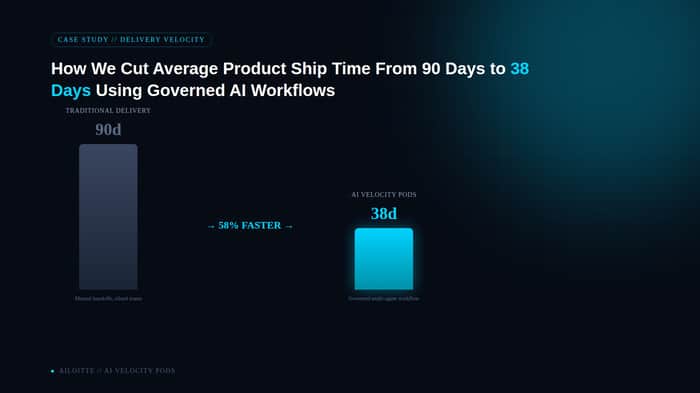
A year ago, our average product ship time was hovering around 90 days. Today it's down to a 38-day median, against an industry norm that's still sitting at 120+ days for comparable work.
We didn't get there by bolting AI tools onto our existing process. We got there by rebuilding the process around what AI actually changes.
"Using AI Tools" vs. "Governing AI Workflows"
Most teams adopt AI the same way: a coding assistant here, a test generator there, maybe an agent for PR reviews. Useful, but it doesn't move the needle much on overall ship time because the bottleneck was never raw coding speed. It's coordination, handoffs, and review overhead.
Throwing AI at the fast parts of the pipeline while leaving the slow parts (ambiguous scope, unclear ownership, untracked handoffs) untouched just moves the bottleneck around. What actually worked for us was treating AI adoption as a workflow redesign problem, not a tooling problem.
Three Changes That Mattered
1. Specialist Agent Design
Instead of one general-purpose agent doing everything, we built narrow agents that are excellent at one task each, validated in isolation before composing them into a pipeline. Reliability compounds bottom-up.
2. Explicit Handoff Contracts
Every handoff—agent to agent or agent to human—has a defined contract:
- What's guaranteed on output
- What's expected as input
- What happens if either side breaks the contract
No more implicit "the agent will figure it out."
3. Agentic QA Integration
Autonomous test generation and self-healing test scripts, but scoped tightly with human review gates at integration points. This isn't us being cautious for its own sake—bounded scope is what makes the automation trustworthy enough to actually rely on.
Why Fixed-Price Forced the Issue
We run on fixed-price, outcome-based engagements rather than hourly billing. That structure removed any incentive to let AI-driven speed gains sit unused, since our margin depends on shipping fast and well, not on logging hours. It's a big part of why we were forced to actually solve the coordination problems instead of just layering tools on top of a slow process.
The Numbers
- 300+ products shipped
- 21 countries reached
- 3x faster ship times compared to where we started
If you're curious about the methodology, check out ailoitte.com/ai-velocity-pods. Our specific numbers and client breakdowns are available at ailoitte.com/roi-case-studies.
Happy to go deeper on any of the three changes above if useful to others building with AI in the loop.
Tags: #aiengineering, #softwaredevelopment, #workflowautomation, #agile, #devops

The explicit handoff contracts stand out to me. AI can generate work quickly, but unclear inputs, outputs, and ownership still create the same old delays—sometimes faster. Cutting the median from 90 to 38 days is strong evidence that redesigning the workflow matters more than simply adding more AI tools.