How we cut our client's MVP timeline from 4 months to 38 days — and what we learned about agentic engineering workflows
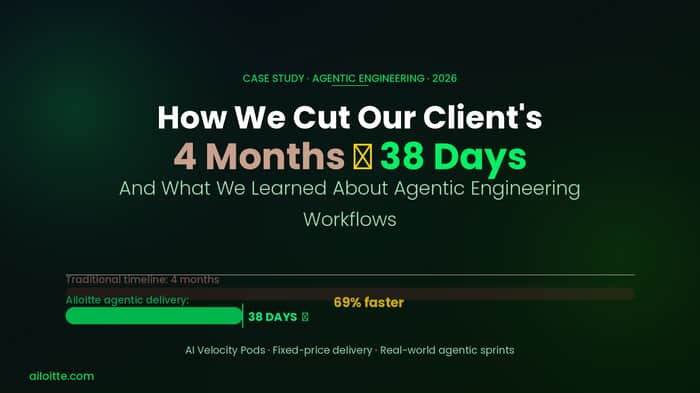
A few months back, we quoted a client 4 months for an MVP — standard staffing, standard handoffs, standard math. We moved it to a fixed-price contract instead and shipped in 38 days.
Here's what nobody tells you about fixed-price work: it doesn't make you faster on its own. It makes you honest about your bottlenecks, because every hour of inefficiency now comes out of your margin instead of the client's invoice. That pressure is what rebuilt our delivery process from the ground up.
First thing that broke: our review process
We'd been treating AI-generated code like junior-dev output — full manual line-by-line review. At a 38-day pace, that's a structural bottleneck, not a safeguard.
We rebuilt it into tiered checkpoints instead:
- AI handles raw implementation.
- A senior engineer reviews architecture decisions and security-sensitive paths specifically.
- Automated QA covers regression rather than a human rechecking everything by hand.
Second thing that broke: estimation
Our old estimates assumed human-only throughput. We had to completely rebuild our scoping framework around what a senior engineer plus governed AI workflows can actually deliver in a single week. It's a completely different number than human-only output, and a much riskier one if you don't have governance backing it up.
The lessons that actually surprised us
- Model selection mattered far less than expected. Swapping which AI model wrote the code moved the needle maybe 5-10%. Swapping how much human judgment sat at each checkpoint — what got reviewed, what got auto-approved, what got escalated — moved it 3x to 4x. Governance was the real lever, not raw model horsepower.
- Review cycle time plummeted. Our review cycle time per feature went from roughly 2 days to under 4 hours once checkpoints replaced blanket code reviews. This wasn't because we got laxer — it was because we stopped re-checking the same low-risk code paths repeatedly and put that saved time into the checkpoints that actually carry architecture or security risk.
What we'd do differently next time
We severely underestimated how much the client's side needed to compress too. Once our internal cycle time dropped, their feedback turnaround became the immediate new bottleneck. Fixed-price, hyper-accelerated timelines only work if both sides move at the new speed — not just the vendor.
Full breakdown of the pod structure, checkpoint design, and cycle-time numbers is here if you want to go deeper: https://www.ailoitte.com/startup-mvp-velocity/
Open to questions on any part of this!
Tags: #mvp #productmanagement #softwareengineering #agenticworkflows #devops #startups

The client-side feedback bottleneck is such an overlooked part of fast MVP delivery. Great breakdown.
This is a masterclass in shifting from 'time-based billing' to 'value-based delivery.' I run Mobiwolf, and I couldn't agree more: the moment you move to fixed-price, you stop being a developer and start being a product-velocity architect.
You hit the nail on the head regarding the client-side bottleneck. It's ironic how often we fix our own house, only to realize the client’s feedback loop is the new anchor. What was your most effective strategy for 'training' the client to match your new 38-day pace? Did you have to introduce specific 'feedback SLAs' or structured demo days, or did the pressure of the deadline naturally push them to adapt?