How We Designed Fixed-Price Contracts for AI-Native Development, And Why It Works When Hourly Doesn't
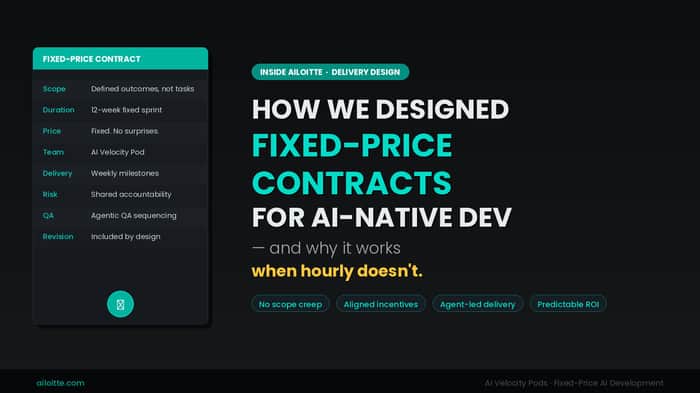
- Milestone Post: Ailoitte | AI Velocity Pods
- Core Premise: Hourly billing rewards slowness. In an agentic world, outcome-based pricing is the only honest structure for software development.
Eighteen months ago, we were having a conversation most product engineering firms were avoiding: If agentic AI can genuinely compress timelines, what does that mean for how we price?
Hourly billing rewards slowness. The longer something takes, the more you earn. When we started running governed agentic workflows internally and watching 15-day tasks collapse into 3 days, the hourly model became untenable — not just commercially, but ethically. We could not bill a client for time we weren't spending.
So we built a different model. Here is the internal logic, what we learned, and why we think outcome-based pricing is the only honest structure for AI-native development.
The Problem with Hourly in an Agentic World
Traditional software development billing is essentially a time-and-materials contract dressed up with sprints. You estimate hours, multiply by a rate, and add a buffer. The client pays for your time. If you're fast, you finish early, and the client saves money. If you're slow, they pay more.
This model made sense when execution speed was strictly bounded by human typing speed. It completely stops making sense when a governed agent can execute 231 person-days of migration work in 13 days.
In agentic workflows, the value delivered is no longer correlated with time spent. A well-designed governance framework running on a capable agent can ship production-grade features faster than any human team, but the time window is short.
Billing hourly against that would force two unacceptable realities:
- Scenario A: Dramatically undercharging for the massive outcome delivered.
- Scenario B: Artificially slowing down the delivery pipeline to justify the invoice.
Neither option is acceptable.
The deeper problem: Hourly billing creates misaligned incentives around AI adoption. If an engineering firm's revenue scales with hours billed, they are structurally incentivized not to get more efficient. That is a massive problem when the whole premise of AI-native development is compounding efficiency.
What Fixed-Price Actually Requires
Fixed-price contracts have a bad reputation in software. Historically, they meant "we'll absorb all the scope creep risk and grow to hate the client by month three."
That is not what we are talking about. Fixed-price done right means committing to a defined outcome, designing the delivery system to make that outcome predictable, and pricing against the value delivered rather than the time spent.
Three pillars have to be true for this to work successfully:
1. Scope must be defined at the outcome level, not the feature level
We scope engagements around shipped, working software that meets defined acceptance criteria — not a generic list of features with implied behavior.
- Feature Spec: "Build a user authentication system."
- Outcome Spec: "Users can register, log in, reset passwords, and maintain sessions; all flows pass our security test suite; deployment to production environment."
Agents can be governed tightly against the second spec. The first spec is an open invitation to project drift.
2. Delivery variance must be engineered down, not estimated around
The traditional response to delivery uncertainty is a financial buffer: add 20-30% to your estimate and hope for the best. In AI-native delivery, the better response is to architect the delivery system to radically reduce variance.
AI Velocity Pods are built around this exact principle. We deploy small, senior-heavy pods with standardized governance frameworks and agentic execution pipelines. The constraint frameworks that govern agent behavior are the same frameworks that make output predictable. When an agent operates within well-defined rails, the variance in output quality drops. When quality variance drops, delivery timeline variance drops.
Our average ship time across engagements is 38 days. That number isn't a marketing claim — it's a predictable consequence of architectural decisions made at the delivery system level.
3. Milestones must be outcome-gated, not time-gated
Payment milestones in fixed-price contracts are typically calendar-based (e.g., 30% at kickoff, 30% at mid-point, 40% at delivery). The problem is that calendar milestones only tell you when time has passed, not whether value was actually created.
Instead, we structure milestones around working software states:
[Definition Complete] ➔ [Architecture Reviewed] ➔ [First Working Build] ➔ [Integrated Testing Passed] ➔ [Production-Ready]
Each milestone has specific, testable criteria. Payment triggers only when those criteria are completely met. The client has visible evidence of progress at every stage, and our engineering team has clear targets for the delivery system.
What We Learned Shipping 300+ Products This Way
A few things weren't obvious to us when we first designed this model:
- The governance framework is the true product: Clients hire us for outcomes, but what they are actually getting is a governance layer that makes agentic output trustworthy for their specific business context. The code the agent writes is simply a byproduct of that. When we hand off engagements, we hand off the frameworks — because that's where the durable value lives.
- Fixed-price forces better scoping conversations: Hourly engagements often start with fuzzy scope because ambiguity is ultimately the client's financial problem. Fixed-price requires us to resolve ambiguity upfront, which turns out to be excellent for everyone.
- Not all work is appropriate for fixed-price: Exploratory R&D, early-stage product discovery, and open-ended research do not have defined outcomes yet. We do not take them on fixed-price terms. The model only works when the outcome can be specified. Knowing when to walk away is part of the operating discipline.
- QA is a governance function, not a final step: In traditional development, QA happens at the tail end. In agentic delivery, QA engineering is embedded in the governance framework from day one — automated test gates, defect escape rate tracking, and agent output validation. By the time code reaches human review, it has already cleared multiple programmatic checks.
The Broader Point
Hourly billing in AI-native development is a legacy pricing structure trying to accommodate a completely new production reality. It doesn't fit, and the resulting friction shows up everywhere: in client relationships, in incentive design, and in how engineering firms adopt (or fail to adopt) efficiency improvements.
Fixed-price based on outcomes isn't a new concept. What is new is that agentic AI finally makes delivery variance controllable enough to commit to those outcomes reliably.
If you're running a software product company or considering working with an engineering partner, the question worth asking isn't "What's your hourly rate?"
The real question is: "How do you govern agent output, and what's your average time-to-production?"
About the Author
At Ailoitte, we build AI Velocity Pods— governed agentic engineering teams that ship production-grade software at a fixed price.
- Global Footprint: 300+ products shipped across 21 countries.
- Average Delivery Speed: 38 days.
Curious how we scope engagements? We're happy to share our blueprint. Drop a comment below or reach out to our team.
Tags: #agentic-ai #software-engineering #developer-productivity #engineering-management #devops #software-development #generative-ai #tech-leadership
