How we restructured our delivery model around AI agents and why fixed price finally became easy to guarantee
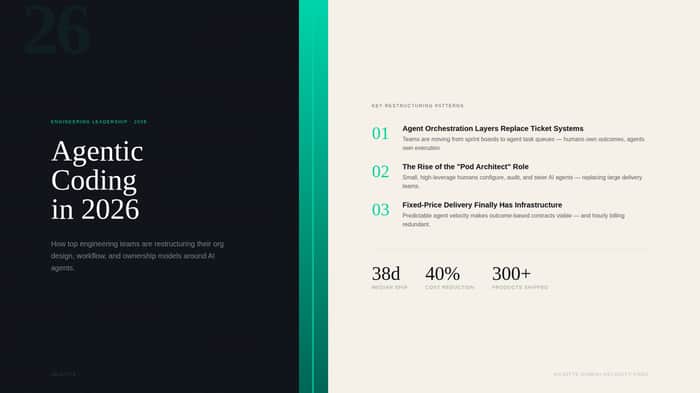
For years, fixed-price software development felt like a liability on our side of the table.
You scope carefully. You write tight contracts. And then scope creep, integration surprises, or a single unclear requirement eats your margin and your relationship with it. Most agencies that tried fixed-price pricing in the traditional model eventually flinched back to time-and-materials — not because they lacked ambition, but because the delivery infrastructure underneath could not absorb the risk.
AI agents changed that. Here is how we rebuilt the model from the ground up — and what it actually took to make fixed-price feel easy to guarantee rather than reckless to offer.
The core insight: fixed-price risk lives in unpredictability. AI reduces unpredictability.
The traditional argument against fixed-price engagements was always about unknowns. You cannot price what you cannot scope. And in a human-only delivery team, unknowns compound — a missed dependency means a conversation, which means a revision, which means a delay, which means a negotiation.
AI agents compress that chain dramatically. Agentic workflows handle boilerplate, test generation, integration scaffolding, and QA loops that used to introduce the most unpredictable time variance in any project. When those variables are tighter, the timeline becomes more predictable. And when the timeline is predictable, fixed-price becomes a rational commitment rather than a gamble.
What we actually built: the AI Velocity Pods
We ship in teams we call AI Velocity Pod. Each pod is small — deliberately so. A cross-functional team with product, engineering, and AI workflow governance sitting inside a single accountable unit.
The pod owns the outcome, not the task list. There is no handoff between a "design stage" and an "engineering stage" that creates the seam where most delays live. The pod runs concurrently, with AI agents handling the parts of the workflow that do not require human judgment, and humans making the calls that do.
On top of that, we built a governance layer. Every pod operates against a defined delivery protocol: clear milestone gates, automated QA checks, and scope documentation rigorous enough to catch ambiguity before it becomes a problem mid-build. That governance layer is what makes the fixed-price commitment credible — not just internally to us, but externally to the client.
The numbers after restructuring
Median ship time dropped to 38 days from an industry baseline closer to 120. That is not marketing language — it is what the timeline data shows across 300+ products shipped across 21 countries.
Clients absorb 40% average cost savings compared to traditional agency or in-house development approaches, with full IP transfer at delivery. No lock-in. No ongoing licensing dependency on our tooling.
The thing that surprised us most in the restructure was not the speed gain. It was how much the fixed-price model changed the client relationship. When you own the outcome, the conversation shifts from "are we on track this week" to "what does shipped look like." That is a much better place to build trust from.
What this unlocked commercially
Fixed-price, outcome-based delivery turned out to be a significant differentiator in a market where most vendors are still billing hourly and hoping for the best. Founders and CTOs who have been burned by open-ended T&M engagements respond very differently to a fixed-price commitment backed by a delivery track record.
It also changed how we scope. We run a paid discovery phase now — not as a revenue line, but as a delivery tool. Getting the scope tight enough to guarantee a fixed-price build requires real work upfront. Charging for that work, modestly, aligns incentives: clients who invest in clear discovery get better outcomes, and we get the clarity we need to stand behind the commitment.
The lesson for anyone building a services business in the AI era
If you are running an agency or studio and you are still pricing for time, you are competing on the wrong variable. AI is compressing time. The agencies that survive this shift are the ones that price for outcomes and build the delivery infrastructure to back it up.
That infrastructure is not a process document. It is a team design, a tooling stack, and a governance model built to absorb timeline risk so the client does not have to.
We are still iterating on it. But the directional bet, small, accountable AI pods, fixed-price outcomes, and a governance layer underneath have held up across more than 300 shipped products. That is enough to feel confident we are building in the right direction.
Happy to answer questions on the pod structure, how we handle scope ambiguity in fixed-price contracts, or what the governance layer actually looks like in practice.
Tags: #ai, #agency, #product, #saas, #bootstrapped

Sunil — the “outside-in review” point is exactly what caught my attention.
Ailoitte already has a strong internal governance model around AI-native delivery, but I’m curious whether you see a point where selected enterprise or regulated clients might want that assurance separated from the delivery team itself.
That’s the gap I’m building OpsWatch around: independently testing actual AI behaviour, control adherence, escalation, failure paths and evidence after deployment — without replacing the governance layer already built into the product or delivery process.
Given the scale you’re operating at, I’d be interested in testing that on one bounded workflow first and seeing whether it adds value as an independent assurance layer for higher-consequence client deployments.
Would that be worth exploring?