How We Saved 100's of Hours and 1000's of $$$ by Automating Comparison Blogs for Web2Chat
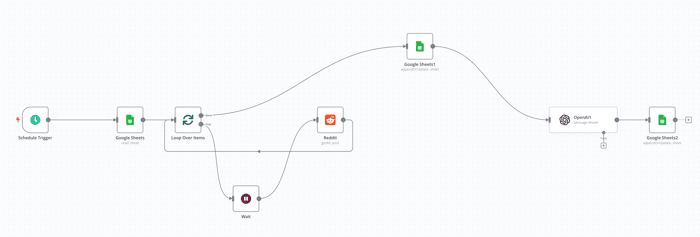
Creating comparison blogs for our competitors used to consume a significant amount of time and resources. At web2chat, we found a way to streamline this process, saving hundreds of hours and thousands of dollars by leveraging tools like ChatGPT, Reddit, N8N, and Webpilot GPT. Here's a step-by-step breakdown of how we automated the creation of comparison blogs, allowing us to produce 40 articles in just 6 hours and achieve strong Google rankings from day one.
Step 1: Identifying Competitors on Reddit
To start, we needed to identify which competitors were actively discussed by users. We used the following tools:
Google Sheets: For organizing and managing our data.
N8N: An automation tool to streamline our workflow.
Ahrefs: To collect relevant product keywords.
OpenAI: For analyzing Reddit posts.
Process:
Keyword Collection: Using Ahrefs, we gathered all product-related keywords relevant to our tool.
Automation with N8N: These keywords were fed into N8N to automate the data processing.
Reddit Analysis: We analyzed Reddit posts with the OpenAI API to identify which competitors were frequently mentioned. This resulted in a list of 50-60 competitors actively discussed in our niche.
Step 2: Discovering Comparison Keywords
With our list of competitors, the next step was to find the specific comparison keywords that potential customers were searching for.
Process:
Using Ahrefs: We input our competitor list into Ahrefs to find keywords that included "vs" (e.g., "Tool A vs Tool B").
Analyzing Metrics: For each "vs" keyword, we noted the search volume and keyword difficulty to prioritize the most promising comparisons.
Step 3: Targeting Low Difficulty, High Volume Keywords
To ensure our articles could rank quickly on Google, we focused on keywords that were both high in search volume and low in competition.
Criteria:
Low Keyword Difficulty: Identified using Ahrefs.
High Search Volume: Ensured that the keywords were frequently searched.
Keyword Golden Ratio (KGR): We targeted keywords with a KGR below 0.25 or an allintitle count of fewer than 100 results. This significantly increased our chances of ranking on Google from day one.
Process:
Manual Verification: We manually checked the allintitle results on Google.
Automation with Sheets: Google Sheets was used to calculate the KGR automatically, streamlining the keyword selection process.
Step 4: Leveraging ChatGPT and Webpilot GPT for Content Creation
Creating high-quality comparison articles at scale required more than just generating text. We needed real-time data from competitor websites.
Tools Used:
ChatGPT: For writing the articles.
Webpilot GPT: To scrape data from competitor websites.
Process:
Data Scraping: Webpilot GPT scraped competitor websites for up-to-date information on pricing, features, and functionalities.
Data Integration: The scraped data was fed into ChatGPT, providing it with all necessary information to create accurate and detailed comparison pages.
Step 5: Perfecting the Prompt for Comparison Articles
Developing effective prompts for ChatGPT was crucial to ensure the quality and accuracy of the articles.
Technique:
Chain of Thought Prompting: This method breaks down the article writing process into step-by-step instructions, ensuring comprehensive coverage of all necessary data.
Process:
Prompt Development: It took us 5-6 hours to refine the prompt.
Efficiency Gain: Once perfected, we could generate a comprehensive article every 10 minutes.
Step 6: Writing the Article
With the refined prompt and data from Webpilot GPT, writing the articles became seamless.
Process:
Feeding Data: We provided Webpilot GPT with the necessary competitor links.
Content Generation: Webpilot GPT extracted key data points, which ChatGPT used to craft well-structured comparison articles.
Step 7: Uploading and Optimizing Content
After generating the articles, the final steps involved uploading and optimizing them for better search engine performance.
Process:
Uploading: Articles were uploaded to our website.
Initial Ranking: From day one, these articles ranked on Google’s page 2 and page 3.
Optimization: We focused on on-page and off-page SEO to push these articles to page 1.
Results and Future Plans
By automating the creation of comparison blogs, we achieved the following:
Time Savings: Produced 40 articles in 6 hours.
Cost Efficiency: Saved thousands of dollars in content creation costs.
SEO Success: Achieved rankings on Google’s pages 2 and 3 from day one, with ongoing efforts to reach page 1.
Future Plans:
Scaling Content Production: Increase the volume of comparison articles while maintaining quality.
Continuous Optimization: Enhance both on-page and off-page SEO to improve rankings further.
Advanced Automation: Explore additional tools and techniques to streamline the process even more.
