How we ship production apps in 38 days using AI Velocity Pods — a methodology breakdown
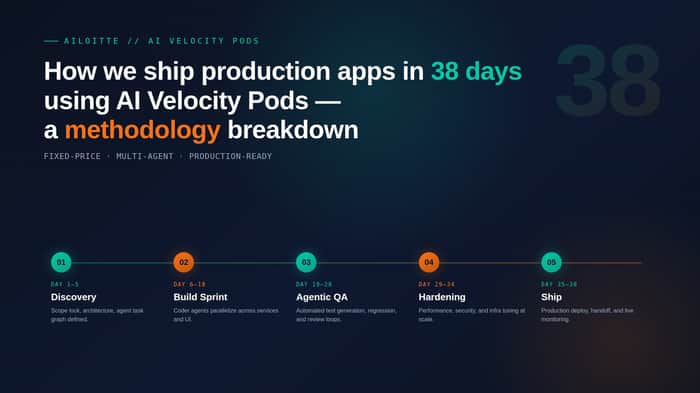
I lead engineering delivery at Ailoitte. We've shipped 300+ products across 21 countries, and our median delivery time on AI Velocity Pod engagements is 38 days against an industry average of 120+. I want to share how, without the marketing gloss — just the actual workflow.
How the pods are structured
A pod is a small, fixed team (typically 4-6 people) covering the full SDLC — not a single specialist bolted onto a client's existing team. Each pod runs a layered agent setup: an orchestrator agent handles sequencing and escalation, with specialized agents underneath for frontend, backend, schema/DB work, QA, and security review. Humans set the spec, review architecture decisions, and approve before anything ships to production.
What "governed AI workflows" means in practice
This is the part most teams get wrong. "Agentic" doesn't mean "unsupervised." Every agent output passes through a deterministic validation gate before moving to the next stage — code generation gets reviewed against the architecture spec, QA output gets checked against defined test coverage thresholds, security review runs against OWASP and known CVE patterns before deployment agents touch infra config.
The governance layer is what makes the speed safe. Without it, you're just generating code faster and shipping bugs faster too.
One example: feature shipped via agentic pipeline
On a recent client build, we needed a multi-tenant permissions system — usually a 1-2 week task involving schema design, API endpoints, frontend role management UI, and a full test matrix for permission edge cases.
The orchestrator broke this into:
- Schema agent designed the permission tables and relationships.
- Backend agent scaffolded the API layer against that schema.
- Frontend agent built the role management UI against the API contract.
- QA agent generated edge-case tests (orphaned permissions, role inheritance conflicts, cascading deletes).
A human engineer reviewed the schema before backend work started, and reviewed the full test suite before the merge.
Total time: under 3 days, including human review checkpoints. The same task took our team roughly 8-9 days before we restructured around this pipeline.
Why this matters for fixed-price delivery
This is the mechanism behind the 38-day median. It's not "AI writes code faster" in some vague sense — it's that the entire pipeline, including QA and security, compresses together because each stage hands off to the next with less rework. Our Agentic QA Pipeline specifically has cut QA cycles by 60%+ on production apps.
Happy to go deeper on any part of this — orchestration setup, validation gate design, how we structure the human review checkpoints, whatever's useful.
More on the pod model here if you're curious: AI Velocity Pods
Tags: #AI #SoftwareEngineering #DevOps #ProductManagement #Agile #Automation #TechStack #IndieHackers
