How we ship products in 38 days at a fixed price — and what 300+ products taught us about outcome-based engineering
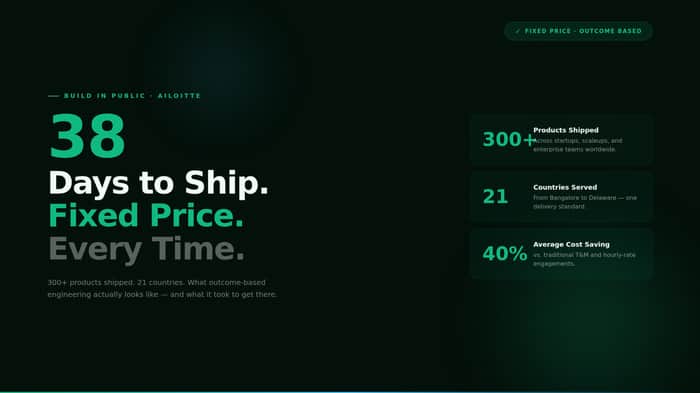
I want to write the honest version of this, not the pitch version. We've shipped over 300 products across 21 countries through our AI Velocity Pods model. The 38-day median delivery number is real. The fixed-price structure is real. ISO 27001-certified pipelines, real.
But the story of how we got here includes three times we nearly broke the model entirely, and I think those are more useful to most people reading this than the metric is.
The decision that was genuinely terrifying internally
In early 2023, we were a traditional product studio: a competent team, good clients, T&M billing like everyone else. We were watching the AI coding tools emerge and doing what most teams were doing — incorporating them into our workflow and billing the same hours while quietly moving faster.
That felt dishonest to us. But more importantly, it was dumb business. If we were shipping in 60% of the time, the value wasn't in our hours — it was in our architecture decisions, our governance layer, our ability to move fast without shipping broken software. None of that was being captured in hourly billing.
So we made the call: fixed price, fixed scope, fixed timeline. You get a defined outcome in a defined window, or we don't charge you for the engagement.
The fear wasn't irrational. Fixed-price contracts punish you when scope drifts, when clients add requirements mid-sprint, when the original spec was underdefined. We had all of those risks, and we knew it. What we were betting was that if we got the pre-engagement scoping rigorous enough — really forcing the "what are we building and why" conversation before any contract was signed — we could control scope well enough to make the model work.
That bet has largely paid out. But it required building a scoping discipline that we honestly didn't have before.
What an AI Velocity Pod actually is
The name sounds flashier than the structure. A pod is typically a senior software architect, an AI logic implementation layer (Cursor + Claude workflows for the heavy code generation), and an agentic QA system that runs automated regression testing against business requirements rather than just syntax.
The architect is an irreplaceable part. That's the person who writes the architecture document before any AI touches the codebase — including the data model, API contracts, authentication model, and service boundaries. The AI is implemented within that structure. It doesn't discover the structure. This is the distinction that separates teams shipping clean AI-native code from teams accumulating technical debt they don't fully understand yet.
Engagements run in 12-week cycles. Weeks 1–3 is architecture and scaffolding. Weeks 4–10 are AI-accelerated implementation with human PR review on everything. Week 11 is the QA sprint. Week 12 is CI/CD handoff with full documentation — Swagger docs, architecture maps, deployment scripts. You own 100% of the IP.
The daily deployment cadence matters more than people expect. It forces scope decisions to be made continuously rather than deferred to a big reveal. When you're deploying every day, scope creep is visible immediately, not two months later.
The three times the model nearly broke
The first near-failure: a client who kept discovering new requirements. Mid-sprint, they would realize the product they'd described wasn't quite the product they wanted. Each change was small. The aggregate was effectively a product pivot in the middle of a fixed-price engagement. We had not built our scoping process tightly enough to catch this pre-contract.
What fixed it: a mandatory "assumption document" step that we now run before every engagement. Not just a spec — a document where the client explicitly states the riskiest assumptions behind their product, the user behavior they're betting on, and the metrics that will tell them whether the product worked. Clients who can't complete this document aren't ready to build. This sounds harsh. It's actually kind to them — it saves them from a fixed-price engagement that will frustrate everyone.
The second near-failure: AI-generated code that passed QA and still broke in production. This was a security failure. Our automated QA was catching functional regressions well, but we had a period where OWASP-level vulnerabilities were slipping through because the QA agents were testing behavior, not security posture. A client's staging environment was probed, and we caught it before anything reached production — but barely.
What fixed it: we added a security scan gate to every sprint, not just at launch. It runs independently of the functional QA. It's not optional, and it's not deferrable. The cost of building this into the pipeline was about two weeks of engineering time. The cost of not having it could have ended client relationships permanently.
The third near-failure: scope creep we enabled ourselves. AI tools make adding features cheap and fast. This is wonderful until it isn't. We had an internal period where our pods were saying yes to feature additions because "it'll only take a day." Those days added up. Engagements that should have been 38 days stretched to 60. The economics broke, the team was tired, and the client got a product that was larger and less focused than what they actually needed.
What fixed it: a formal change-order process. Any addition outside the original scope document requires a signed change order with a scope, timeline, and cost delta attached. This is not bureaucracy — it's protection. It protects the client from a bloated product they don't need, and it protects us from building things that weren't in the deal.
Current metrics, honestly reported
38 days average from kickoff to production-ready handoff. That's across product categories: SaaS dashboards, agentic AI applications, telemedicine platforms, D2C marketplace logic.
21 countries represented in our client base. The geographic spread matters to us — it's evidence the model works across different regulatory environments, different infrastructure constraints, different user behavior patterns.
ISO 27001-certified development pipelines. This is non-negotiable for us given the number of healthcare and fintech clients in our portfolio. AssureCare (53M+ member connected care platform) and BankSathi are on our client list. You don't work with those organizations without a serious security certification.
40% cost savings versus traditional agency models, on average. This is not because we're cheap — our pods are not the lowest-priced option in the market. It's because the fixed-price model eliminates the hidden costs of T&M: management overhead, unbounded scope, the 10+ hours a week clients spend chasing updates.
What fixed-price doesn't work for
I want to be direct about this because I think it's important for anyone evaluating our model or building something similar.
Vague requirements. If you can't describe what you're building at the level of "here is the user action, here is the system response, here is what success looks like," you are not ready for a fixed-price engagement. You are in a discovery phase, and you should pay for discovery. We offer that separately. Conflating discovery with delivery is where both parties end up unhappy.
Experimental scope. If you're genuinely uncertain whether the core feature is technically feasible — if there's meaningful R&D involved, if you're working with models or data infrastructure that are still maturing — fixed-price is the wrong structure. Fixed-price transfers risk from the client to the vendor. That transfer only works when the risk is scoped. Genuine technical uncertainty is not scopeable.
Clients who need to change direction mid-engagement. Some founders are still discovering their product-market fit while in the middle of a build. That's valid. It's just not compatible with a fixed-price structure. It requires an exploratory, iterative model with a different economic structure. We'd rather tell you this before you sign than realize it at week six.
Why we think this is where product engineering is going
The AI Velocity Pod model isn't a niche delivery approach for a specific client type. We think it's the direction the industry is moving for a structural reason: the value of engineering is shifting from code production to decision quality.
When AI tools can generate competent implementation code in hours, the scarce resource isn't coding capacity. It's the judgment behind the code — the architecture decisions, the security posture, the product scope discipline, the ability to say no to features that dilute the hypothesis. Those are human contributions. They're not commoditizable by the same tools that are commoditizing implementation.
The clients who get the most out of our pods are the ones who come in understanding this. They're not buying hours of developer time at a discount. They're buying a defined outcome delivered by a system that has been refined across 300+ products to deliver that outcome reliably.
If you're thinking about whether this model makes sense for your next build, the AI Velocity Pods page has the detailed structure and economics. And if you're an early-stage founder specifically, the Startup MVP Velocity program is the entry point — $24,900 fixed price, four-week delivery, full IP handoff.
Happy to answer questions in the comments about any of this — the scoping process, how we handle edge cases in the change-order system, what the QA pipeline actually looks like. If you've built a similar outcome-based model and hit different failure modes, I'd genuinely like to hear about them.
Tags: lessons-learned building-in-public ai product-development engineering

I like the point about the assumption document.
To me, the fixed-price part is less interesting than the boundary it forces before the work starts.
A fixed scope does not remove ambiguity by itself. It either excludes it, prices it separately, or turns it into a discovery output.
That distinction matters because a lot of services try to productize the billing first, while the delivery is still custom.
I would be curious where the line is in practice after 300+ builds:
What kind of uncertainty is allowed inside the 38-day sprint, and what has to be rejected or moved into discovery before the contract starts?