How We Shipped 300+ Products Across 21 Countries Using AI Velocity Pods (And What We Learned)
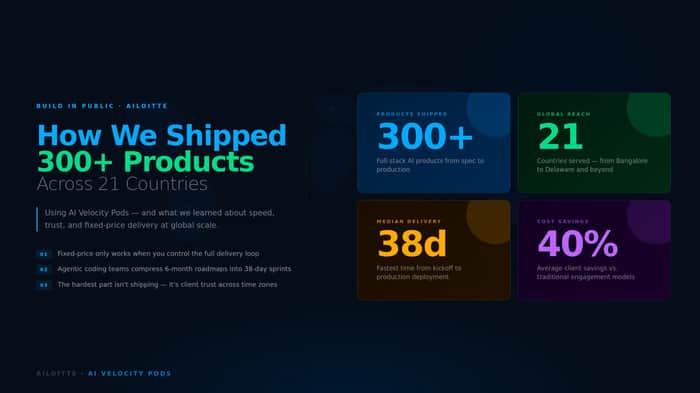
The milestone is real: 300+ products, 21 countries, 38-day median delivery, fixed-price contracts.
But the lesson isn't "use AI." That framing is too easy and, honestly, what got us into trouble early.
The Failure We Don't Talk About Enough
When we first wired AI agents into our delivery pipeline, output volume went up immediately. So did rework. Agents generated plausible-looking code that broke in integration. Test coverage was inconsistent. Dependencies appeared confident and wrong.
We weren't moving faster. We were accumulating technical debt faster, just with more confidence.
The actual problem: we had AI tools without AI governance. Velocity without guardrails isn't speed; it's noise.
What Fixing It Actually Looked Like
We rebuilt around three principles:
Consistency over capability. We stopped chasing the most powerful model for every task and started building reproducible agent pipelines with defined roles — scaffolding agents, review agents, compliance checkpoints. Boring infrastructure, but it's what makes a fixed-price commitment defensible.
Human judgment at the right junctions. AI handles generation and first-pass review. Humans own architecture decisions and client-facing quality gates. This hybrid isn't a concession; it's the architecture that makes 38-day delivery reliable, not lucky.
Scope discipline from day one. Outcome-based pricing only works if everyone agrees on what the outcome is before the first sprint. We over-invested in scoping sessions. It paid back tenfold in avoided rework.
The Numbers Now
- 38-day median time to production deployment
- 3x output compared to our pre-AI baseline
- 40% average cost reduction for clients on comparable builds
- ISO 27001 and 9001 certified delivery processes
- Clients across fintech, healthtech, and enterprise SaaS
The full breakdown of what this looks like in practice is on our ROI case studies page.
The hard-won insight: governance is the product. The AI is the raw material.
Any team can spin up agents. The teams winning in 2026 are the ones who've built the systems to make AI output consistent, auditable, and deliverable at a fixed price.
That's what took us two years to get right.
Tags: ai saas productivity buildinpublic startups
