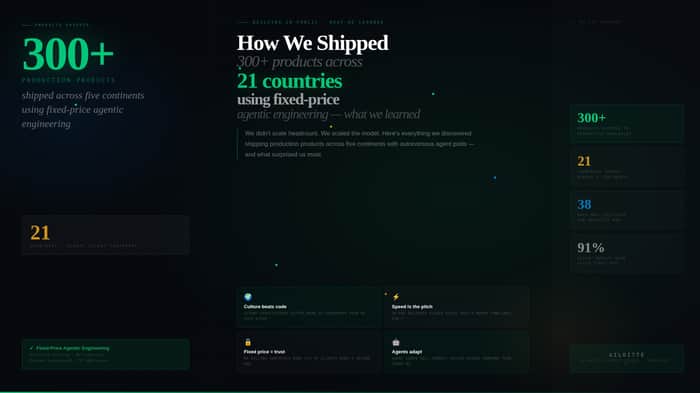
How we shipped 300+ products across 21 countries using fixed-price agentic engineering - and what we learned
We've been building AI products since before "agentic engineering" was a phrase anyone used seriously.
This is not a hype post. It's a breakdown of what actually changed, what broke, what we fixed, and what we'd do differently if we were starting from zero.
A bit of context first
We run AI Velocity Pods, small, cross-functional product teams (ML + data + backend + product) that deliver production-ready MVPs on fixed-price, outcome-based contracts.
We've shipped across fintech, healthtech, logistics, edtech, and a dozen other verticals. 21 countries. 300+ products.
Average delivery time: 38 days.
Industry average for comparable scope: 120+ days.
That gap didn't come from hiring faster people or working longer hours. It came from rethinking the workflow entirely - specifically, how humans and agents divide the work, and what governance infrastructure makes that division reliable.
Part 1: The thing that changed everything - fixed-price + agents
When we moved to fixed-price, outcome-based delivery, the obvious benefit was commercial clarity.
Clients know exactly what they're paying. We know exactly what we're committing to. No scope creep arguments at invoice time.
But the benefit we didn't anticipate was scope discipline, and that turned out to matter more.
Fixed-price contracts force you to define acceptance criteria before a line of code is written. You cannot be vague. You cannot defer decisions. You have to answer "what does done look like?" before the clock starts.
That turns out to be exactly what agentic workflows need to function well.
Agents are exceptional at executing against a clear spec. Give an agent a well-defined feature with explicit inputs, outputs, edge cases, and acceptance criteria, it will produce working, reviewable code fast.
Give an agent a vague spec, and it will make a plausible-looking assumption, generate 200 lines of code confidently in the wrong direction, and hand it back looking complete.
The scope clarity that fixed-price forces isn't just a commercial best practice. It's infrastructure for making agent-native engineering reliable at scale.
Part 2: How the AI Velocity Pod model actually works
A lot of teams say they're doing "agentic development." Most of them mean they're using Cursor or Copilot alongside their normal sprint process. That's not what we mean.
The team
- 1 product engineer — owns scope and client communication
- 2–3 ML/backend engineers — own architecture and review
- AI agents — own execution of defined feature specs
The workflow
- Week 1: Discovery and requirements lock. We do not write a line of code until acceptance criteria are defined for every feature in scope. This feels slow. It pays back fast.
- Week 2 onward: Agent-native execution. Engineers write specs. Agents implement. Engineers review at the judgment layer, architecture, security, edge cases, not line by line.
- Parallel QA: Automated tests run concurrently with feature generation, not as a post-sprint phase.
- Milestone gates: Fixed checkpoints where the client signs off before the next phase begins.
The governance layer
Agents need guardrails. Not because they're bad, but because they're fast and confident, which means errors propagate further before they're caught.
- Scope boundaries: agents only touch defined feature areas
- Automated test coverage is required before any feature is marked complete
- Architecture review checkpoints
