How We Went From £0 to Our First £10K Month Selling Refurbished MacBooks in Europe
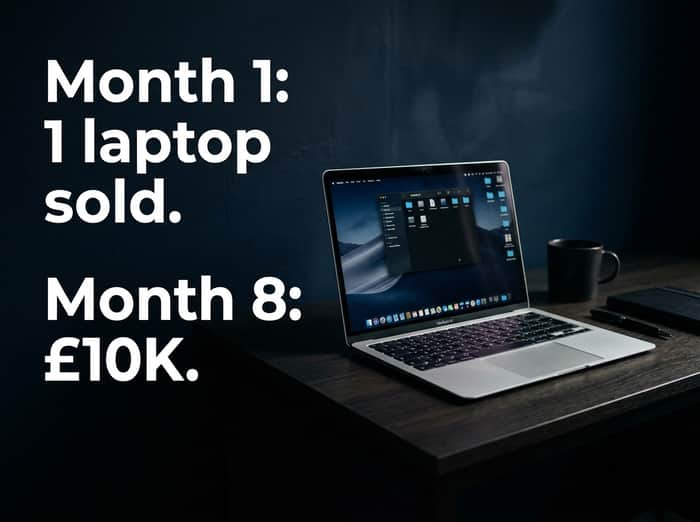
I'm going to be honest with you. The first month, we sold one laptop. One. And the buyer messaged us three times asking if it was actually going to arrive.
That was the beginning of Exact Solution.
We weren't funded. We didn't have a warehouse. We had a process we believed in, a small inventory of refurbished MacBooks we'd tested ourselves, and a Shopify store that looked decent enough. What we didn't have was customers, trust, or any real idea of how long it would take to get both.
Eight months later, we crossed £10K in a single month. Here's exactly what that journey looked like — the decisions that worked, the ones that didn't, and the thing that actually moved the needle when nothing else did.
The First 60 Days — Slower Than We Expected
We launched thinking the product would sell itself. Refurbished MacBooks at 30–50% below retail, fully tested, graded honestly, backed by a 12-month warranty. What's not to like?
Turns out, a lot — if nobody knows you exist and nobody trusts you yet.
Our first traffic came from organic search. We'd written a few product descriptions, had some category pages, and were getting maybe 40–60 visitors a day. Conversion rate was roughly 0.8%. At that volume, that's nothing.
The one sale we did make in month one taught us something important though. The buyer wasn't looking for a cheap laptop. He was looking for a cheap MacBook he could actually trust. He'd been burned before — bought something from a marketplace seller, received a unit with a dead battery and a cracked hinge, got a runaround on the return. He chose us because our grading policy was spelled out clearly on the page and we had a phone number listed.
That was the first signal. Trust language converts. Vague product listings don't.
Month Two and Three — We Stopped Talking About Price
The mistake most refurbished sellers make — and we made it too — is leading with the discount. "Save 40% vs new." "Half the price of Apple Store." It's tempting because it's true, but it attracts the wrong buyers and triggers scepticism in the right ones.
We rewrote every product listing. Instead of opening with price, we opened with process. What we checked. What we replaced. What the battery health actually was. What Grade A meant in concrete terms — not "excellent condition" but "minimal to no visible marks, battery above 85% capacity, all ports tested, fresh macOS install, wiped of previous user data."
Sales didn't jump overnight. But the quality of enquiries changed immediately. People started asking specific questions — "does this model support macOS Ventura?", "what's the SSD speed on this unit?" — rather than just "is this legit?"
Specific questions from buyers are a buying signal. They only ask detailed questions when they're already half-convinced.
By end of month three we were doing £1,200–£1,800 a month. Still small. But the return rate was near zero and the customer messages were shifting from nervous to satisfied.
The Thing That Actually Broke Us Through — Content, Not Ads
We tried ads in month four. Google Shopping. Spent about £400 over six weeks. Got some clicks, made a few sales, broke roughly even after cost of goods. Not a disaster but not a growth engine either.
What worked — and this surprised us — was a single detailed blog post.
We wrote about what actually happens to a MacBook before it gets sold as refurbished. The real process. Diagnostic software, what it checks, why battery cycle count matters, what Grade A versus Grade B actually means, why we replace certain components even when they're technically functional. Roughly 1,800 words, no padding, no fluff.
That post started ranking for "refurbished MacBook what to check" and a handful of related queries within about six weeks. The traffic it brought converted at nearly 3x the rate of our homepage traffic. People who found us through that post already trusted us before they hit the product page — because we'd already shown them we knew what we were talking about.
We wrote four more posts in the same style. Each one answered a question we kept seeing in customer emails or support chats. By month six, content was driving about 60% of our organic sessions.
The lesson: in refurbished tech, education is the sales pitch. You're not selling a product — you're selling confidence in a process.
Month Six — We Fixed the Thing We'd Been Ignoring
Our checkout abandonment rate was sitting at around 71%. We'd been watching that number and telling ourselves it was normal for ecommerce. It's not. Or at least — it was higher than it should have been for a reason we hadn't addressed.
We ran a simple exit survey. Three questions, optional, took thirty seconds. The most common response to "what stopped you from completing your purchase today?" was some variation of: I wasn't sure about what happens if something goes wrong.
We had a warranty. We had a return policy. But neither was prominent anywhere near the purchase decision. They were buried in a footer page.
We put the warranty and return policy directly on the product page — above the fold, next to the price. "12-month warranty included. 14-day returns, no questions asked." Checkout abandonment dropped to 58% within two weeks. Revenue jumped about 22% that month without any increase in traffic.
That was month six. We hit £4,300. Getting closer.
Month Seven — International Shipping Opened Up the Numbers
Up to this point we'd been focused almost entirely on UK buyers. Month seven we switched on shipping to mainland Europe — Germany, France, Netherlands, Belgium initially.
The demand was there immediately. European buyers, particularly in Germany and the Netherlands, are extremely comfortable with refurbished tech. The environmental angle resonates strongly, the value proposition is clear, and there's an established culture of buying certified second-hand hardware.
We didn't do anything fancy to reach them. Our existing organic content had been indexing in European search results already. We added currency display, translated the key trust elements of our product pages, and made sure shipping timelines were clearly stated.
European orders that month accounted for roughly 30% of revenue. That ratio has held ever since.
Month Eight — £10,340
We didn't do anything dramatically different in month eight. No big campaign, no viral moment, no influencer. It was the compound effect of everything that had come before — the content building trust at the top of the funnel, the product pages converting that trust into purchases, the warranty and return policy removing the last objection at checkout, and European shipping expanding the addressable market.
£10,340. It felt significant not because of the number itself but because of what it meant structurally. The business was working on its own logic. We understood why people bought, what stopped them from buying, and how to close that gap.
What I'd Do Differently
Three things, if I was starting again tomorrow:
Fix the trust signals on day one. Don't wait six months to put your warranty and return policy where buyers can actually see them. It costs nothing and it's probably the highest-leverage change we made.
Write the content earlier. We treated content as a month-four experiment. It should have been a month-one priority. In refurbished tech, the buyer needs to trust the process before they trust the price. Content is how you build that at scale.
Open international shipping sooner. We left months of European revenue on the table by staying UK-only longer than we needed to. If your product can ship internationally and the demand signals are there, don't wait.
We're past that first £10K month now and the model keeps compounding. But I think about that first single-laptop month more than I think about the milestones that came after it.
The buyer who messaged us three times asking if his MacBook was actually going to arrive — he left us a five-star review when it did. That's still the thing that tells me the business makes sense.

The "education is the sales pitch, you're selling confidence in a process not a product" line is the real lesson here, and it generalizes way past refurbished tech. Any category where buyers have been burned before (used cars, contractors, supplements, freelance services) runs on the same logic — the content that explains your process IS the conversion mechanism, because trust is the actual product.
The warranty-placement detail is the highest-ROI thing in the post and the easiest to miss. Abandonment dropping 71% → 58% from moving existing copy above the fold — that's revenue you already had, just hidden. Most founders would've tried to fix 71% abandonment with discounts or retargeting ads before checking whether the answer was already on the page, in the footer.
One thing worth watching as you scale: the model is heavily concentrated on organic content + SEO (60% of sessions). That's a strength now and a single point of failure later. One Google core update or AI Overview eating your "what to check" queries and a chunk of the funnel moves overnight. Worth diversifying the trust-content into channels you own — email list from buyers, a YouTube version of the teardown posts (refurb tech does well on video), maybe a Reddit presence in r/refurbished or r/macbook communities — before you need to.
The European insight is underrated too. Germany/Netherlands comfort with certified refurbished is a structural tailwind most UK sellers ignore. Curious — did you find the EU return/warranty expectations differ enough to need different trust copy, or did the same messaging carry across?
The "product did not sell itself" lesson is one every early stage founder learns the hard way. You can have the best product and still sit at zero because trust is the actual thing being sold, not the MacBook. Those first 60 days being slow despite having a solid product is completely normal you were essentially paying a trust tax until enough social proof accumulated. What was the thing that finally broke the trust barrier for you?
Congratulations!!
Interesting write-up.
The thing I'd be careful with is that several of the wins you described could support more than one explanation at the same time.
That's usually where I start getting nervous about conclusions.
Not because the data is weak.
Because different explanations can all look right for a while.
I'd probably spend more time on that question than on the £10k milestone itself.
Good story! can you post it in our forum https://dev.us.kg/ :)