HVAC Repair in Newark, NJ | New Jersey HVAC Pros | 877-401-0454
Newark is a hard city to heat and cool well, and the reason is usually sitting in the basement. Roughly 23.7 percent of the city's approximately 119,000 housing units were built in 1939 or earlier. That stock went up around steam and hot water heat, decades before anyone expected a house to have central air conditioning. Add the density (18.4 percent of units are in two-unit buildings and 22.2 percent are in three-to-four unit buildings, so close to 40 percent of everything here is small multi-family, with another 22 percent in buildings of twenty units or more) and the mechanical problems in Newark stop resembling the ones in a postwar subdivision out in Morris County.
We are New Jersey HVAC Pros. We work on heating and cooling equipment across Essex County's largest city, population 311,549 as of the 2020 census, in all five wards and in every delivery ZIP from 07102 down to 07114. This page is the wide view: what we service, what Newark's buildings do to equipment, and which neighborhoods and bordering towns we cover. The other pages on this site go deeper on diagnostics, on installation and code, and on emergencies.
What we work on
Our technicians service, repair, and replace:
- Gas furnaces, including units converted from oil in older houses
- Cast iron and steel boilers, one-pipe and two-pipe steam, and hot water (hydronic) systems
- Central air conditioning: condensers, evaporator coils, air handlers, and refrigerant line sets
- Ductless mini-split heat pumps, single-zone and multi-zone
- Air-source heat pumps and dual-fuel systems paired with a gas furnace
- Rooftop packaged units on storefronts and small mixed-use buildings
- Radiators, steam traps, air vents, circulator pumps, expansion tanks, zone valves
- Thermostats and controls, including swapping millivolt or line-voltage controls for modern ones
- Duct repair, sealing, and new duct runs where a building has room for them
- Condensate drains, condensate pumps, float switches, and the ceiling damage they exist to prevent
- Bath and kitchen exhaust, plus combustion air in basements that have been tightened up
Call New Jersey HVAC Pros at 877-401-0454.
What Newark's housing stock does to equipment
In practice, a quarter of Newark's homes are brick or frame two and three family houses with plaster walls, balloon framing in places, and a basement originally built around a coal boiler. Many of those boilers were converted to oil, then converted again to gas. The evidence is still visible: an oversized cast iron sectional boiler with a modern gas burner bolted into an opening sized for a much bigger flame, a flue that was never resized after the conversion, and a masonry chimney now far too large for the appliance it vents.
Oversized flues cause real failures. When a big chimney vents one modern appliance, the flue gases cool on the way up, condense, and attack the mortar joints from inside. We find spalled brick, partially blocked flues, and draft problems that present as a pilot that will not stay lit or a rollout switch that keeps tripping. The correct repair is usually a properly sized stainless liner, not another burner adjustment.
The second pattern is distribution. Newark's older buildings were piped, not ducted. There is no plenum, no return trunk, and often no chase to build one in without opening ceilings on two floors. That one fact drives most of the cooling work in this city.
Call New Jersey HVAC Pros at 877-401-0454.
Steam and hot water heat
One-pipe steam is still everywhere in the North and Central Wards, and it is a system most homeowners have never had explained to them. A single pipe carries steam up to each radiator and carries condensate back down the same pipe. Air has to get out ahead of the steam, which is what the vent on the side of the radiator does, and the vent has to close when steam reaches it. Vents fail closed and the radiator stays cold. Vents fail open and the radiator spits water and hisses all winter.
Banging is not normal and it is not something you live with. It is almost always condensate trapped somewhere the steam is trying to move through: a radiator pitched the wrong way, a sagged main, a wet return that has silted up, or a main vent that failed and left the mains full of air. We check pitch with a level, look at the near-boiler piping against the manufacturer's diagram, and check the water line and the pigtail feeding the pressuretrol. A shocking number of one-pipe systems in Newark run at three or four PSI when they should be cycling under two, and high pressure alone will make a house bang.
Hot water systems fail differently. Air in the loop, a seized circulator, a waterlogged expansion tank, or a zone valve that will not open all show up as one room or one floor that never warms up.
Call New Jersey HVAC Pros at 877-401-0454.
Cooling a building that has no ducts
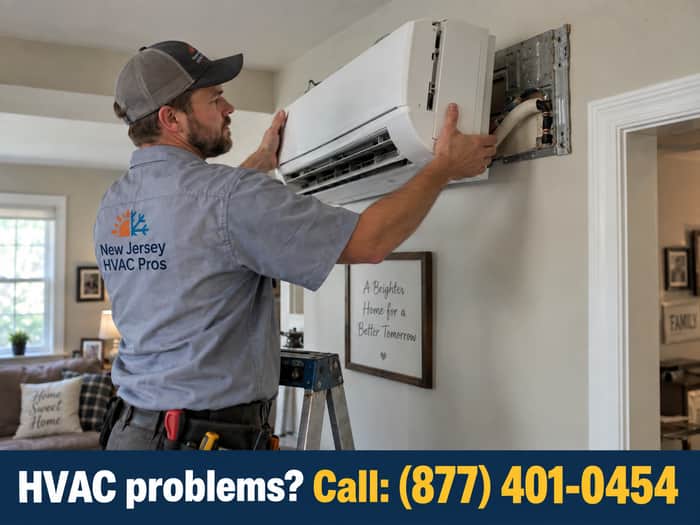
Because roughly 40 percent of Newark's housing is in two-to-four unit buildings with hydronic or steam heat, ductless mini-splits are the usual path to air conditioning here. A mini-split puts an outdoor condenser on a pad, a bracket, or a flat roof, and feeds one or more indoor heads through a small hole in the wall carrying refrigerant lines, a control cable, and a condensate drain. No trunk line, no soffits, no lost closet.
The details are what separate a good install from a noisy one. Line set length and lift between the outdoor unit and the heads have limits, and exceeding them costs capacity. Condensate has to fall the whole way to daylight or reach a pump, and a wall head that drains uphill will overflow onto drywall. On brick, the sleeve through the wall needs to be sealed and pitched outward. Multi-family adds a wrinkle: where the condenser goes, who owns the wall it hangs on, and whether the building's electrical service can carry another circuit per unit.
Ducted systems still exist in Newark, mostly in newer construction, gut renovations, and larger buildings with air handlers in closets. We work on those too, including condensing furnaces with PVC venting and the condensate neutralizers they need.
Call New Jersey HVAC Pros at 877-401-0454.
Newark's climate, in numbers
Newark sits at the transition between humid subtropical and humid continental, Koppen Cfa and Dfa. That is not trivia. It means equipment here has to handle both a real summer and a real winter, and neither season is an afterthought.
From the NOAA 1991 to 2020 normals at Newark Liberty International Airport (station USW00014734), the average July high is 86.9 degrees and the average January low is 25.5 degrees. Annual heating degree days on a 65 degree base run 4,700.6, and cooling degree days run 1,269.5. The record high is 108 degrees, set on July 22, 2011, and the record low is 14 below zero, set on February 9, 1934.
Read those two degree day totals together. Heating load dominates, which is why a heat pump in Newark should be sized and controlled with cold weather performance in mind, and why the backup heat strategy matters more here than it does in the South. But 1,269 cooling degree days plus the humidity that comes off the Passaic River and the harbor means an undersized or badly commissioned AC system will be obvious by the second week of July. Essex County is IECC climate zone 4A under the New Jersey energy subcode, and 4A is a mixed-humid zone with a heating bias.
Call New Jersey HVAC Pros at 877-401-0454.
The refrigerant change, in one paragraph
If your air conditioner or heat pump is more than a couple of years old, it is charged with R-410A. Under the EPA AIM Act, a 700 GWP limit with a January 1, 2025 manufacture compliance date ended production of new residential systems using R-410A, which has a GWP of 2,088. New equipment ships with R-454B at a GWP of 466, classified A2L. Your existing R-410A system is still legal and we can still service it. R-410A remains available, but supply will tighten and prices will climb the way R-22 did. The two refrigerants cannot be mixed, and a system designed for one is not simply topped off with the other. Our installation page covers what this means for replacement timing.
Ward by ward
North Ward. Forest Hill, Broadway, Mount Pleasant, Woodside, and Roseville. Forest Hill has some of the largest single family houses in the city, many with original two-pipe steam or converted hot water systems and finished third floors that never get enough heat or cooling. Branch Brook Park runs along the western edge of this ward.
East Ward. The Ironbound (Down Neck), East Ferry, Four Corners, Gateway Center, and part of downtown. Dense rowhouse and small multi-family construction, storefronts with apartments above, and a lot of restaurant kitchens with exhaust and makeup air issues that turn into heating complaints upstairs.
Central Ward. James Street Commons, Military Park, Lincoln Park, University Heights, Springfield/Belmont, and Seventh Avenue. This ward holds NJIT and Rutgers-Newark, historic districts with real preservation constraints on where equipment can be mounted, and a mix of tower buildings and restored townhouses.
South Ward. Weequahic, Clinton Hill, Upper Clinton Hill, Dayton, South Broad Valley, plus Port Newark and the airport area. Weequahic and Clinton Hill are heavy on 1920s single family and two family stock. The southern end runs industrial toward the port.
West Ward. Vailsburg, Ivy Hill, Fairmount, and the West Side. A lot of interwar two-family houses and garden apartment complexes, many with shared boilers or converted central systems.
Call New Jersey HVAC Pros at 877-401-0454.
ZIP by ZIP
- 07102: Downtown, Four Corners, James Street Commons, Military Park
- 07103: Central Ward, University Heights, Springfield/Belmont, Fairmount
- 07104: North Ward, Forest Hill, Mount Pleasant, Broadway
- 07105: East Ward, the Ironbound, East Ferry
- 07106: West Ward, Vailsburg, Ivy Hill
- 07107: Roseville, Woodside, Lower Broadway
- 07108: Clinton Hill, Upper Clinton Hill, South Broad Valley
- 07112: Weequahic
- 07114: Dayton, southern South Ward, Newark Liberty International Airport, Port Newark
We take calls from all nine.
Call New Jersey HVAC Pros at 877-401-0454.
Towns around Newark
Newark borders thirteen municipalities and we work in them. In Essex County: Belleville, Bloomfield, East Orange, Irvington, Maplewood, and South Orange. Across the Passaic River in Hudson County: Harrison and East Newark (both 07029), Kearny (07032), Jersey City, and Bayonne. To the south in Union County: Elizabeth and Hillside.
One clarification, because local pages get this wrong constantly: Silver Lake is not a Newark neighborhood. It is a census-designated place split between Belleville and Bloomfield. We service it, but it is not in the city.
PSE&G supplies both the gas and the electricity
In Newark, PSE&G is the utility for natural gas and for electric service. That matters for two reasons. First, when a gas appliance is red-tagged or a meter is locked, the utility controls when it comes back, not us. Second, the Whole Home Energy Solutions program is administered by PSE&G under New Jersey Board of Public Utilities direction, which means the assessment, the incentive, and the optional interest-free on-bill repayment all run through the same account.
That program starts with a home energy assessment performed by a BPI-certified participating contractor. It pays in tiers against modeled total energy savings from that assessment, roughly $2,000 at 5 percent projected savings and up to about $7,500 at 33 percent, subject to a cap on the share of project cost. Nothing gets metered afterward; the payment follows the model.
One thing to ignore: the federal Section 25C Energy Efficient Home Improvement Credit is gone. Under the One Big Beautiful Bill Act (P.L. 119-21) it is not allowed for property placed in service after December 31, 2025, and the IRS has published FAQs confirming it. Plenty of contractor pages still advertise that credit. Do not budget around it.
Licensing, and how to check anyone's
New Jersey requires a Master HVACR contractor license issued by the State Board of Examiners of Heating, Ventilating, Air Conditioning and Refrigeration Contractors, under the Division of Consumer Affairs. Anyone who opens a refrigerant circuit also needs EPA Section 608 certification. The Division runs a public license verification tool on its website, and you should use it before anyone touches your equipment. Ask for the license number, then look it up yourself rather than taking a photo of a truck door as proof.
Before you call
Have the following ready and the first visit goes faster: the equipment type (furnace, boiler, mini-split, rooftop unit), the model and serial number off the data plate, roughly how old it is, what the thermostat is reading against what the room feels like, and whether the problem is the whole building or one apartment. If it is a multi-family building, know who controls the boiler and whether other units are affected.
Call New Jersey HVAC Pros at 877-401-0454.

This resonates a lot — how long did it take before you saw any real signal on it?