I almost had a very exciting day
Hey IH,
I use hotjar to try and determine how people interact with my landing site in the hope I can get some insight to make improvements to get people to sign up.
Today, I found someone actually tried to create an account for CritiMon - except the submit failed....NOOO!
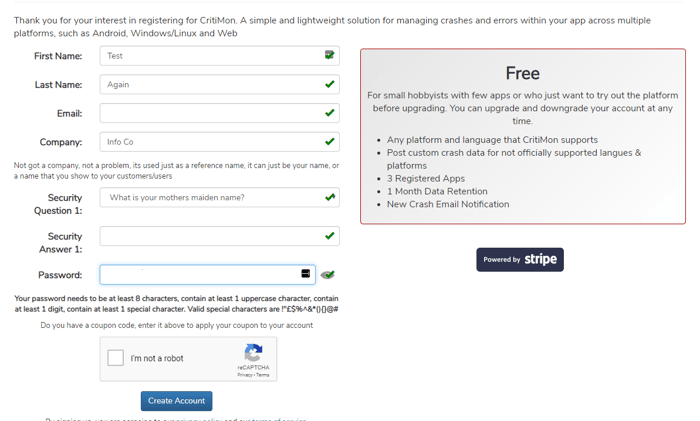
It turns out it didn't fail in the sense that I had a bug I wasn't aware of, the user entered a password for their account, but it didn't meet the password policy and was therefore rejected, and by the looks of it they never attempted again, they just gave up and left 😭
I've attached a screenshot of the signup page where it shows what the password policy is, if it doesn't meet, a little dark grey box appears next to the password field to inform the user that the password policy wasn't met.
Just wondering if anyone has got any advice on how to try and prevent this from happening. If anyone wants to see the sign up page for real it can be found at https://critimon.com/sign-up.php?plan=free
Thanks
Chris

So close!
In my opinion, your signup form is pretty heavy. For an error reporting app (or any app that needs to hook into your code), there's a lot of onboarding work to get people up-and-running, so you want to ruthlessly remove as many steps as you possibly can. Do you need their first and last name? Their company? A security question? You could remove all of this and just ask for an email address and a password most likely. Or at the very least, you could ask for this information in stages.
As for the password stuff, is it really true that requiring a special character, a number, and an uppercase digit makes your password more secure? It's quite possible to have a secure password that has none of these things. I would remove all of those unnecessary restrictions, as a lot of users (especially tech-savvy users, which will likely be 100% of your customers) will find this cumbersome.
Finally, when you're this early, do things that don't scale! Probably your first 5 or 10 customers at least should be people that you've personally talked to and convinced to join, rather than hoping you get lucky and people join on their own. As tempting as it can be to spend all your time coding, I recommend halting all code and spending 100% of your time on outreach, sales, customer interviews, etc. This will have numerous beneficial effects:
Great response
Hey thanks for the feedback. The information I asked for in the sign up for seemed pretty standard for most things, I have seen some that don't though. I ask for the first and last name for the notification messages, although only really use the first name for that, so maybe I should omit the last name. The company I ask as that does seem pretty standard for most things I've signed up for relating to this sort of service, and its a way I can group users/crashes together with a single point of reference to find someones account information easily. The security question and answer is for if someone messages me about their account I can confirm that it is indeed them and is also used for the password reset requests. If I don't have that, how can I confirm the user is the actual user if I'm speaking/emailing for example for a support ticket/billing issue.
For the password, that's an interesting one, I've seen many sites do things in different ways, maybe I have gone a tad OTT on password requirements, but I wanted to have sort of policy to stop people setting a password at "password123", as you say 100% of my users are likely going to be tech savvy so I hope they wouldn't try using that as a password but you never know.
Regarding the contacting of people, that has been one of the hardest things I've tried. Finding the right person to contact to see if they want to signup isn't particularly easy to find. At least not that I can find, how do you find relevant people that you can speak to, is there any tools that can help? The other problem I have with cold calling/emailing people is a personal thing that I don't actually like cold calls/emails. I tend to get a lot of them from my full time job, and 99.9% of the time, if I get a cold email/call from somone I'm not likely to respond or sign up to them.
Thanks again
Chris
I get lots of cold emails, and I've sent a lot in the past. I think how annoying they are is largely dependent on how targeted they are. In my opinion, people love getting the right cold email. For example, if I cold emailed a marketing employee at a company to ask them to buy ads on the Indie Hackers podcast, I was literally making their job easier. But when people email me to ask if I'll add a link to their website in a random IH interview, they're asking me to do work to one-sidedly help them out. So, like other things in life, it largely depends on how you do it.
Steli Efti gave some good advice in my most recent podcast with him: people often enjoy being asked for advice about things, and they often enjoy complaining about things. Instead of being sales-y, ask people for advice, or ask them what troubles them about their current error handling. Be upfront about who you are and what you're doing. People are often happy to share.
You don't have to use cold emails, either. I'm sure you have lots of potential customers all over the web, across forums, on Twitter, etc., who you can reply to and ask questions of. It's not easy, but if you dedicate time to it and make that your only tasks for hours or day or weeks, you'll pick up a knack for it.
Oftentimes with tasks like this, the uncertainty is paralyzing. "Where do I even start? I don't know, so I guess I just won't start." It helps to simplify overwhelming and uncertain tasks and break them down into small steps. Make the first step tiny and doable. For example, maybe start by reading IH interviews and taking notes on the ways that other people have gotten in touch with early customers.
If the most important information you want to get from user is name and email, I would suggest using a third party login like Facebook, Twitter or Google. Creating a login/sign up system is hard and except for some rare cases ( in banking or health for example) it's just better for users and easier for us (developers) to use social login. I wrote a post about this topic https://simplelogin.io/blog/do-not-create-own-auth-system/ .
Yea, I'm in the process of reworking the sign up page, I'm still keeping my own who want to use, but changing to only need Name, Company, Email and Password and changed the password policy. Due to this I'm changing the password reset functionality as it relied on the secret question, but I'm also going to look into implementing SSO using GitHub initially. I'll check out your blog post for sure though :)
Simplify your password policy to just the number of characters. You can increase it to 10 or even more characters to make the password harder to break, but get rid of requiring lowercase, uppercase, numbers and special characters - it's so annoying, especially when your favorite special character is not accepted.
I think @csallen is correct, I won't go so in depth but you could try to reduce the number of fields on signup. Consider why you really need each field right on sign up (for example maybe first and last name can be done later on in settings).
I tried to take this mentality as far as I could on my website, and I ended up allowing signup with literally only email 😂. I did passwordless auth via email and anything else I either don't truly need or it can be added after signup.
Maybe don't take it as far as me but just an idea.
Yea I think it would be worth a try. If your not asking for any security questions though and one of your users email or phone about their account, how do you confirm you are actually dealing with that person though and they're not trying to trick you into doing something you shouldn't.
I'm also thinking of implementing single sign on maybe using GitHub initially but but sure if it's worth implementing yet
Yeah, I am only able to get away with this because I don't deal with any sensitive information on my site and I explicitly state if you lose access to your email there is no way to recover your account. There's nothing users would ever really need to call me for.
In your case you obviously need these things so it's a bit different. A good idea in this case might be to A/B test a couple different flows, maybe one asks the questions on the next page after they set their email and password just so the first page isn't overwhelming. You could try a few different setups and see which converts more.