I analyzed 500 subreddits + 50k top posts using Claude Code to understand what actually works if you want to get traffic from Reddit
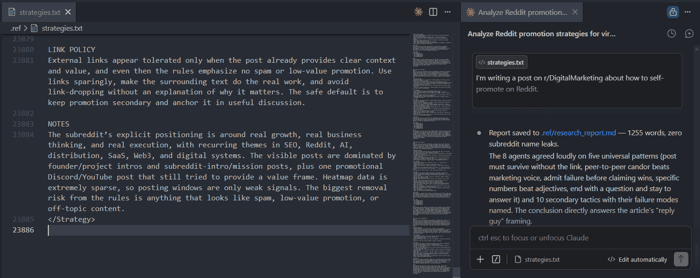
Decided to use my side project with an idea: take top 100 posts per month + top 100 per year for a sub, dump rules and description in, and let Sonnet write a "personalized writing strategy" per subreddit. After ~2k subs cached, I got curious and pointed Claude Code with Opus at the almost 500 most popular ones, split into 60 chunks, spawned 8 agents to consolidate patterns. Below is what actually fell out, not what marketing blogs keep repeating.
The 5 patterns that showed up in almost every slice:
- The post has to be worth reading with the link removed. If the value depends on the click, it gets pulled. Every time.
- Lead with what happened to you, not what you sell. "I tried X, I'm Y months in, here's what I'm seeing" beats any hook a copywriter would write.
- Admit what failed before you mention what worked. Self-deprecation outperforms confidence, consistently.
- Ship numbers, not adjectives. "$2,847 in 67 days" reads as a receipt. "$3k/month" reads as a slide. "Life-changing", "10x", "game-changing" are AI-spam tells in every chunk of the corpus.
- End with a question and stay in the thread for the first 24h. Posts framed as community consultation beat posts framed as announcements.
A few smaller ones that surprised me: stop asking for DMs (flagged as a removal trigger in dozens of niches), skip urgency theater ("limited spots", "first 10 only"), and put links in comments when the sub is link-skeptical - readers will scroll to find it if the body earns it.
The thing nobody says out loud: Reddit doesn't hate promotion, it hates the reply guy who optimizes for visibility while the platform optimizes for relevance. Disclosed affiliation beats hidden affiliation. Transparent monetization beats opaque monetization. If the post would still be worth reading with the CTA stripped out, you've earned the CTA. If not, it's not ready.
Anyone here seeing different patterns in your own niche? Curious where this breaks - especially in heavily moderated subs where even the "useful post" route gets nuked.
The project is Achiv - Reddit Viral Writer Copilot: https://achiv.com

The multi-agent chunking approach is the right call for this scale. I use a similar structure when I have Claude Code do live analysis rather than cached snapshots -- for subs with active moderation drift, I have browser-act grab freshly rendered post scores since the rendered page catches shadow-removed posts that still show a score in the API. Cached data misses that. Did your 2k-sub snapshot pick up removal signals cleanly, or is that a gap you're still working around?
Spot on. The "reply guy" problem isn't unique to Reddit; it plagues outbound teams everywhere who are chasing visibility over real engagement. As a RevOps leader focused on early to mid-stage acquisition, you know that linking replies directly to pipeline is critical. If you constantly wonder which conversations are actually converting, you're probably spending too much time on manual updates instead of optimizing what truly works. Getting that clearer visibility means better credit where it’s due and less guessing about your acquisition strategy. Worth a thought if you're battling that manual work and visibility gap.
The pattern you're describing - automate data collection, apply human attention to interpretation - scales across data types. We've been running the same approach with legislative data: goffer.ai monitors Congress for our keywords, auto-labels matching bills in Gmail by topic, sends SMS for floor votes. What was 45 min/day of manual checking compressed to a 5-min digest review. The win is the same as yours: you stop spending research time on mechanics and start spending it on the actual question.
The pattern you're describing - automate data collection, apply human attention to interpretation - scales across data types. We've been running the same approach with legislative data: goffer.ai monitors Congress for our keywords, auto-labels matching bills in Gmail by topic, sends SMS for floor votes. What was 45 min/day of manual checking compressed to a 5-min digest review. The win is the same as yours: you stop spending research time on mechanics and start spending it on the actual question.
Using Claude Code to do the analysis itself (not just write the scraper) is the part that's underrated here. Most people stop at extraction and then eyeball the spreadsheet. Did you find the patterns held up across niches, or were the 'what works on Reddit' rules basically subreddit-specific with a thin shared layer on top?
i run content across chinese and english platforms and one thing that jumps out is that the "strip the link and the post should still work" rule applies even harder for non-native english speakers. when you're writing in your second language every word costs more effort so the tendency is to shortcut straight to the pitch. the posts that worked for me were the ones where i wrote the whole thing as a stackoverflow-style answer and only dropped the tool name when someone asked in the replies. pattern #5 (stay in the thread 24h) is underrated. i got more traction from 4 followup replies than from the original post body.
Interesting breakdown - especially the point about “the post should still be worth reading with the link removed.” That resonates a lot.
I’m currently launching an MVP and already noticed something similar: posts framed as “here’s the frustrating workflow I kept running into” seem to get much better reactions than anything remotely promotional.
One thing I’m curious about: did you notice meaningful differences between technical/builder subreddits and more mainstream consumer ones?
Feels like in founder/dev communities transparency and “here’s what failed” works really well, but in broader consumer subs people sometimes react more to novelty or strong emotion than numbers.
This actually explains a lot about why some Reddit posts feel “human” immediately while others feel optimized from the first sentence.
The “worth reading even without the link” point is probably the biggest one.
I’ve noticed the same while trying to discuss DocMetrics on Reddit — the moment the value of the post depends on clicking the product, Reddit treats it differently almost instantly.
Also agree heavily on numbers vs adjectives.
Specific observations feel authentic.
Generic excitement feels manufactured.
Curious if you found any patterns around comments themselves though, not just posts. Some threads with average posts seem to explode because the OP handles replies unusually well.
The "lead with what happened to you" pattern is the one that changed how I'm thinking about my own Reddit approach.
I'm about to make my first real posts in r/vinyl and r/flipping for a cross-market alert tool. The story I have is real — I lost a rare Joni Mitchell pressing on eBay UK at 4am Tokyo time, twice, before I built the thing. That's the lead. The tool is almost a footnote.
One thing I'm curious about: did the data show any difference between niche collector subs (r/vinyl, r/PokemonTCG, r/Watches) vs. broader ones? My instinct is those communities are even more allergic to anything that smells like promotion — but the flip side is the pain is so specific that a genuinely useful post might land harder.
This is much stronger than a “Reddit writing copilot” if you frame it around subreddit-specific market intelligence. The useful part is not just helping someone write a post. It is decoding what each community rewards, rejects, flags, and trusts before the founder wastes weeks posting into the wrong tone.
The “worth reading with the link removed” rule is probably the core positioning hook. That gives Achiv a cleaner promise: not viral copy, but promotion that survives moderation because it is built around community value first.
One thing I’d watch is the name Achiv. It is short, but the spelling feels slightly compressed and may not immediately carry the GTM workflow layer behind the product. If this expands beyond Reddit writing into a broader founder distribution system, Xevoa .com would probably feel cleaner and more scalable than a name that sounds like a writing-assistant shortcut.
The methodology here is the part I found most interesting — splitting 500 subs into 60 chunks and spawning 8 consolidation agents is essentially a map-reduce pattern applied to qualitative data. That's not a common approach for this kind of analysis and it probably explains why the output feels different from what you'd get reading a few hundred posts manually.
The pattern about 'ship numbers not adjectives' maps directly onto what I see in BI/analytics work — dashboards that show '$2,847 in 67 days' get acted on; dashboards that say 'strong revenue growth' get ignored. Specificity is what makes data trustworthy, whether it's a Reddit post or a CFO report.
Curious whether you saw any patterns break down differently in technical subreddits vs. business/founder ones — my guess is technical communities are even more allergic to adjectives and urgency theater.