I Bet on Godot's 10% Instead of Unity's 40%. Here's Year 3.
Three years ago I picked a market that everyone told me was too small. I built an AI coding assistant for Godot, a game engine that has roughly 10% of the indie market against Unity's 40% and Unreal's 30%. Investors I talked to politely asked why I wasn't building "Cursor for Unity". Here is what the bet looks like from the inside in 2026.
The pitch everyone told me was wrong
When I started, the logic against Godot was simple. Unity had 1.5M active developers. Godot had maybe 150K. Why build for the smaller market?
The logic for Godot was less obvious and took me longer to articulate.
Godot is growing fast. GMTK Game Jam entries in Godot went from 19% in 2021 to 39% in 2025. Steam releases made on Godot tripled between 2023 and 2026.
Unity burned its trust. The 2023 Runtime Fee announcement hit every Unity-dependent business at once. Mega Crit rewrote Slay the Spire 2 on Godot and earned $108M in its first month on the new engine. They are the headline, not the only story.
Godot users are underserved. Unity has Cursor, GitHub Copilot, and a dozen asset-store plugins. Godot has basically none of that because the market is small enough that generic tools do not bother tuning for it.
The bet was that the smaller market was also the less-served market, and that the growth rate would close the absolute size gap within a few years.
What I got wrong in month one
I thought "Godot devs want AI tools" was one problem. It is three.
1. Indie Godot devs. Solo or small team. Price-sensitive. Want something that just works. They buy if the trial shows value in the first 30 minutes.
2. Studios evaluating Godot. Medium team, 5-50 people. They want enterprise features like team context sharing, on-prem options, and compliance answers. They buy on a 3-6 month evaluation cycle.
3. Unity migrators. Teams actively moving off Unity. They want specific migration workflows. They buy fast if you show them the migration path is shorter than they thought.
I built for indie devs first because it was easiest. That was right. What I got wrong is I assumed the other two segments would be "later problems". They showed up in month two asking about features I had not built, and I was not ready.
The 90-day content experiment
Last quarter I ran an experiment that felt silly at the time. I would automate blog publishing across 10 platforms simultaneously, daily, using a single orchestrator. Sites: ziva.sh, Substack, DEV.to, Indie Hackers, Hashnode, plus international platforms in Japanese, Korean, Vietnamese, Arabic, and others.
Rules:
- Each platform picks its own topic, no shared content
- Each platform does its own SEO research
- All posts published same day across platforms
- No human review between platforms (the whole point was to see if it scaled)
What I learned:
- Organic search is where the traffic is. Direct traffic from posts is tiny. Google indexing the posts 2-6 weeks later is where the compounding happens.
- International platforms outperform per capita. A post on Korean Velog or Japanese Qiita gets 20-100 visitors on publish day. A comparable DEV.to post gets 50-300. But the international SEO window is less competitive, so a month later the Korean post is still getting traffic while the DEV.to post has decayed.
- Indie Hackers is the highest-conversion platform. 1000x smaller audience than DEV.to, 10x better trial-to-paid conversion. Founders who click through have higher intent than drive-by devs.
- The LLM citation effect is real. After 60 days of publishing, "Godot AI assistant" queries on Claude and Perplexity started surfacing my content as citations. That drove signups I could not attribute to any specific post.
The pricing lesson
I launched at $15/month. A founder friend told me I should charge $40. I said "my users are indie devs, they will not pay $40".
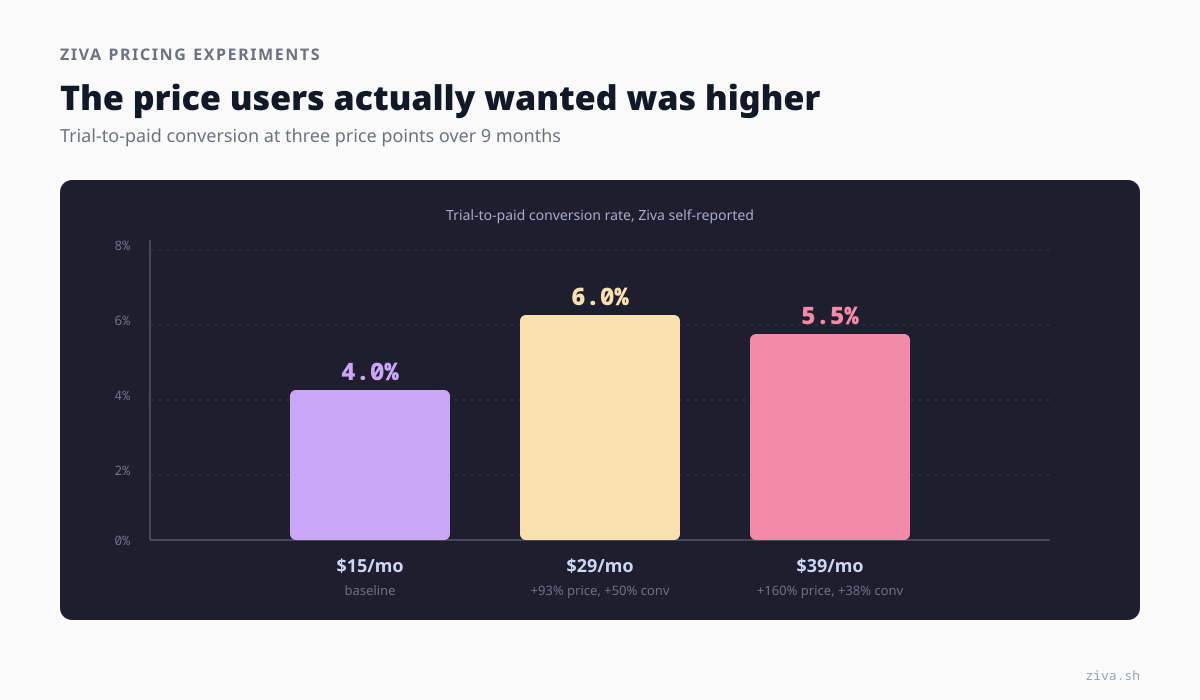
I was wrong. I raised prices twice, both times with less churn than expected. The users who really wanted the product were not the ones price-shopping. The ones who were price-shopping were not converting anyway.
Concrete numbers: at $15, trial-to-paid was 4%. At $29, it was 6%. At $39, it was still 5.5%. The market did not punish the increase nearly as much as I feared.
What I would do differently
Three things.
Build for migrators on day one. The Unity-to-Godot migration story was already starting when I shipped. Having a specific "here is your 2-week migration plan" would have caught more studios earlier.
International content sooner. I waited a year before expanding beyond English. That was a year of free SEO real estate I gave to competitors who had not published there yet.
Charge more at the start. Not 3x. But the initial $15 price point was leaving money on the table and signaling "hobbyist tool" when the product was worth more than that to the right users.
The bet, three years in
The short version: betting on a smaller, faster-growing, less-served market is working. Not as fast as a "Cursor for Unity" would have worked in terms of raw audience size, but the conversion economics are better because the users have fewer alternatives.
The risk was always that Godot growth would stall and the market would stay too small. What actually happened is Unity's self-inflicted wounds in 2023 permanently moved the trajectory. The addressable market is bigger now than my pessimistic case was when I started.
If you are thinking about a similar bet on a niche platform with fast growth, I would tell you this: the "too small" objection is usually wrong when the growth rate is 2x+ annually. Absolute market size three years out matters more than size today, and growing markets give you room to figure out positioning before competitors show up.
If you are a Godot dev and want to try what we built, ziva.sh. Free tier is enough to see if scene-aware AI is meaningfully different from whatever you were using before.
