I Built a Bot That Trades Polymarket Instead of Predicting It (BTC 15min market)
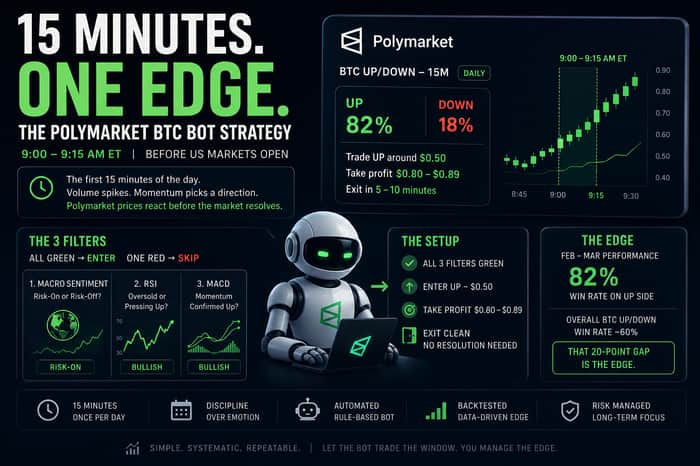
Most people use prediction markets like Polymarket to make a prediction and wait.
Buy YES.
Buy NO.
Wait hours—or even days—for the market to settle.
I started wondering if that was the wrong way to think about it.
Instead of predicting the final outcome, could you make money from how the market reprices before it resolves?
That question led me down a rabbit hole of historical data, backtesting, and eventually an open-source trading bot.
The Idea
One thing stood out while analyzing Polymarket's Bitcoin Daily UP/DOWN markets.
The period just before the U.S. stock market opens—roughly 9:00–9:15 AM Eastern Time—looked unusually active.
During those minutes:
- Bitcoin volume often increases.
- Momentum accelerates.
- Prediction market prices adjust quickly.
- Traders react to overnight news and macro events.
That creates something interesting.
You don't necessarily need to know whether Bitcoin will finish higher today.
You only need to identify when the market is repricing faster than expected.
If the contract moves from $0.50 to $0.60, you can potentially sell before settlement.
The trade is about capturing momentum—not predicting the final result.
Turning an Observation Into a System
Rather than manually watching charts every morning, I wanted a process that could be tested objectively.
The strategy became simple:
- Watch the market before 9:00 AM ET.
- Check whether momentum conditions are aligned.
- Enter a position only if every filter agrees.
- Exit once a predefined profit target is reached.
- Avoid holding contracts until settlement whenever possible.
Everything follows rules.
No discretionary decisions.
That makes it easy to automate—and even easier to backtest.
The Three Filters
The bot doesn't trade every morning.
It waits for confirmation from three independent signals.
1. Macro Market Sentiment
The first question is whether the broader market agrees with the trade.
The system looks at signals such as:
- Bitcoin price action
- Equity index futures
- Dollar strength
- Volatility indices
- Major macroeconomic events
If macro conditions don't support the trade, nothing happens.
Sometimes the best trade is skipping the day entirely.
2. RSI
Next comes Relative Strength Index.
Instead of buying every dip, RSI helps determine whether momentum is beginning to recover—or whether the move is already exhausted.
3. MACD
Finally, MACD confirms whether momentum is actually strengthening.
Only when all three filters agree does the bot generate a signal.
No single indicator is trusted on its own.
Building the Bot
Once the strategy was defined, automation became straightforward.
The architecture looks something like this:
Exchange Data
        │
        ▼
Technical Indicators
        │
        ▼
Signal Engine
        │
        ▼
Polymarket API
        │
        ▼
Order Execution
        │
        ▼
Position Monitoring
        │
        ▼
Logging & Analytics
Automation removes the hardest part of trading:
emotion.
The bot follows the exact same rules every day.
Backtesting Before Trading
One lesson I learned early is that almost every trading idea looks good until you test it.
Backtesting forces you to answer uncomfortable questions.
- How many trades were actually taken?
- What happens after fees?
- How much slippage exists?
- What's the maximum drawdown?
- Does the strategy still work on unseen data?
A high win rate means very little without understanding those numbers.
Historical performance is useful because it helps eliminate bad ideas before risking real capital.
What I Built
The project eventually became an open-source repository containing several Polymarket trading bots, strategy experiments, and tools for researching short-term prediction market behavior.
It includes:
- automated signal generation
- historical testing
- indicator calculations
- API integrations
- experimental trading strategies
- ongoing research into short-duration market inefficiencies
It's still evolving, but open-sourcing it has led to useful feedback and new ideas from other developers.
Why I'm Interested in Prediction Markets
Prediction markets are still relatively young compared to traditional financial markets.
That means there's plenty of unexplored territory.
Most participants focus on forecasting outcomes.
I'm more interested in studying how prices move before those outcomes are known.
Sometimes the opportunity isn't being right about the final answer.
It's recognizing when the market is repricing faster than everyone else.
Whether that edge lasts is an open question—and that's exactly what makes it interesting.
What's Next?
I'm currently exploring:
- multi-asset confirmation strategies (BTC, ETH, SOL)
- sub-second historical replay
- cross-market arbitrage
- volatility clustering
- AI-assisted signal generation
- more robust backtesting tools
Every experiment answers one question and usually creates five new ones.
That's part of the fun.
Open Source
If you're interested in prediction markets, algorithmic trading, or just curious about how these systems are built, the project is open source.
GitHub
https://github.com/Benjam1nCup/Polymarket-trading-bot-python-V2
There are multiple experimental bots, strategy implementations, and ongoing updates as I continue testing new ideas.
Demo Video
https://www.youtube.com/watch?v=Yp3gpNXF2RA
I'd Love Feedback
This project started as a simple curiosity:
"Can you trade the repricing instead of the prediction?"
It's grown into a collection of bots, backtests, and research experiments, and there's still plenty left to explore.
If you've built algo trading systems, worked with prediction markets, or have ideas for improving the strategies, I'd love to hear from you.
You can also reach me on Telegram:

I like the shift in perspective here. Building an automated execution system is often more challenging than generating signals. In production, reliability, observability, risk controls, and continuous monitoring become just as important as the underlying strategy.