I built a browser-based photo geotagging tool. What should I lead with?
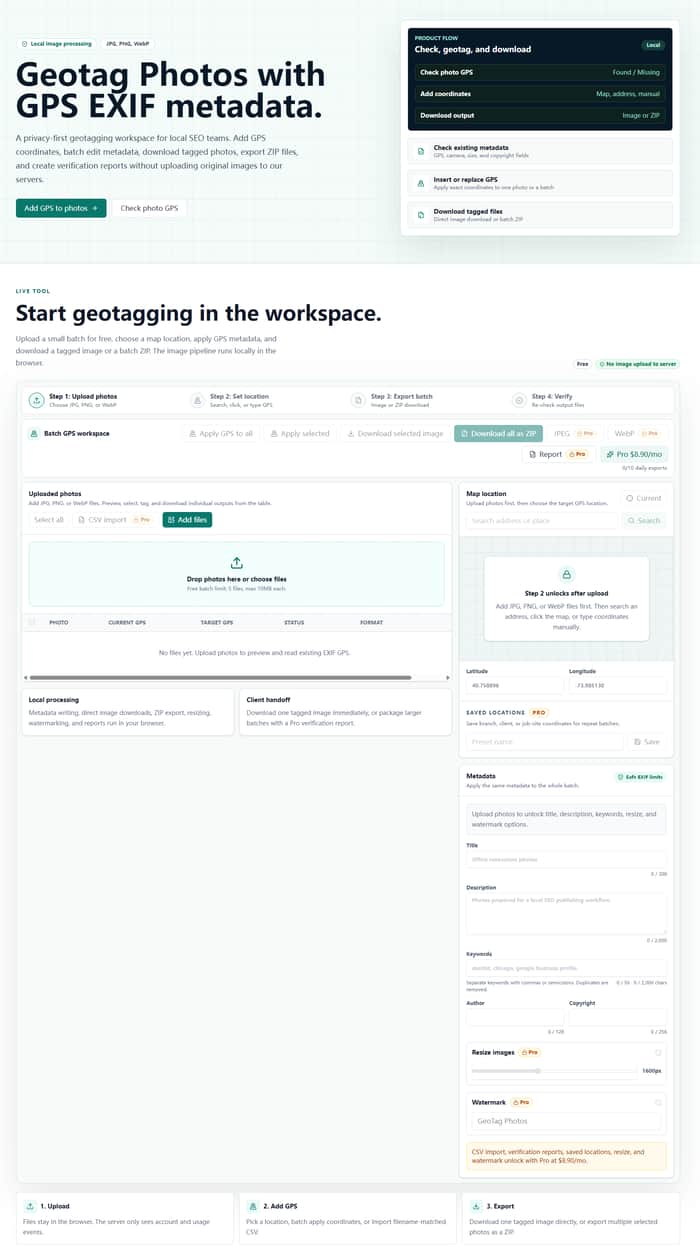
I'm building GeoTag Photos: https://geotagphotos.app
It reads existing EXIF GPS data, lets you add or replace coordinates, and exports tagged photos individually or as a ZIP. It's mainly built for local SEO teams, photographers, and people processing location-based image batches.
Image processing happens in the browser, so original photos aren't uploaded to our servers.
One thing I learned while building it: writing latitude and longitude is the easy part. Compatibility is messy. JPEG is the safest format for GPS EXIF. PNG and WebP can store metadata, but other platforms may not read it consistently. That's why I added output verification and client reports instead of simply showing a "done" message.
The free plan supports 5-photo batches and 10 exports per day. Paid features include 50-photo batches, CSV import, address search, saved locations, resizing, watermarks, and reports.
I'm still working out the positioning. Which message would make you pay attention?
Your original photos stay in the browser.
Batch geotagging built for local SEO work.
Verified exports and reports for client handoff.
I'd especially value feedback from anyone running a local SEO agency or handling repeated photo workflows. What sounds useful, and what sounds unnecessary?

The privacy angle is a feature, the SEO workflow is the actual job, and the verified export might be the thing agencies pay for. Those are three different products pretending to be positioning options for one product. The comment about describing it one step earlier in the workflow than where the value lands is the sharpest thing here. If agencies are paying for proof they can hand to a client, that's not a geotagging tool anymore, that's a deliverable generator that happens to use geotagging as the mechanism.
The reason none of the three messages feel right is that each one is describing a different buyer in a different moment — and they're not equally ready to pay. The "verified export for client handoff" angle is the sharpest, but it only converts if the agency has a client currently pushing them for GPS proof right now. Worth knowing which agencies are actually in that moment before committing to a message.
I'd keep "local SEO" in the first line so people immediately know who it's for, then use verification as the reason to choose it: "Batch geotagging for local SEO, with verified exports your clients can check." Privacy feels more like supporting proof than the headline.
Before settling on the copy, I'd ask five agency users what they send a client after a batch is finished. If the answer is screenshots, spreadsheets, or a bunch of back-and-forth, the report may be the thing they're paying for. In that case, I'd put the report much higher in the paid plan messaging.
I think it’s a well-built tool, easy to navigate and does the job smoothly. What I’m struggling with is understanding who it’s really for.
I see two broad user groups here. First, people who care deeply about privacy. They usually prefer removing metadata rather than adding anything new, especially something like geotagging.
Second, organizations or individuals who actually need this kind of information, like banks, survey teams, government bodies, or service providers. But in their case, they’re more likely to trust data that comes directly from the device that captured the image, rather than something added later.
So I feel like I might be missing the actual target audience here, or maybe there’s a specific use case I’m not seeing yet.
The part that caught my attention is that the post starts as a geotagging tool, but most of the story is actually about everything that happens after the coordinates get written.
Writing the metadata sounds like the easy part.
The thing you seem to have spent most of your time solving is making sure the result survives contact with the real world.
"Survives contact with the real world" is probably a better description of the product than the one I started with.
Geotagging is the easy entry point to explain, but a file containing coordinates isn't useful if the next platform can't read them or the client can't verify what was delivered.
I may be positioning the product one step too early in the workflow. Would "verified geotagged photo delivery" make the value clearer, or would you still lead with geotagging?
I don't think I'd feel comfortable giving a confident answer in a thread.
What makes it interesting to me is that those aren't just two different descriptions—they imply very different ideas about where the product's value actually starts.
I've got a few thoughts on that, but it's probably more than I'd unpack properly here.
What's the best email to reach you on?