I Built a Habit Tracker SaaS Alone in 6 Weeks (No CS Degree, No Team). Here's Exactly How
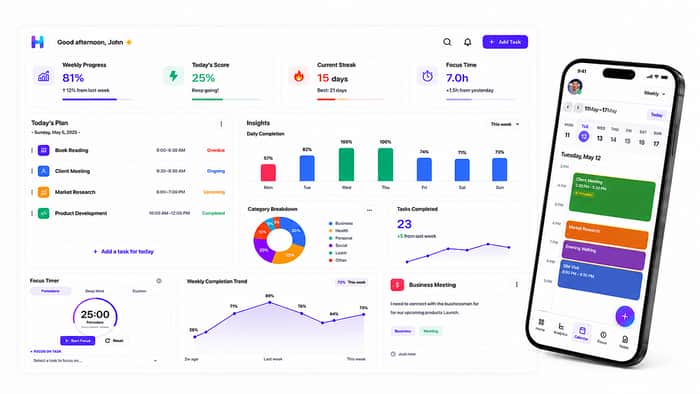
I'm a Product/Project Manager by profession. Not an engineer. But recently, I shipped a complete SaaS product...solo. Design, frontend, backend, deployment, branding, all of it.
Here's the honest breakdown of how it happened, what broke, and what I'd do differently.
Why I Built HabiTracks
I kept downloading habit trackers, using them for 3 days, and abandoning them. The problem wasn't motivation, it was that those apps tracked actions but gave me no sense of progress. No momentum. No insight into patterns.
I got frustrated enough to build my own in Excel. That's when I knew I had to build the real thing.
The product idea in one line: A personal growth system where consistency beats motivation with streaks, heatmaps, behavioral insights, and an smart insight Coach built in.
The Stack
I'm not a trained engineer, so I leaned heavily on AI-assisted development:
→ Frontend: React + Tailwind
→ Backend/DB: Firebase
→ AI assistance: Claude (heavily)
→ Design: Stitch/ChartGPT
→ Deployment: Vercel
Total cost to ship v1: essentially $0 beyond domain + hosting.
What Actually Happened (The Honest Part)
Nobody talks about this stuff, so I will:
→ I redesigned the same screen 7 times because something felt off
→ Had a bug that only appeared in light mode on mobile took me a full session to track down
→ Spent more time fixing deployment issues than building features some weeks
→ Waited 4.5 hours for Claude token resets to continue building
→ Some weeks felt like pure progress. Some felt like I went backwards.
Solo building is non-linear. That's just the reality.
What I Shipped (v1 Features)
→ Habit tracking with streaks, heatmaps, and analytics
→ Smart Insight Coach spots your patterns and weak areas
→ Schedule Manager + Focus Timer + Quick Notes
→ Weekly growth summaries
The Biggest Lesson is...
I thought I'd come out with better technical skills. I didn't expect it to change how I think.
Building alone forces you to hold every role simultaneously product, design, engineering, QA, DevOps. That context-switching is brutal at first. But it gave me a level of product intuition that no PM course ever could. As a PM professionally, I now understand what I'm asking engineers to do in a completely different way.
Current Status
✅ Live at www.habitracks.com
✅ Free to use (collecting feedback, iterating)
🔄 Working on v2 features based on early user feedback
No revenue yet being transparent. The goal right now is users and feedback before monetization.
Would I Do It Again?
Yes. Immediately.
Not because it was easy it wasn't. But because shipping something real, alone, end-to-end, builds a kind of confidence that's hard to get any other way.
If you're a non-technical founder or a PM thinking about building just start. The first version doesn't need to be perfect. It needs to exist.
Happy to answer questions about the stack, the AI workflow, or the PM-to-builder transition. Drop them below.
👉 www.habitracks.com — free to try, feedback welcome.

Also using goffer.ai as the data layer. The main thing it handled was the event detection logic - identifying when a bill crossed a meaningful threshold (committee assignment, floor vote scheduled, vote result) rather than just detecting any change on the Congress.gov record. That saved probably 3 weeks of engineering time. We are feeding the webhook output into a Postgres table and running our own queries on top of it. If you are building something that needs amendment tracking or hearing dates, the structured output covers those too.
The PM-to-builder transition you described is something I don't see talked about honestly enough. Most posts are either "I learned to code in 3 months" success stories or "I hired a developer" — the middle path of building with AI assistance while figuring it out in real time is much more common than people admit.
The bit about understanding what you're asking engineers to do differently now — that's probably worth more than the product itself long term. That context is genuinely hard to get any other way.
One thing I'm curious about: Firebase as a backend for a SaaS with behavioral analytics — did you hit any limitations there, or did it hold up fine for what you needed? I've been going back and forth on Firebase vs PostgreSQL for a similar project and the habit/streak data model seems like it could get complex fast.
Congrats on shipping. The light mode mobile bug hunt alone would have made most people quit.
Really appreciate this. You captured exactly what I was trying to say. I think a lot more people are in that messy middle of “building with AI while figuring it out” than we admit.
On Firebase: it’s held up well so far because speed mattered more than perfect architecture. If I were building something more analytics-heavy long term, I’d probably lean PostgreSQL/Supabase.
Congrats on shipping — that first solo launch builds a muscle nothing else can. I went through something similar building briefpeak, and the one thing I wish someone told me earlier: don't wait too long on monetization. Even a $5/mo tier tells you something feedback forms never will — whether people value it enough to pay. We waited almost 3 months to charge anything and it completely changed which features we prioritized once real money was on the line. Are you seeing any patterns yet in what users are asking for in v2?
Thank you so much for the suggestion and for sharing your experience, really valuable insight. I completely get your point about monetization.
For now, the plan is to keep it free for the first month. The goal is to gather user feedback, understand pain points, improve the product, and fix bugs before introducing a paid plan.
I’m already noticing some early patterns in feedback for v2, so just listening, learning, and improving for now 😄 Really appreciate the advice, man.
Huge respect for shipping this! For a V1 product from a solo builder without a CS degree, this is seriously impressive.
I do have a piece of feedback regarding the onboarding: I was a little lost on how to actually start using the tool when I first logged in. Would you consider adding small info pop-up icons (tooltips) for each section? I think that would make the experience much clearer for new users!
Hey Yen....I've implemented onboarding guidance today. When you sign up, you'll be guided through the key actions to help you get started quickly. There's also a Help & Support section in Settings where you can access the product guide and onboarding resources anytime.
Thanks for taking the time to share your thoughts!
Hey, thank you so much for using the product and sharing your suggestions. I really appreciate it. I’m noting everything down and will definitely work on improving it. Please keep exploring the product and sharing your feedback, it really helps. Thanks again, man ❤️
Give UUMuse a try. It’s an all-in-one knowledge base with cited answers across all AI models. Upload files once, switch LLMs freely and deploy anywhere. It can handle nearly all your needs with just one click. Search for UUMuse if you want to experience it.
Looks like it is a shopping website
One more habittracker why man why ?
You’re right, there are a lot of productivity apps out there. I built this because most tools felt overwhelming or hard to stay consistent with.
My goal is to make things simpler and help people actually follow through, not just track tasks. That is the reason i built this.
thats gret let see how this goes can make small video for on YTD, Insta just wants tag you there
alright
hahahah feel you completely. I built mine aswell solo and the claude token limits is what always got me
yeah true :)....have you got any hack for the claude token limit thing?😂
Well not particulary but i built it via antigravity which automatically helps with managing tokens and also if you install some skills to reduce the unnecesary output it helps a bit.
That 's sound great man
Really respect the honesty in this post. The part about habit trackers tracking actions but not creating a sense of momentum is so true. Huge respect for shipping a full product solo and learning through the messy process instead of waiting for perfection
Thank you so much for this. Means a lot.
Btw, I’d really appreciate it if you could give Habitracks a try and share your honest feedback, it would help a lot in improving the product.
Please check it out here: www.habitracks.com
The product diagnosis is the sharpest part of this post. "Tracked actions but gave no sense of progress" is exactly why most habit apps fail. People don't quit because they lack discipline — they quit because the app never makes them feel like anything is accumulating. That's a behavioral insight most founders miss.
The PM-to-builder shift is underrated too. You said it changed how you think, not just your technical skills. That's the real outcome. I've seen PMs who've shipped their own thing come back to cross-functional work completely differently — they stop writing specs that assume things are easy.
The 4.5 hours waiting for Claude token resets made me laugh. That's the most honest solo-builder detail I've read in weeks. No one talks about it but everyone who's building this way has sat there watching that counter.
What does your early feedback look like so far? Are users engaging with the streak/heatmap features or the Smart Insight Coach more?
I’m still in the early stage and working hard to bring more users to the landing page, as distribution is currently limited.
I’d really appreciate it if you could give Habitracks a try and share your honest feedback, it would help a lot in improving the product.
Please check it out here: www.habitracks.com
Your diagnosis of why existing habit trackers fail is spot on — tracking actions without giving a sense of progress is exactly the drop-off point for most people. It's the difference between logging data and actually feeling momentum. Curious about the Smart Insight Coach: is it proactively surfacing patterns (like "you tend to skip on Wednesdays") or more of a reactive query tool? Also, the observation about the PM-to-builder transition changing how you think is underrated — there's something about owning a production deploy end-to-end that shifts your intuition in a way no amount of sprint planning can replicate.
Great question. The Smart Insight Coach is more of a proactive pattern recognition system rather than just a reactive query tool. It analyzes your weekly habit and task data to surface meaningful insights automatically, such as:
• Which days you perform best (and where consistency drops)
• Which hours of the day you're most productive
• Which task categories you tend to miss more often
• Where you're investing the most time and energy
• What tasks are left for today and what should be prioritized tomorrow
The goal is simple: move beyond just tracking actions to helping users understand patterns and build momentum. Instead of staring at raw data, users get actionable insights that help them improve week by week.
That's exactly where I'm headed with LifePilot too — the pattern recognition layer is already on the roadmap. The "which hours you perform best" and "where consistency drops" insights are what turn a task tracker into something that actually changes behavior over time.
Curious about your distribution since we're building in similar territory — not the initial launch spike, but the steady daily growth. What are you doing to get a consistent 1-2 new downloads per day over time?
I’m currently using different social media platforms especially Threads, X (Twitter), and Medium to bring traffic to the platform. Since I’m still in the early stage, I’m focused on building distribution and learning from real user feedback.
I’d really appreciate it if you could give Habitracks a try and share your honest feedback, it would mean a lot and help improve the product.
Check it out here: www.habitracks.com
Happy to try Habitracks and share honest feedback — would love the same in return. Give LifePilot a try at https://getlifepilot.org/ and let me know what you think, especially around the daily planning flow.
Sure man
That line about sitting there for 4.5 hours waiting for the Claude token reset hits way too close to home. The AI-assisted workflow is an incredible superpower, but people don't talk enough about the mental whiplash when your 'co-pilot' suddenly cuts you off right in the middle of a complex debugging loop.
Your breakdown of the non-linear reality is spot on. One day you feel like an absolute genius shipping features in minutes, and the next day you spent an entire afternoon tracing a bizarre mobile CSS layout issue that only happens in light mode. Massive respect for pushing through that context-switching hell and getting V1 live. The product intuition gained from managing your own dev-ops and QA is worth more than a decade of corporate PM meetings.
Appreciate this a lot....you described the reality perfectly 😅 The AI workflow feels like a superpower until it suddenly stops mid-debugging.
That exact pain is one of the reasons I’m building Habitracks, to reduce the chaos, create clarity, and help people stay consistent even through the messy, non-linear journey of building and growth. V1 was just the beginning.
Using a habit or consistency builder to tame the chaos of independent shipping is actually a genius angle. When you're a solo founder, the hardest thing to manage isn't the stack or the marketing pipeline—it's your own psychology.
When an unexpected API block or a broken layout pass throws you out of flow state, it doesn’t just cost you hours; it drains your baseline motivation for the next day. Building something that acts as an anchor to keep you showing up through those messy, non-linear dips is exactly what prevents early-stage burnout. V1 is a huge milestone, man. Looking forward to seeing how you scale the habit mechanics to fight that shipping fatigue!
Wow Eva, this is such a thoughtful perspective and honestly, you explained it better than I could. As a solo founder, the biggest battle is often with your own psychology, especially during those messy moments when things break and motivation takes a hit.
I’d really appreciate it if you could give Habitracks a try and share your honest feedback, it would help a lot in improving the product.
Please check it out here: www.habitracks.com
Appreciate the kind words, Rahul! I'll absolutely head over and play around with the interface.
One specific angle I'm genuinely curious to look at while testing is how it tackles habit-triggering during deep execution mode. For most independent builders, standard time-based reminders (like a notification at 4 PM) just get swiped away when we are stuck in a messy database refactoring or debugging a broken webhook. If a consistency tool can anchor habits to behavioral states or direct progress milestones instead of rigid clock times, it becomes an absolute game-changer for developer psychology.
I'll dive in this week and drop you a clean, bulleted breakdown of what felt intuitive and where the friction points are. Congrats again on getting V1 out in the wild!
I completely agree that fixed-time reminders alone often get ignored during deep work.
With Habitracks, we currently support fixed-time reminders, but we also go beyond that through real-time insights. For example, the product helps users understand what task is next, whether their streak/track is at risk, how much they’ve completed today, and how today compares with previous days or this week overall.
The goal is to make consistency more contextual and actionable, not just another notification that gets swiped away. Your point around behavioral-state or milestone-based triggers is super interesting as well definitely something worth exploring further.
Also, really appreciate you taking the time to dive in this week and share a clean breakdown of what felt intuitive vs. where the friction points are. That kind of honest feedback is incredibly valuable while improving V1.
Thank you for that.
The context-switching pain is real. I'm also building solo with no CS background. Biggest lesson so far — deciding what NOT to build is harder than building. What made you pick habit tracking specifically?
Actually, I’ve always believed in systems. Lists, routines, small daily actions that compound into something meaningful over time. But my own experience with habit trackers was consistently disappointing.
I’d download one, get excited, use it for three days, feel overwhelmed by the interface, and quietly forget it existed. Two months later….new app, same cycle. I even started building my own trackers in Excel, which tells you how frustrated I was.
I wanted something that felt less like a checkbox and more like a mirror.
So, I decided to build it myself.
The Claude token-reset wait hit close to home. I build with Claude Code a lot too, and the bottleneck that surprised me wasn't the AI. It was my typing speed. Jumping between Claude, the IDE, notes, and docs meant half-formed thoughts kept dying in the context switch.
I built DictaFlow, a hold-to-talk dictation app for Mac, Windows, and iOS, for exactly that. Hold a hotkey, speak, and it types wherever your cursor is. When I'm deep in Claude and realize I need to save something for later, I just say it instead of switching windows to type it.
The Quick Notes feature is smart. Fast capture is one of those things solo builders don't realize they need until it's there. If typing friction is part of your context-switching pain, DictaFlow might help: dictaflow.io
That’s great, man. I’m not a big fan of typing either, so I use Wispr Flow, it’s a great tool. Just hold Ctrl + Windows key, say something, and it types it for you instantly.
Good to know you built DictaFlow sounds really interesting.
The strongest part here is not “habit tracking.” It is the shift from tracking actions to showing progress, patterns, and momentum.
That matters because habit apps are extremely crowded. Most people do not quit because they cannot check a box. They quit because the product stops feeling meaningful after a few days. Your better angle is personal growth feedback: streaks, heatmaps, weak spots, weekly summaries, and an insight coach that makes consistency feel visible.
I’d pressure-test the name before v2 and monetization. HabiTracks is clear, but it also sounds very close to the generic habit-tracker category. That may make the product feel smaller than the actual direction you are building.
Auryxa .com would fit better if this becomes a polished personal growth system, not just another habit tracker. The current name explains the feature. A stronger brand could make it feel more premium, more ownable, and harder to compare directly against every other habit app.
Since you are still free, early, and collecting feedback, this is exactly the stage where the naming decision is easiest to fix before users, content, and v2 positioning lock around HabiTracks.
That’s great, man. I’d really appreciate it if you could try the product and share your feedback, it would be super helpful as we improve and build v2.
You can check it out here: www.habitracks.com
Thanks Rahul, I’ll take a look.
One thing I’ll be honest about: the product feedback that will actually help v2 is probably not just “nice app / bad app.” It is more about the positioning, monetization angle, and whether HabiTracks feels like another habit tracker or a personal growth feedback system.
If useful, I can do a focused v2 naming/positioning audit for you: current name risk, landing page perception, monetization angle, where the product feels generic, and how I’d frame it before v2.
Not a long consulting thing. Just a sharp written breakdown you can actually use.
Since you’re still early and free, I can keep it light at $49.
If that helps, I’ll review HabiTracks properly and give you a clear outside read instead of surface-level feedback.
LinkedIn: https://www.linkedin.com/in/aryan-y-0163b0278/