I built a health platform for my family because nobody has a clue what is going on
Here's what I saw happening in my family:
My dad gets blood work done and sends a photo on WhatsApp.
My mom mentions a doctor visit two weeks after it happened.
I find out about an uncle's diabetes diagnosis at a family dinner.
Nobody has the full picture.
There is simply no transparency, no insights and no understanding.
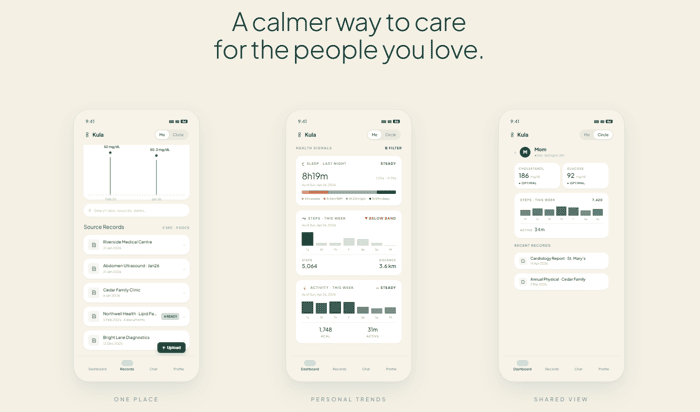
So I built Kula. Upload lab reports (photo, PDF, or just forward them on WhatsApp), connect a wearable, and everyone in the family sees a shared dashboard.
It parses reports, tracks personal baselines over time, and you can ask it questions in plain language: "what's dad's cholesterol trend?" and get a sourced answer.
My family's been using it.
My parents actually told me they'd use it even without me on it just to have everything in one place before doctor visits. That surprised me and changed how I think about the product.
Do you feel the same way about health and family health in particular?
If you have a few minutes, would love for your feedback and thoughts on this. Would you keep using this?
Is there anything critical missing?
What would make you open it again tomorrow?
www.mykula.health

Looks like a really interesting app, is it built for the UK health market ?
It is built to GDPR compliance standards, so YES to the UK.
Once you install the app and are onboarding, you can see the comprehensive privacy and security measures we have in place for health data.
Please do register interest on the website. Would be so happy to have your insight and feedback!
What makes this interesting is that the problem already exists long before the software.
Most families are already managing health information through:
So the real value isn’t just storing reports —
it’s reducing the mental load and fragmentation around family health communication.
The part that stood out most to me was your parents saying they’d still use it without you involved. That’s probably one of the strongest validation signals you can get because it means the product became useful beyond the original “founder solves own problem” phase.
I also think trends/baselines over time are probably more valuable than individual reports because that’s where people start feeling continuity instead of isolated data points.
Thanks for the feedback!
Would you be interested in trying it out? If so, please help us out and register through our website:)
Absolutely — I’ll check it out.
I think there’s a real opportunity here, especially around helping families see continuity over time instead of isolated reports and messages. Looking forward to seeing how the experience evolves.
The detail that stuck with me is your parents saying they'd use it even without you on it. That's the actual product — not the family dashboard, but a personal pre-visit prep tool that happens to be shareable.
I'd gently push back on "family transparency" as the wedge though. In my own family, the reason no one shares isn't tooling — it's that health stuff is loaded. My mom would absolutely upload her labs for herself, but "share with everyone" is a different emotional ask. The shared dashboard might be the eventual outcome, not the entry point.
If I were poking at this, I'd wonder whether the killer loop is: forward report on WhatsApp → get a plain-language summary back → optionally share. The summary is the daily value. The family layer is the network effect once trust is built.
One genuine question — when your parents said they'd use it solo, did they mean the upload-and-track part, or the AI Q&A? Those are very different products and I'd chase whichever one they meant.
Nice work on something that clearly came from a real place.
So you're saying individual first is something that aligns more with what you're thinking with the option to share.
The way the app currently works is it can be used fully as an individual. One has the option to add family members to keep tabs on family members as well.
This is something I went back and forth with a lot and thought the family framing was stronger because a lot of people are simply away from loved ones and needed ways to keep a tab on them. If they consent to it of course.
Please do sign up if you'd like to try it out for yourself! Be glad to have you on board trying this out :)
Love the WhatsApp forwarding feature that is key for getting older parents to actually use it
Yup, that's the goal!
Would love to know any other thoughts you'd have on this or if you'd be interested in using it?
The moment your parents said they would use it without you is the signal.
That means this is not “AI for health data.”
It is family health infrastructure.
That is the stronger product.
Most health tools are built for one patient.
The real problem is shared context across people who are all partially responsible and none fully informed.
That is why this feels stronger than symptom tracking or report summarization.
You are not organizing records.
You are reducing family-side medical ambiguity.
That is the actual pain.
Kula is warm, but probably too soft if this becomes serious longitudinal health infrastructure.
If this keeps moving from “help my family stay informed” toward “shared health memory / family medical system,” Lyriso.com is the stronger long-term name.
Thanks for your feedback. Not sure I understand what you mean by, "Kula is warm, but probably too soft..."
I'm not sure I understand your reframing of the pain point either.
Happy to discuss further
Fair.
What I meant is this:
“Kula” feels warm, personal, and family-friendly. That’s good for the early emotional layer.
But if the product becomes something families rely on over time for medical context, records, decisions, and shared understanding, the trust bar gets higher.
Then the name needs to feel less like a caring helper and more like a durable health system.
On the pain point:
I don’t think the strongest pain is “organizing health data.”
The stronger pain is:
family members not having the same medical context when decisions matter.
One person knows the meds.
Someone else has the reports.
Parents remember symptoms differently.
Kids don’t know the full history.
That creates ambiguity.
So the product isn’t just storing health information.
It’s creating shared medical memory for the family.
That’s why I mentioned Lyriso.com — it feels more suitable if the product grows into a serious, trusted health layer rather than just a warm family app.
I see where you're going with this.
I'd love to get to this stage soon enough. This can drive real impact to users and families.
Naming, I think, can always change to reflect the mission or vision.
Thanks for this insight!
Would love to have you on board to try this out! Please do let me know or simply sign up on the website.
You can use it personally as well with the option to add family to it
Appreciate that.
I’ll take a look.
The reason I pushed on naming is because in health, trust is not something you fix later.
If families are going to rely on this for shared medical memory, the product has to feel serious before they even upload anything.
Kula works for warmth.
But the moment this moves toward longitudinal family health context, the name starts affecting trust, not just branding.
That’s the part I’d keep pressure-testing early, even if the rename happens later.
Makes sense. Building trust right from the get go
Thanks!
Exactly.
In health, trust starts before the first upload.
If the product ever becomes the shared medical memory layer for families, the name will matter much earlier than most founders expect.
Warmth helps people start.
Trust is what makes them stay.