I built a launch coach after my own product launch got 11 upvotes and 3 signups
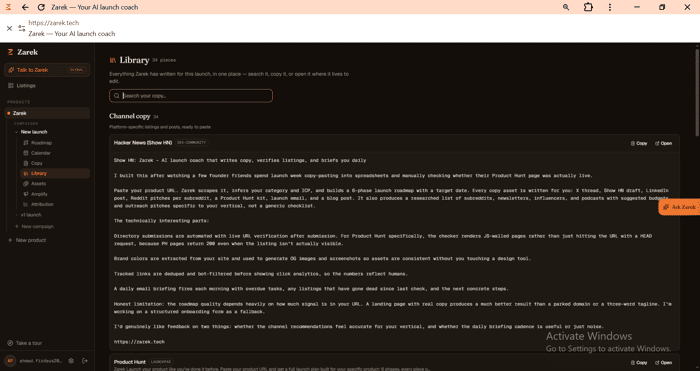
I spent 6 months building a launch tool after watching my own product launch go completely sideways
Last year I launched a SaaS. I had a landing page, a Product Hunt post, and a vague plan to "post in some subreddits." The result: 11 upvotes on PH, three signups (two were me testing), and a Reddit post that got removed for self-promotion within four minutes.
The embarrassing part is I work in product marketing. I know what a launch is supposed to look like. But knowing the theory and actually executing it alone, with no team, no budget clarity, and no one checking your work, are two completely different things.
After that failure I spent a few weeks doing a post-mortem. What actually went wrong:
I had no copy ready before launch day. I was writing my Show HN post at midnight the night before. My Product Hunt tagline was written in five minutes. I posted in the wrong subreddits because I just guessed. Half the directories I submitted to had broken submission forms I didn't notice until weeks later. I had no idea what to do on day two, or day five, or day twelve.
So I built Zarek to solve the problem I actually had.
You paste your product URL. It reads your site, figures out your vertical, and builds a 6-phase launch roadmap calibrated to your actual product, not a generic SaaS template. Every piece of copy gets written: the X thread, the Show HN, the LinkedIn post, the Reddit pitches, the Product Hunt tagline and description, the launch email. It researches which subreddits, newsletters, influencers, and podcasts fit your product and gives you a pitch and a budget for each one. It submits you to directories and verifies every URL is live (including pages hidden behind JavaScript rendering). And every morning it sends you a briefing: what's overdue, what listings have gone dead, what to do today.
The core insight I kept coming back to: the problem isn't that founders don't know they should post on Product Hunt. They know. The problem is the gap between "I should do this" and "I have a good version of this done and out the door." That gap is where launches die.
What worked during building:
The daily briefing turned out to be the feature people responded to most in early testing. Not the roadmap, not the copy generation. The email that shows up and says "you have three overdue tasks and this directory submission returned a 404 yesterday." People told me it felt like having a launch manager. That surprised me.
Vertical-specific channel selection also resonated more than I expected. Founders were tired of the same 30-item checklist that applies equally to a B2B fintech tool and a consumer recipe app. Filtering channels by actual fit made the output feel credible.
What didn't work:
My first version tried to do too much in one session. It would generate everything upfront and dump it on you. People felt overwhelmed and didn't know where to start. Phasing the roadmap and surfacing only what's relevant right now fixed most of that.
I also underestimated how much time I'd spend on directory verification. A lot of submission pages are JavaScript-rendered, redirect silently, or just return 200 with an error message in the body. Getting live-check to actually mean live took longer than the rest of the feature combined.
Pricing is still something I'm working through. I've gone back and forth between a one-time fee (fits the "launch is a moment in time" framing) and a subscription (fits the ongoing briefings and monitoring). Haven't fully committed yet.
The product is live at https://zarek.tech. I'm in the early days of getting real users through it.
For those of you who have launched something in the last year: what was the thing that actually fell through the cracks? Not the thing you knew you should do and didn't. The thing you thought you had handled and then discovered you hadn't. That's the gap I'm trying to close, and I'd genuinely like to know if I'm building toward the right problem.

I also have a product that gets a lot of registrations and trials every day, but I don't see any feedback, let alone any paid subscriptions. I'm wondering if the product isn't what users want or what the problem is, but I have seen some users download the product. I'm unsure how to handle this.
This is a conversion problem, not a product problem — or at least, you can't tell yet which it is.
Registrations and downloads without feedback usually means users aren't reaching the moment where the product clicks. They're signing up, poking around, and leaving before they get value. The gap is almost never "wrong product" at this stage — it's onboarding, activation, or messaging that's off.
Three things worth doing right now:
Find the 2-3 users who downloaded and actually came back. Email them directly. Ask what made them return, not what they liked.
Look at where users drop off in the first session. That's where your real problem lives.
Check if your landing page promise matches what the product actually delivers on day one. Misaligned expectations kill trials silently.
If you're launching or relaunching to get fresh eyes on it, Zarek can help — it builds the full distribution roadmap, writes all the copy, and verifies every step is live. Might be worth a run to make sure the right people are even seeing it.
https://zarek.tech | wangc2016217@gmail.com
Acquisition, no contest. The technical stuff (domain verification, email delivery) was annoying but solvable in an afternoon once I knew what to look for. Finding one real merchant to actually install it has taken weeks — tried Reddit (removed twice), tried cold-posting for beta testers on a couple of platforms, no luck. Where I've landed instead: just submitting straight to the Shopify App Store this week, since merchants there are already actively searching for exactly this, instead of me trying to convince strangers on social media to test something. Curious if you've seen the same pattern — the technical risk is scary until you hit it, but the distribution risk is the one that actually eats the weeks.
My problem is my audience loves free products so I built an hour mail list but nobody bought my dream business programmes! I had to post in Reddit groups to sell my downloadable products and so far I sold two one helps to build an email list thanks to organic marketing on LinkedIn another was how to promote on Instagram.
I featured on a podcast to get some free promo and referral and I hope to see an increase in my traffic and I am reflecting if I should promote le leads kit which is the email builder more and add the content calendar to help entrepreneurs grow their business instead because launching programmes seems difficult! If anyone knows where people who are stuck finding what business are hanging out or want help building their email list of qualified leads I am a reply away.
The gap between a free list and paid buyers is one of the most common stalls in this space — and you've already done the hard part by getting two sales through organic work. That's real signal.
The shift worth making: stop optimizing for list size and start optimizing for list fit. A smaller list of people who have a specific, urgent problem they'll pay to solve beats a large list of people who love free things. The Le Leads Kit and content calendar angle makes sense if it's aimed at founders who are actively trying to grow and are frustrated — not just curious.
On where those people hang out — Reddit communities like r/entrepreneur, r/smallbusiness, and r/sidehustle have people actively stuck on exactly this. The key is showing up with the problem, not the product.
If you're about to promote Le Leads Kit or relaunch anything, Zarek might be worth a look — it builds a full launch roadmap from your URL, writes the copy for each channel, and tells you exactly where to post and how to frame it. Try it at https://zarek.tech or reach me directly at wangc2016217@gmail.com.
Happy to help if you want to talk through the positioning.
Same pattern here. Soft-launched last night, a few lurks, almost no replies. The thing that helped me mentally was separating “the launch post” from “one useful comment on someone else’s thread.” If useful: I built a tiny Grok-only tool that turns one idea into five platform drafts so I could stop rewriting the same thought. 2 free gens, no card — https://forgeprod.com — demo is https://forgeprod.com/s/LyRjJK4hh1eq3ZY6tdaKjv1J
Curious what you changed in the coach after those 3 signups. Was it the offer or the first 10 minutes of the product?
The separation between "launch post" and "useful comment on someone else's thread" is the right mental model — the second one compounds in a way the first one never does.
Tried forgeprod.com — the five-platform draft idea is clean. The friction of rewriting the same thought for different venues is real and most people just skip channels because of it.
On what changed after those 3 signups: it was the first 10 minutes. The offer was fine but the product wasn't explaining itself fast enough. People landed, didn't immediately see what Zarek would do for their specific product, and left. Tightening that first screen — making it obvious that you paste a URL and get a full roadmap back — was the change that moved things.
If you're figuring out the launch side of forgeprod.com, paste your URL at https://zarek.tech — it builds a full launch roadmap, writes the copy for each channel, and verifies every step is actually live. Reach me directly at wangc2016217@gmail.com if you want to talk through it.
One additional failure mode worth surfacing is the product-side equivalent of a logged-out URL check: a channel can create clicks or installs while nobody reaches the first useful outcome. That gets mistaken for a distribution problem when the actual break is an untested onboarding step, permission, template, or integration.
For every channel, I would have the daily briefing separate: reach, activation, and first-success completion. “Traffic arrived but nobody completed the first task” is a much more actionable alert than a generic low-conversion warning, and it points back to the exact step that needs a copied-file or controlled test.
The 6-phase pacing makes sense to me because it turns that feedback into the next smallest action instead of another overwhelming launch checklist.
This is the right framing and it's sharper than how I had it in my head.
The logged-out URL check analogy is exact — you can verify a listing is live and still have no idea whether anyone who clicks it reaches a useful state. Reach landing without activation is invisible unless you're specifically looking for it, and the default instinct is to blame the channel.
Separating reach, activation, and first-success completion in the daily briefing is going into the roadmap. "Traffic arrived but nobody completed the first task" is a different alert than "low signups" and it points at a completely different fix. That distinction is worth building explicitly rather than leaving it to the founder to interpret aggregate numbers.
The 6-phase structure is designed exactly for what you're describing — each phase produces a specific signal, and the briefing turns that signal into the next smallest action. Good to hear that reads clearly from the outside.
If you want to try it on your own product, paste your URL at zarek.tech — happy to get you early access. You can also reach me directly at [your email address].
The thing I thought I had handled was distribution, and specifically the difference between "posted" and "still visible".
I run a profile-based VPN service (Lisar - standard clients, no proprietary app), which turns out to be a rules-heavy niche in a way I badly underestimated. My launch material was ready and my channel list was written down. What actually happened is that nearly every launch-framed post I made was removed. Not argued with, not downvoted - removed. Some by moderators, several by the site's own spam filter, and nothing on the page said so while I was logged in as the author. The one that survived was the only one I had written as a genuine question about how people prefer to configure their clients rather than as an announcement, and it was also the only one that produced an actual conversation.
So the failure was not "I didn't know which communities to post in". I had the list. The failure was that a launch post in a community that bans provider names or self-promotion does not bounce, it silently disappears, and you keep waiting on traffic from a page that no longer exists.
Two suggestions, both cheap next to the copy generation, and both the same idea as your directory live-check applied one step earlier:
Verify your own posts the way you verify listings. Fetch every submitted URL logged out, 24 and 72 hours after posting, and diff it against what the author sees. That one check would have told me on day two what I found out weeks later.
Read the rules before the copy, not after. For each recommended community, extract the specific constraints - provider names banned, self-promotion banned, AI-generated content banned, karma or account-age gates, promotion confined to a monthly megathread - and let that decide which channels are even offered, with the framing that fits. In my niche the megathread was the only legitimate route into the biggest community, and I worked that out afterwards.
On the pricing question you left open: the monitoring is the part that has to keep running, and it is also the part people described as feeling like a launch manager. Charging once for the roadmap and copy, and separately for the ongoing checks, seems easier to defend than forcing everything into one shape.
This is exactly the kind of failure mode I hadn't modeled well enough — and the "posted vs still visible" framing is the sharpest way I've seen it described.
The silent removal problem is real and it's worse than a rejection because you lose the feedback loop entirely. You're right that the directory live-check is already the same idea — I just hadn't extended it to community posts. Fetching submitted URLs logged out at 24h and 72h and diffing against the author view is a concrete, cheap check and I'm adding it to the roadmap.
The rule extraction point is the one I want to get right. Right now Zarek recommends communities based on fit — but fit without constraint awareness is half the picture. Knowing "this subreddit bans provider names" or "self-promotion is megathread-only" before the copy gets written changes both whether to include it and how to frame the pitch. That pre-screen should happen before copy generation, not after.
On pricing — you've now made the same argument as two other people here, all independently. One-time for the roadmap and copy, recurring for the ongoing checks. I think you're right that they're genuinely different purchase decisions and trying to bundle them into one shape creates a weird fit for both.
Thanks for writing this up in detail. This is the kind of thing that only surfaces from someone who actually ran the process.
Really interesting point about the gap between “I should do this” and actually getting it done. The daily briefing sounds especially useful turning a launch from a huge checklist into clear actions at the right time makes a lot of sense.
The directory verification problem is also something I wouldn't have expected to be such a big part of the work. Congrats on getting Zarek live interested to see how founders respond to the launch-manager approach.
The directory verification problem is the one that never shows up in any launch guide, which is exactly why it catches everyone. The assumption is that submission equals listing — it doesn't, and by the time you notice, you've lost two weeks of potential traffic from a page that was silently broken the whole time.
The "launch manager" framing is the one that stuck from early testing. The roadmap and the copy are useful, but what founders actually wanted was something that felt like a person checking in — not a dashboard to remember to open, but a briefing that shows up and tells you what's on fire today. That shifted how I thought about the whole product.
Glad it resonated. If you've got a launch coming up, paste your URL at https://zarek.tech — the pre-launch checklist will catch the things you think are handled before they cost you anything.
And if you want to talk through where you are in the process: wangc2016217@gmail.com.
his is a great post-mortem — the "gap between should do and have a good version of it done" line is going to stick with me. I'm about a month out from my own first launch, so I'm right in the phase you're describing: writing copy, guessing at which subreddits will actually welcome the post, hoping I don't hit the same 4-minute removal you did.
The thing I'm most worried will fall through the cracks isn't the launch day itself — it's day 3, day 10, the follow-through after the initial push fades. Your "daily briefing" insight tracks with that; I think most first-time launchers (myself included) plan hard for the moment and have no plan at all for the two weeks after.
Following your pricing debate with interest too — my instinct says subscription, since the ongoing monitoring is the part that actually seems hard to replicate manually, but curious what you land on.
A month out is actually the right time to be thinking about this — not the night before. The founders who have the smoothest launch days spent the previous four weeks doing the quiet work nobody writes about: warming up the list, finding the two or three subreddits that will actually welcome the post, getting the copy drafted before the pressure is on.
The day 3, day 10 worry is the right worry. Launch day has adrenaline to carry it. Day 3 has nothing — no external pressure, no notifications rolling in, just you deciding whether to keep pushing or quietly let it fade. The daily briefing exists entirely for that moment. Not a dashboard you have to remember to open, but something that shows up and says: here's what's overdue, here's what died quietly, here's the one thing worth doing today.
On pricing — your instinct toward subscription for the monitoring layer tracks with where I'm landing. The launch package is a moment in time; the monitoring is ongoing value. Two different products, two different purchase decisions. Still working through the exact structure but that's the direction.
You're a month out — paste your URL at https://zarek.tech now, not the week before launch. The roadmap will show you what needs to happen in the next four weeks, and the copy will be ready before you need it.
wangc2016217@gmail.com if you want to talk through the subreddit selection before you post — happy to save you the four-minute removal.
A Reddit post that got removed for self-promotion within four minutes" — I felt this in my bones, hit the exact same wall two days ago with a brand new account, twice.
To answer your question: the thing I thought I'd fully handled but hadn't was email delivery. I built a Shopify abandoned-cart app, tested sending reminder emails to myself dozens of times, everything worked perfectly. Then I tried sending to a different address and got a flat 403 — turns out my email provider only allows sending to your own verified address until you verify a custom domain. I'd tested the "happy path" so thoroughly that I never hit the one case that would matter most once real customers show up. Now trying to find my first real Shopify merchant to test with, which is basically my version of your launch problem.
The four-minute removal with a brand new account is the worst version of that lesson — you don't even get to see if the post had legs.
The email delivery story is a perfect example of the problem Zarek's verification step is trying to catch. You tested the happy path so completely that the failure mode was invisible until it mattered. That's not a testing failure — it's a structural blind spot. The thing that works in your own environment is almost never the thing that fails in production. It's always the edge case you had no reason to test because it never came up during building.
The Shopify merchant problem is the same shape as my launch problem: you need one real person outside your own context to find the thing you can't see. For me it was a real user going through the flow. For you it's a merchant who doesn't share your verified domain.
How are you approaching finding that first merchant? Cold outreach, Shopify communities, or something else? Curious whether the acquisition problem or the technical verification problem is the harder one right now.
If you want to run the Shopify app through Zarek's launch flow when you're ready, paste the URL at https://zarek.tech — and wangc2016217@gmail.com if you want to compare notes on the "one real user who breaks everything" problem before then.
11 upvotes / 3 signups is a distribution problem, not a coaching-app idea. If the coach tells people to “post more,” it will fail the same way the launch did. What does it tell someone to do on day 1 that isn’t another Product Hunt checklist?
Fair challenge. Day 1 isn't "post on Product Hunt." It's: your Show HN draft has a weak opening line — here's a rewrite. This directory submission returned a 404 this morning. You haven't followed up with the three people who commented yesterday.
Specific, verified, based on what's actually broken right now. Not a checklist.
The 11 upvotes taught me the same thing you're pointing at — generic advice is noise. Zarek reads your product, checks what's live, and tells you the one thing that's overdue today. That's the difference.
https://zarek.tech — paste your URL and see what it actually says on day 1. wangc2016217@gmail.com if you want to push back after.
That’s the version I wanted. “Post on PH” is a checklist. “Your Show HN line is weak and you didn’t answer the three people from yesterday” is a product.
I’ll paste https://forgeprod.com into Zarek and see what day 1 actually says. If it’s generic I’ll push back.
One question: if the overdue thing is “go talk to the one person who already commented,” do you still surface that, or do you bias toward launch-channel tasks?
That distinction is exactly right — and it's the standard I'm holding Zarek to.
On your question: yes, it surfaces that. The daily briefing prioritizes by what actually moves the needle that day, not by category. If the highest-leverage action is "reply to the three people who commented yesterday," that's what leads — not the next channel on the list. A launch-channel task that nobody's waiting on ranks below a live conversation that's going cold.
Paste forgeprod.com and tell me what day 1 says. If it's generic, push back hard — that's exactly the kind of test I need.
That’s the bar I needed. Highest-leverage action first — including “reply to the three people from yesterday” — is the product. I’ll use that as the test, not another PH checklist.
This hits hard. Launching ThumbRank on Product Hunt Monday and my biggest fear is exactly this — 11 upvotes and silence. What was the #1 thing you changed between that first launch and the successful ones?
Good luck Monday. The #1 change: I stopped launching to strangers.
The first launch had zero warm audience — no waitlist, no one who already cared, no one to upvote in the first hour. Cold traffic on PH converts at almost nothing. The launches that worked had 20–30 people who already knew the product and showed up on day one. That first-hour velocity is what determines whether PH surfaces you or buries you.
If you still have time before Monday — even a day — message the people who've seen ThumbRank before. Past users, anyone you demoed to, anyone who said "let me know when it launches." That list matters more than the copy.
https://zarek.tech for the next one. wangc2016217@gmail.com if you want a second pair of eyes before Monday.
Thanks for the detailed reply — this is exactly the kind of real-world insight I needed. The "first-hour velocity" point hits hard. I don't have a warm list yet, but I have 3 days until launch. Time to hustle. Appreciate the offer — might take you up on that second pair of eyes before Thursday.
Three days is enough if you use them right. Focus the first hour entirely on getting 10–15 people you've already talked to — even loosely — to upvote and leave a comment the moment it goes live. That's what sets the velocity.
If you want that second pair of eyes before Thursday, just paste your URL at https://zarek.tech and run it through. You'll see exactly what the launch briefing looks like for your product. If anything looks off or you want me to review it directly, reach me at wangc2016217@gmail.com.
Good luck — let me know how Thursday goes.
Thanks for the detailed advice — the first-hour focus is exactly what I needed to hear. Already started reaching out to a few founders for the warm list.
Would you be open to joining it? No pressure at all, but your upvote + honest feedback would mean a lot. Happy to return the favor for your launch coach if you're planning another PH run.
Going live Thursday 10:01 AM Kyiv / 00:01 PT. Will drop the link here.
The four minutes to deletion detail is brutal and very familiar. I had a Reddit account banned this week for basically the same reason, commenting too fast on a new account with a product mentioned in a couple of them. The filters don't read your intent, they read your pattern.
The line about knowing marketing in theory versus doing it solo with nobody checking your work is the real point of this post. Working on someone else's launch, half the job is other people telling you what you forgot. Alone, the thing you forgot just stays forgotten until the launch is over.
Curious what the tool actually catches that you personally missed. Is it mostly sequencing and timing, or is it more about the stuff you'd only know to prepare if you'd already launched badly once?
Both, but the second one is the harder problem.
Sequencing and timing Zarek handles mechanically — the roadmap knows that Show HN copy needs to exist before launch day, not at midnight the night before. That's just structure.
The stuff you'd only know after launching badly once is where the real value is. The directory that accepts your submission and never publishes it. The subreddit that looks right but removes anything with a URL in the first comment. The Product Hunt tagline that reads fine to you because you wrote it, but says nothing to a stranger who's never heard of your product. Those aren't things a checklist catches. They're things that only show up as failures — unless someone who already failed that way built the check in.
Your Reddit ban this week is a perfect example. The filters don't read intent, they read pattern — new account, product mention, fast comments. Zarek flags that before you post, not after the ban. Same with directory verification: it doesn't trust a 200 response, it reads the body and takes a screenshot, because a surprising number of "successful" submissions are silently broken.
The solo part you named is exactly right. On a team, the thing you forgot gets caught by someone else. Alone, it stays forgotten. Zarek is the person checking your work when there's no one else to do it.
https://zarek.tech — wangc2016217@gmail.com if you want to talk through what it would have caught before your Reddit ban.
The daily briefing outperforming the roadmap/copy generation actually answers your pricing question: a roadmap is a deliverable you'd pay a flat fee for, but a briefing only has value because it keeps watching after launch — that's inherently a subscription, not a one-time thing.
What fell through the cracks for me: attribution. UTM params felt buttoned-up, but Slack strips query strings on link previews, so weeks of signups showed up as "direct" with no way to trace the source. Cost me more than any broken directory link would have. Curious if Zarek's briefing catches "is my tracking even trustworthy," not just "is this listing dead."
The Slack UTM stripping problem is exactly the kind of thing that passes every naive check. The link works, the page loads, the signup happens — and the attribution is silently wrong for weeks. By the time you notice, the data is already poisoned.
Zarek doesn't currently catch "is your tracking trustworthy" — it catches "is this listing live." You've just named the harder and more valuable check. A 404 is visible. Bad attribution is invisible until you're making channel decisions on data that doesn't mean what you think it means.
Adding a tracking integrity check to the verification layer is the right move. Not just UTM presence, but whether the params actually survive the full redirect chain to your analytics tool. That's a real gap.
On pricing — you've closed the debate. A roadmap is a deliverable. A briefing that keeps watching is a service. Flat fee for the launch package, subscription for the monitoring. The usage signal was already pointing there; your framing makes it obvious.
https://zarek.tech — wangc2016217@gmail.com if you want to dig into the attribution layer further.
Glad it was useful — pricing debates like that are hard to resolve from the inside, sometimes it just takes someone outside the build saying the obvious thing back. Redirect-chain verification for UTM survival sounds like the right scope, not full attribution modeling. Might take you up on the email once I'm further along and hit my own version of this problem — good luck with Zarek.
For me, the gap was between “product ready” and “outreach ready.” I had the site and core workflow working, but later realized I still needed a trustworthy domain email setup, a clear reply path, an admin workflow, a qualified prospect list, and follow-up messages prepared.
None of those tasks felt like product development, so they were easy to treat as finishing touches. In practice, they determined whether I could actually start talking to users. A launch roadmap that separates technical readiness from distribution and response readiness would have caught this much earlier. Does Zarek continue guiding users through post-launch follow-ups, or does its roadmap mainly end at launch day?
The "outreach ready" gap is one of the most common and least discussed parts of a failed launch. Technical readiness feels like the finish line because it's measurable — the site works, the workflow runs. But a broken reply path or a domain email that lands in spam means the people who were interested never hear back, and you never know why conversion died.
Zarek's roadmap covers the distribution readiness layer — domain email, reply setup, follow-up sequences — as part of the pre-launch phase, not as finishing touches after the product is done. The framing you're describing, separating technical readiness from distribution readiness from response readiness, is actually how the phases are structured. Each one has a verification step so nothing gets treated as done until it's confirmed working.
On your question: the roadmap doesn't end at launch day. The daily briefing runs through the post-launch window and covers follow-up actions — which outreach got a reply, which directories went silent, what's overdue. The goal is that day 2 through day 30 have a script, not just day 1.
The honest answer is that post-launch follow-up depth is still being built out. The bones are there; the detail is improving with every launch I watch go through it.
What was the outreach channel where the response readiness gap hurt most — cold email, or something else?
https://zarek.tech — paste your URL and the pre-launch checklist will flag the distribution and response readiness gaps before they cost you. And wangc2016217@gmail.com if you want to walk through where you are.
Cold email was the clearest response-readiness gap for me — not sending volume, but having a trustworthy reply path, bounce visibility, and a simple follow-up ledger. LinkedIn and community replies are easier to see, while email can silently disappear into spam or remain unanswered. I’m now treating reply checks, follow-up dates, and response logging as part of the launch loop. The day 2–30 framing is exactly right.
Reply tracking is the part most launch tools pretend doesn't exist. You send, you wait, nothing. No bounce signal, no follow-up nudge, no log of who responded and who didn't.
Adding that to the loop is the right call. A launch that stops at send is half a launch.
https://zarek.tech | wangc2016217@gmail.com
Your usage signal already points to the pricing answer. The roadmap and generated assets are a launch package, while the daily briefing is an operating service. I would test a fixed 30-day launch sprint that includes setup and execution, then offer ongoing monitoring only to founders with another release, directory portfolio, or repeated campaign cadence. The key metric is not tasks completed; it is how many daily briefings cause one priority action to be completed that day. If that habit disappears after launch, forcing a permanent subscription will create churn rather than recurring value.
The framing of "launch package vs operating service" is the cleanest version of the pricing structure I've heard — and it maps directly to how the product actually gets used. Nobody needs a permanent subscription to launch once. The recurring value only exists if there's a recurring need: another release, a directory portfolio that needs monitoring, a founder who launches repeatedly.
The metric you've named — daily briefings that cause one priority action to get completed — is the right unit. Not tasks generated, not copy drafted, not directories submitted. One action completed per briefing. That's the habit worth measuring, and it's the one that tells you whether the product is working or just busy.
The churn observation is the important one. Forcing a subscription onto a one-time need doesn't create retention — it creates resentment and a cancellation on day 32. A clean 30-day sprint with a clear end date is more honest and probably converts better because the founder knows exactly what they're buying.
I'm taking the 30-day sprint as the working model. The open question is what the trigger looks like for the monitoring upsell — does it happen at day 28 when the sprint is ending, or does it wait until the founder comes back with a second launch?
https://zarek.tech — and wangc2016217@gmail.com if you want to think through the transition point between sprint and monitoring.
Sell monitoring lightly at launch as an option, but trigger the real upsell from behavior. The strongest moment is not automatically day 28. It is when the sprint reveals an ongoing need: a second launch is scheduled, listings go stale, follow-ups are missed, or the founder keeps using briefings after the launch window. Instrument those events and offer monitoring when one occurs. That makes the upgrade feel like continuity rather than a subscription attached to a one-time job.
The thing I thought I had handled was “directory submissions.” I had confirmation screens and a spreadsheet full of completed rows, but several entries were still pending, one public page had no outbound link yet, and some platforms rewrote or dropped the tracking URL. So I had activity, not verified distribution.
The fix was to stop treating submission as binary. I now use a small state sequence: prepared → submitted → approved → public link confirmed → first referred visit → first signup. A listing only becomes a channel after the last three stages start moving.
That might be a useful shape for Zarek’s daily briefing. Instead of “submit to directory X,” it could say “this listing is approved but has not produced a referred visit in 14 days—review or deprioritize it.” The thing that fell through the cracks wasn’t a task; it was the transition from completed work to an observable outcome.
The state sequence you've described is the right model and more precise than what Zarek currently uses. "Submitted" and "live" are two different things, and "live" and "producing traffic" are two more different things. Collapsing them into a single checkbox is how you end up with a spreadsheet full of green rows and zero referred visits.
The briefing message you've drafted — "this listing is approved but has not produced a referred visit in 14 days" — is better than anything I had written for that state. It names the gap between completed work and observable outcome, which is exactly the distinction most launch trackers miss. I'm taking that framing directly.
The tracking URL rewrite problem is one I've run into too. Some directories strip UTM parameters on approval, so you lose attribution silently. The fix is a redirect through a domain you control before the directory URL, so you own the tracking regardless of what they do downstream.
Your five-stage sequence is going in as the canonical model for how Zarek tracks directory listings. That's a genuine product improvement from a comment thread.
What prompted you to build the sequence in the first place — one specific listing that went cold, or a pattern across several?
https://zarek.tech — and wangc2016217@gmail.com if you want to see how the verification layer handles the approved-but-silent state.
The thing that usually falls through the cracks for me is the post-launch path, not launch day. Day 1 gets attention, then day 3 needs proof of what happened: which channel sent clicks, which CTA got tapped, and what single fix ships before the next push.
Day 3 is exactly when most launches go quiet — not because nothing is working, but because nobody stopped to look at what actually moved before deciding what to do next.
The daily briefing is built around that moment. Not a summary of everything that happened, but one signal: this channel sent real clicks, this one didn't, here's what's worth doing today based on that. The goal is that by day 3 you're not guessing — you're making a decision based on what day 1 and day 2 actually showed you.
The "single fix before the next push" framing is the right unit of work. A list of 12 things to improve is a reason to do nothing. One fix with a clear reason is actionable.
What's the channel that's most consistently surprised you — either outperformed or underperformed what you expected going in?
https://zarek.tech — paste your URL and the roadmap includes the post-launch tracking layer, not just launch day mechanics. And wangc2016217@gmail.com if you want to talk through the day 3 diagnostic directly.
I'd put the strongest guardrails around the Reddit pitches. In my experience, the copy usually isn't what gets a post removed. The bigger problem is choosing a community where the product mention feels forced. I'd have Zarek read the rules and recent top posts first. It should also be willing to say, "Do not post here," instead of generating a pitch every time. That recommendation would be more useful than another polished draft.
This is the most useful Reddit feedback I've gotten and it's correct on both counts.
The subreddit selection problem is harder than the copy problem. A well-written post in the wrong community gets removed regardless of quality — and worse, it damages your account standing for the next attempt. Zarek already reads subreddit rules before generating a pitch, but you're right that the output should include a "don't post here" recommendation when the fit isn't there. Right now it leans toward finding an angle. That's the wrong default.
The "read recent top posts first" piece is also the right instinct — rules tell you what's banned, top posts tell you what actually lands. Those are different signals and both matter.
I'm going to add an explicit "not recommended" verdict as a first-class output alongside the pitch. If the subreddit doesn't fit, saying so clearly is more useful than a polished draft the founder will either ignore or get burned by.
What community did you find hardest to read correctly — the ones with vague rules, or the ones where the written rules and the actual culture are completely different?
https://zarek.tech — and wangc2016217@gmail.com if you want to dig into the subreddit selection logic directly.
"The gap between 'I should do this' and 'I have a good version of this done and out the door'" — that line hit close to home. We just scheduled our Product Hunt launch for a CSR generator API, and I can confirm everything you wrote: the copy deadlines creep up, and the directory forms are genuinely the worst part (we found a couple of dead submission pages too, hours after they should have been done).
The daily briefing idea is the piece I'd steal if I built this myself. Launch day isn't the hard part — it's day 2 through 14, when nothing is forcing you to keep going and every dead listing is silently wasting a slot in someone's Google results.
Curious about one thing: how do you keep the briefing from turning into noise for people who don't have 30 launches queued up? For a solo founder doing one launch a month, half of the daily items would be "nothing to do." Do you throttle based on how many active items someone actually has?
The dead submission pages hours after they should have been done — that's exactly the failure mode Zarek's verification step exists for. Not "did the form submit" but "is the listing actually live and pointing somewhere real." Glad you found them, but finding them manually at midnight before launch day is the problem.
On the briefing becoming noise: it's a real risk and one I think about. The answer isn't a fixed daily cadence — it's a priority queue that only surfaces something when there's actually something worth acting on. If your listings are live, your copy is scheduled, and nothing is overdue, the briefing is short or silent. The goal is that when it does show up, it means something. A briefing that cries wolf every day trains you to ignore it.
The throttle you're describing is essentially the right model: surface items based on active state, not calendar slots. A solo founder doing one launch has maybe 3–5 live items at any point. The briefing should reflect that, not pretend there are 47 things to track.
Good luck with the CSR generator API launch — when is the PH date? If you want Zarek to run the pre-launch checklist against it before you go live, paste the URL at https://zarek.tech. Takes 60 seconds and it'll flag anything that's quietly broken before it matters.
wangc2016217@gmail.com if you want to compare notes on the directory form graveyard.
11 upvotes on PH and 3 signups (2 of them yourself) is a completely standard first launch. I went through almost the exact same thing about 18 months ago. The Reddit self-promotion removal is basically a rite of passage.
The thing that clicked for me post-mortem was that I'd optimised for launch mechanics when the actual gap was pre-launch distribution. The people who get big PH days have usually spent 6+ weeks building an audience before they ever hit publish. The launch itself is just the finale.
What does the coach actually focus on — pre-launch warmup, execution on the day, or both?
18 months ago lines up with when most of the "launch playbooks" were written, so the mechanics advice was probably solid — the distribution gap just wasn't visible until after.
You've named the exact tension Zarek is built around. The answer is both, but the sequencing matters: the roadmap starts with pre-launch warm-up — building the list, seeding early access, getting a handful of people who already care before day one. The launch execution phase comes after that foundation exists. The mistake most solo founders make is treating the launch as the start of distribution when it's supposed to be the payoff of 4–6 weeks of quiet work.
The daily briefing is what keeps the pre-launch phase from getting skipped. It's easy to deprioritize "build audience" when you're also building the product — the briefing makes it the one thing that's overdue today, not a vague should-do.
What was the product 18 months ago? Curious whether the pre-launch gap was fixable or whether the audience just didn't exist yet.
https://zarek.tech — paste your URL and the roadmap will show you exactly where the warm-up phase sits relative to your launch date. And wangc2016217@gmail.com if you want to talk through it directly.
The thing I thought was handled and wasn't: the list. We had a launch date and no warm audience to tell, so day one traffic was all strangers, and everything downstream looked like a copy problem when it was a distribution problem. On pricing, charge one-time for the launch and sell the monitoring as a separate recurring product, because a subscription bought for a launch churns the month after by definition.
The "strangers on launch day" problem is one Zarek can't fully solve after the fact — you're right that it's upstream of copy. The roadmap includes a pre-launch warm-up phase specifically because of this: building the list, seeding the waitlist, getting a handful of people who already care before the day arrives. But if someone skips that phase or comes to Zarek too late, they're launching cold and no amount of good copy fixes that.
The pricing distinction you're drawing is clean and I think correct. A subscription sold at launch moment has a natural expiry — the launch ends, the urgency ends, the subscription churns. One-time for the launch package, recurring for the monitoring layer. Those are two different jobs and two different purchase decisions. Bundling them creates a pricing conversation that gets in the way of the first sale.
That's actually the clearest framing of the pricing structure I've heard. Logging it.
What was the product? Curious whether the distribution problem was fixable in retrospect or whether the audience just didn't exist yet.
https://zarek.tech — and wangc2016217@gmail.com if you want to talk through the pre-launch warm-up piece directly.
To answer your question: for me, it was 100% Day 2 and Day 3 momentum. On launch day you're riding this crazy adrenaline rush replying to Product Hunt comments, but by Day 2 you're totally burnt out and have zero clue what to post on X or Reddit next. That daily briefing feature telling you what's overdue or what to do today is a lifesaver for that exact slump. Definitely bookmarking zarek.tech for my next build.
That Day 2 crash is the most predictable thing in a launch and somehow still catches everyone off guard. You spend everything on launch day and wake up the next morning with no script and a half-dead thread.
That's exactly the gap Zarek is built around. The daily briefing isn't just a checklist — it's "here's the one thing most likely to matter today, and here's why yesterday's thing is now stale." The goal is that Day 2 and Day 3 feel like a system running, not a founder guessing.
Really glad it resonated. When you're ready to build again, paste your URL at https://zarek.tech — the roadmap takes 60 seconds and the briefing kicks in from day one, not after you've already lost momentum.
If you want to talk through your next launch before you're deep in it: wangc2016217@gmail.com.
Hi! I'm building BrandScope — a tool that tracks how AI assistants (ChatGPT, Gemini, Perplexity, Qwen, GLM) mention brands in their answers. Saw your Zarek post and ran a free AI mention scan on it as a demo.
TL;DR: 4 of 5 AIs actively recommend Zarek — often at number one.
Results across 5 AIs:
Two gaps worth knowing:
Happy to send the full report with verbatim AI quotes — what's the best email?
That's a useful scan — thanks for running it. The Qwen gap makes sense given where Zarek's current distribution has focused, and the "no verifiable public information beyond your own website" flag from Perplexity is exactly the kind of thing that's easy to miss when you're heads-down building.
The independent source problem is one I'm actively working on — Show HN post, a few directory listings, and a Product Hunt launch are all in the pipeline. Good to have confirmation that's the right lever.
Send the full report to wangc2016217@gmail.com — I'd like to see the verbatim quotes, especially the Zarek vs LaunchList comparison.
And if you want to see what Zarek does with BrandScope, paste your URL at https://zarek.tech — takes 60 seconds.
full report with the verbatim quotes is in your inbox, including the Zarek vs LaunchList comparison. And heads-up: I tried Zarek per your invite but the Google login is returning "invalid request" (looks like an OAuth redirect URI mismatch) — flagged it in the email too. Only login option, so worth a look before your PH launch 😅
Also curious — given the report, does the "no second source" point resonate? That's the #1 lever we see across brands.
Answering the actual question: the thing I thought I had handled was my own landing page. Reading pages is literally my product - I sell landing-page teardowns - and during launch verification my own checker flagged the meta description I'd written twenty minutes earlier: 173 characters, which truncates in search results around 160. Small miss, but the mechanism is the point: "this is my area of expertise" is precisely the feeling that stops you from re-checking it.
On directory verification taking longer than the rest of the feature combined - I believe you, and I'd argue it's the most defensible thing you described. "Returns 200" and "is actually live" are different species. I've had to build separate detection for three ways a page lies about being fine: challenge walls that return 200 with a block page in the body, JavaScript-rendered pages whose HTML carries the full text while the visible hero never paints (the screenshot is a black void), and soft-404s that serve the homepage for any path. Each one passes a naive status check. The awkward part is that this work is invisible in a feature list - it only shows up weeks later as the absence of a dead listing. Your daily briefing line "this directory submission returned a 404 yesterday" is how it becomes visible. I'd lead with that.
The meta description catch on your own product is the best possible illustration of the point. Expertise creates blind spots, it doesn't eliminate them. That's exactly why the verification step can't be self-reported.
The three failure modes you described are the ones that cost me the most time to get right. The challenge wall returning 200 is the most common and the most annoying — you don't know it's blocked until you look at the body. The JavaScript-rendered black screenshot is the one that looks like a bug in your own code the first time you see it. Soft-404s are the quiet ones; they succeed silently and the listing just never exists.
You're right that none of this shows up in a feature list. "We detect challenge walls" doesn't land the same way as "your Betalist submission has been returning a block page for 11 days." The daily briefing is exactly where that surfaces — and I'm going to make that specific failure message the lead, not a footnote.
This is the most useful product feedback I've gotten from a comment thread. If you're open to it, I'd like to stay in touch as this develops — you're clearly thinking about the same problems from a different angle.
https://zarek.tech — paste your URL if you want to see how Zarek reads your landing page.
Or directly: wangc2016217@gmail.com
The 11-upvotes-3-signups gap is usually a positioning problem more than a launch-day traffic problem — when I shipped an iOS app, the launches that converted were the ones where the first line named a specific painful moment instead of the product category. One thing I'd add to a launch coach: make it force the user to write the "who is this NOT for" line, since that's what makes the rest of the copy specific. Curious whether you're generating copy per-channel or one draft that gets reworded.
The "who is this NOT for" line is genuinely underused — it's the fastest way to make the rest of the copy stop sounding like every other SaaS landing page. I'm adding that to the roadmap.
To your question: Zarek generates per-channel copy from the start. The X thread, Show HN, Reddit, LinkedIn, and Product Hunt posts are all written separately — different voice, different structure, different hook — because what works on HN actively hurts you on Reddit and vice versa. One draft reworded is just one draft with different punctuation.
The positioning problem you're describing is exactly what I'm trying to solve at the input stage. Right now Zarek reads your URL and infers the ICP — but forcing the founder to confirm or correct "who this is NOT for" before generating anything would make every downstream piece sharper. That's a real product improvement, thanks for it.
If you want to see how it handles your product, paste your URL at https://zarek.tech — takes about 60 seconds to get a full roadmap. Curious what it would do with something as specific as Hades.
If you'd rather talk through it directly: wangc2016217@gmail.com.
The daily briefing sounds like the wedge because it converts a large plan into the next executable decision. I would measure whether users complete the highest-impact task each day and whether stalled launches recover, not just how much copy gets generated. Pricing could follow the value shape: a fixed launch package for preparation and execution, then an optional monitoring plan for listings, mentions, and follow-up.
The recovery metric is the one I haven't instrumented yet and probably should. A stalled launch that gets unstuck is a much stronger signal than a smooth one — it means the briefing actually changed behavior, not just informed it.
The pricing shape you're describing maps well to how the value actually lands. The preparation and execution phase is where the effort is front-loaded — that's the natural place for a fixed package. Monitoring is lower friction but longer tail, which fits a recurring plan. I've been thinking about it roughly that way but haven't committed to a structure yet.
The question I keep coming back to: does the monitoring plan need to be sold at launch, or does it sell itself after week two when the founder realizes their listings have gone cold and nobody followed up?
Go https://zarek.tech and sign in. You can trial. You can reach me at wangc2016217@gmail.com.
11 upvotes and 3 signups is basically Product Hunt reminding us that attention and demand are different species.
The daily next-action idea feels much stronger than another giant launch checklist. Founders rarely need 47 more tasks. They need the one move most likely to create a real conversation today.
That's the exact reframe I landed on after watching people interact with the roadmap. The checklist gets saved, the daily action gets done. There's something about reducing it to one move that removes the excuse to procrastinate.
The 3 signups from 11 upvotes is actually the number I'm most interested in — that's a 27% conversion from engaged readers, which is higher than I expected. The people who upvote and don't sign up probably weren't the target anyway.
What's your read on the right cadence for that daily signal — is it a push (email, notification) or a pull (they check a dashboard)? You can reach me at wangc2016217@gmail.com.
The useful distinction in your post is between launch-day attention and the work that keeps a launch alive afterward. The daily briefing resonating more than the generated roadmap also feels diagnostic: founders may not need another plan, they need a small, trusted signal about what is overdue or broken today. I’d measure the product around completed actions and week-two return rate, not content volume. One thing I’d be careful with is directory verification: a listing being live is only the first check; the stronger test is whether the listing produces qualified visits or conversations after a few weeks. Which post-launch action has the clearest link to a real user outcome so far?
You've put your finger on exactly the tension I'm still working through. The roadmap is what gets someone to sign up; the daily briefing is what makes them come back. Week-two return rate is the number I care most about right now, and it's early enough that I don't have clean data yet — but that's the hypothesis I'm building around.
On directory verification — agreed. Live listing is table stakes. The real question is referral traffic after 2–3 weeks, and that's what Zarek checks. But you're right that I haven't closed the loop to "did this listing produce a conversation." That's the next thing to wire up.
To your question: the clearest link to a real user outcome so far is the Show HN post. It drives the kind of founder who actually reads the roadmap and replies with something specific. Directory traffic tends to be lower intent. Still early, but that's the pattern I'm watching.
What's your measurement setup for Hades — are you tracking at the lead list level or the campaign level? You can reach me at wangc2016217@gmail.com.
"11 upvotes, 3 signups (two were me)" — I've been there, different product, same arithmetic.
The reframe that actually helped: those numbers aren't failure, they're expected output. A solo account posting cold to Product Hunt has a realistic reach of 400-600 people. At 0.5-1% CTR to your site and 0.5-1% cold conversion on a $39 product, the probability of any signup approaches zero. You'd need roughly 40 equivalent posts to get one paying customer. Zero sales isn't the signal your product is wrong — it's the signal the distribution math hasn't cleared the minimum threshold yet.
The embarrassing part is this math is knowable before launch, and almost nobody runs it. I didn't. I assumed if the product was good enough and the post was good enough, signups would follow. The actual distribution problem looks nothing like a product problem from the inside.
"Wrote my Show HN post at midnight the night before" — that line will ring true for everyone who's done this.
Go https://zarek.tech and sign in.
The part about launch day getting all the attention while day 2, day 5, and day 12 get neglected really resonates.
For a solo founder, a small number of clear and verifiable actions seems more useful than a huge launch checklist. Otherwise planning can become another form of procrastination.
If you had to keep only three actions for the first week after launch, which ones would they be?
Exactly three, in order:
Reply to every comment, upvote, and mention within 24 hours.
Not to pitch — to learn. Every person who engaged on launch day is a free user interview. Ask them what problem they were hoping it solved. The answers rewrite your next week's copy better than any tool can.
Post one honest update to wherever you launched.
"Day 3: here's what happened, here's what surprised me, here's what I'm fixing." This keeps the thread alive, brings back people who missed day one, and signals you're a real founder not a drive-by spammer. One paragraph is enough.
Submit to three directories — manually, one per day.
Not thirty. Three. Pick the ones where your actual audience looks for tools (for Zarek: there.is, Futurepedia, AI tool directories). Verify each one went live before moving to the next. Done right, these send a slow trickle of traffic for months.
Everything else — the email sequence, the second Reddit post, the backlink outreach — can wait until week two. These three keep the momentum alive without turning launch week into a second full-time job.
Go https://zarek.tech and sign in.
That is a useful priority order, especially the point about replying to every real signal rather than treating attention as momentum.
I’m still pre-launch, so I’m focusing on collecting evidence before adding more distribution channels. The manual directory approach also makes sense: checking whether a listing is actually live and brings the right traffic is better than chasing a huge checklist.
Thanks for the concrete breakdown.
The evidence-first instinct is right. Adding channels before you know what converts just multiplies noise.
One thing worth doing in the pre-launch window: pick one or two directories that your target audience actually uses and verify the listing manually — not just "is it live" but "does the category page get real traffic." Most don't. A handful do. Finding out which ones before you build a 50-item checklist saves a lot of time.
Good luck with the launch — curious what you're building.
Go https://zarek.tech and sign in. You can trial.
Thanks, that is a helpful distinction. I’m building Hades Lead Auditor, an evidence-based quality gate for B2B lead lists before outreach. I’m keeping pre-launch distribution small and measurable, and I will check real referral traffic rather than only whether a directory accepted a listing.
That's exactly the right instinct — most founders treat directory submissions as a win the moment they're accepted, but accepted ≠ traffic ≠ pipeline. Verifying actual referral impact is what separates a launch that compounds from one that just looks busy.
Hades Lead Auditor sounds like it fits a real pain point. B2B lead list quality is one of those problems that's invisible until it costs you — bad data kills reply rates and burns sender reputation quietly.
What's the core check you're running — email validity, company fit, intent signals, or something else?
The core check is evidence-backed lead quality rather than intent scoring.
Hades combines the email-verification signals supplied with a lead list with source evidence: whether the person, email, company, and domain can be connected to the cited source. It then classifies each record as approved, review needed, on hold, or rejected, while retaining the reason behind the decision.
So it acts as a quality gate between sourcing and outreach, rather than another lead database.
Which failure do you encounter most often: invalid emails, mismatched identities, or records with no trustworthy source?
The quality gate framing makes sense — that's a different problem from lead generation, and worth solving separately.
For Zarek the failure mode is mostly mismatched context rather than invalid emails. The leads exist and the emails are real, but the source evidence is thin — someone found in a directory or a community post with no clear signal that they actually have the problem Zarek solves. That makes prioritization harder than verification.
The "no trustworthy source" bucket is probably the most expensive one to ignore. An invalid email fails fast. A real person with no relevant context just burns time.
Curious how Hades handles the source evidence step — is that manual tagging on import, or does it pull signals automatically from the cited source?
Right now it is a hybrid workflow.
The user supplies the cited source URL and the existing email-verification fields in the CSV. For eligible public webpages, Hades then fetches the cited source automatically and checks whether the name, email, company, and email domain can be connected to it. Directory and social sources are not treated as strong owned-source evidence. The result is classified as approved, review needed, on hold, or rejected, with the reason retained.
It does not currently infer whether the person has the specific problem the user solves. Your example makes that distinction very useful: identity evidence answers “is this record trustworthy?”, while context evidence answers “why is this lead relevant now?”
I’m considering a separate context layer where the user defines a relevance criterion and Hades retains the supporting evidence from the source. Would that be genuinely useful for your workflow, or would it introduce too much subjectivity?
That distinction is exactly right and worth building around. Identity evidence and context evidence are two different jobs — conflating them is where most enrichment tools go wrong.
The separate context layer makes sense. If the user can define the relevance criterion once (e.g. "recently launched a product" or "hiring engineers"), and Hades retains the supporting snippet from the source, you get auditable relevance — not just a score. That's genuinely useful and not more subjective than the current classification logic.
One thing worth considering: the criterion definition UX is where it gets hard. Free-text is flexible but inconsistent across runs. A small set of structured signals (job change, funding, launch, hiring) might give you 80% of the value with far less variance.
Curious how you're thinking about the source coverage problem — public webpages work, but a lot of the strongest context signals live behind LinkedIn or paywalled news. Is that on your radar?
— wangc
https://zarek.tech | wangc2016217@gmail.com
The part about launch day getting all the attention while day 2, day 5, and day 12 get neglected really resonates.
A lot of launch advice focuses on the big moment, but the follow-through seems to be where things actually get messy. Curious to see what you learn from real launches with Zarek.
Go https://zarek.tech and sign in. Maybe you will know about everything.
I’ll take a look. What are you seeing so far from the first launches?
Honest answer: we're in early access, so the data set is small. But a few things are already clear.
The daily briefing is the feature people respond to most — not the roadmap generation, not the copy writing. The email that shows up and says "you have two overdue tasks and this directory submission returned a 404 yesterday" is the thing that makes it feel like a real teammate rather than another tool. That surprised me.
The second thing: vertical-specific channel selection lands better than I expected. Founders are tired of the same generic 30-item launch checklist. When Zarek filters channels by actual product fit, the output feels credible in a way that a template never does.
What I'm watching closely right now: whether people come back after day one. A launch plan is only useful if you actually execute it over two to three weeks. Retention past the first session is the metric that matters most at this stage.
Still early. But those are the signals so far.
That’s a much more useful early signal than launch-day activity alone. The daily briefing point is especially interesting. I’d be interested in continuing the conversation — if you’re open to it, what’s the best email to reach you at?
Sure, happy to continue the conversation. You can reach me at wangc2016217@gmail.com.
Thanks! I’ve just sent it over.
Looking forward to hearing your thoughts whenever you have a chance.
Hey, just checked and it doesn't seem to have come through — might have gone to spam or got lost somewhere. Feel free to resend, or I can reach out to you directly if that's easier. Either way, happy to continue the conversation.
Absolutely — I’ll resend it now. If it still doesn’t come through, feel free to email me directly at hello@beryxa.com and we can continue there.
This comment was deleted a month ago