I built a link-in-bio tool in a market dominated by Linktree. Here's the bet I'm making.
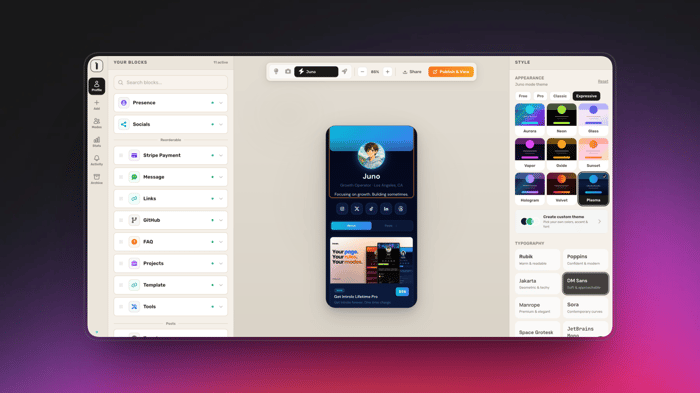
Yes, I know. Another link-in-bio tool. Hear me out.
I'm a solo founder building Introlo (introlo.com). It's live. It's pre-rev. And I'm entering a space where Linktree has tens of millions of users and a billion-dollar valuation.
I'm not delusional - I know how that sounds. But I think there's a real gap that nobody is filling, and I want to share the thinking behind it and get some honest feedback from this community.
The problem I kept running into
I'm someone who does multiple things. I network. I create content. I build projects. And every time I needed to share a link - whether it was with a potential client, a recruiter, or just someone I met - I had to choose which version of myself to present.
My Linktree had everything on it. Content links, portfolio links, social links, a booking page. And because it had everything, it worked for nobody. A brand looking to collaborate doesn't care about my resume. A recruiter doesn't care about my latest YouTube video. But they all land on the same page.
I looked around and realized every link-in-bio tool works the same way: one page, one view, every visitor sees the same thing.
That felt broken to me.
What I built instead
I started from a different premise than most link-in-bio tools. Instead of building a better page, I built around the idea that people aren't one-dimensional, and their profiles shouldn't be either.
Introlo lets you present different sides of yourself depending on who you're talking to. One URL, but the experience changes based on context. If you're a freelancer who also creates content, a potential client and a casual follower don't need to see the same thing. So they don't.
But it's not just that one concept. It's a full platform - deep customization, analytics, rich profile blocks, the whole thing. The context-switching is the differentiator, but the foundation is a tool that can genuinely replace whatever you're currently using as your link-in-bio. I didn't want to build a gimmick with one clever feature. I wanted to build the thing I'd actually switch to.
I won't get deep into every feature here, but if you're curious you can poke around at introlo.com and it'll click pretty fast.
Where I'm at right now
Being completely transparent:
- Product is live and functional
- Small number of users, mostly from warm outreach
- Zero revenue
- Team is me plus one person handling outreach
- Tech stack: Next.js, React, Supabase, Stripe (ready for payments, just need people to pay lol)
I've been doing direct DM outreach on Instagram and X, mostly targeting mid-tier creators (1K-50K followers). The response rate has been decent when I keep it casual and peer-to-peer, but I've mostly tapped out my warm network at this point.
I also have a blog running, ICP-specific landing pages in progress, and I'm starting to think about SEO and content as longer-term channels.
The bet I'm making
I know I can't compete with Linktree on brand recognition or feature breadth. That's not really the play to me.
The bet is that there's a meaningful segment of people - creators, freelancers, founders, students, anyone who does more than one thing - who are underserved by the "one page fits all" model. And that if I build specifically for them, I can carve out a real niche in a massive market.
The difference is my wedge isn't price. It's the idea that your online identity shouldn't be static - it should adapt to context.
What I'm wrestling with
A few things keeping me up at night:
-
Getting from zero to first paying customers. The product works, but I haven't cracked the conversion from "cool, interesting" to "here's my credit card." Curious if anyone reading this has navigated this specific gap - where the product is live but revenue is zero and you need to figure out what unlocks that first payment.
-
Whether the core concept is too abstract to sell quickly. When I demo it, people get it immediately. But explaining it in a DM or on a landing page is harder. The differentiator is better shown than described.
-
Distribution as a solo founder in a crowded space. I don't have a big audience. I don't have funding. I'm trying to figure out the right mix of direct outreach, content, and community to get traction without burning out.
Asking the room
For those of you who've built in crowded markets or gone from zero to first revenue:
- What actually unlocked your first paying customers?
- How did you explain a differentiated feature that was hard to describe but easy to show?
- Any channels that worked way better than expected for early traction?
I'm not looking for validation. I'm looking for sharp feedback. If you think this is a bad bet, I want to hear that too.
Thanks for reading. Happy to answer any questions about the product, the market, or the approach.
