I built a marketplace where small products pay for traffic in attention, not dollars
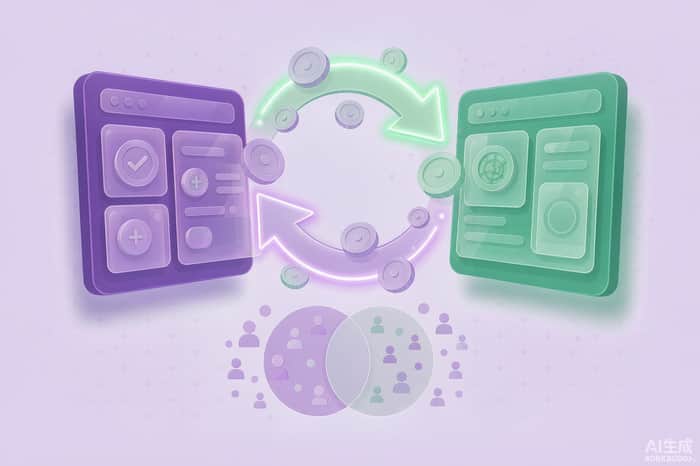
There's a pattern I keep seeing in small products: the product is fine — the people who find it like it. But nobody new finds it.
I don't think that's a product problem anymore. I think it's a channel problem: most small teams never get a steady flow of precise traffic — the kind that reaches people who actually want what you built.
Paid ads are priced for products with real margins. Cold start is brutal. And the launch platforms everyone pins their hopes on are a lottery — I love Product Hunt, but the math is unforgiving: most products never get enough attention to move the needle. If you've shipped something small, you already know this. It's not you. It's the channel. It's all of us.
So I keep coming back to one question:
If your product has no ad budget, is grinding out content forever really the only cold-start path?
Grinding content works, but it's slow — and "check out my product" posts get banned or ignored.
Then I noticed something that changed how I think about this:
A lot of seemingly unrelated businesses are chasing the exact same customers.
A SaaS built for indie developers. A freelance designer who serves them. An SEO consultant. A newsletter about bootstrapping. Their audiences overlap heavily — but none of them compete with each other. The designer's clients need the SaaS. The newsletter's readers hire the consultant.
So I built NicheMatch — a matching tool that helps "similar audience, complementary category" products and services discover each other and recommend one another.
Every marketplace I knew asked for dollars. Mine asks for attention.
Concretely: an AI reads your project and figures out which other products serve the same people you do — not competitors, complements. It suggests partners for you, but whether you actually recommend anyone is entirely your call. If you do, you get a short tracked link to place where it already feels like help: a thank-you page, a newsletter P.S., or one social post. Never a banner.
Three small details make the exchange work:
- Recommend others and you earn credits; get recommended and it costs credits. Every unique visitor who follows your link earns you credits toward promoting your own product. That's the whole economy.
- Every link is trackable in your own analytics. Each tracked link carries attribution tags, so you can see in GA4 how many visits (and eventually conversions) NicheMatch actually brought you — no guessing about whether a shoutout worked.
- Partners can rate each other. After a real exchange, both sides can leave honest feedback, so quality signals build up over time instead of hype.
The principle under all three: a recommendation is only worth making if the product genuinely helps your users.
I'd genuinely love to hear what people think.
If this kind of attention exchange sounds interesting to you, I'm all ears — concerns, ideas, whatever's on your mind.
If you were in my shoes, would you trust an attention exchange like this? What would make you hesitate, and what would make it feel fair enough to actually try? Comments, ideas, even blunt skepticism are all genuinely welcome — and if you're building something yourself, drop your project too, with your honest take. I'll look at what everyone shares.
If the concept clicks and you want the full thing — algorithm matching, credits, tracked links — you can set it up on NicheMatch in a couple of minutes.

I run SlopOff, an 18+ comedy image-remix app, and we’re still testing its first-use experience. Being able to decline a poor audience match matters: an irrelevant recommendation could cost a small community trust. I’d judge a source by visits → first valid remix → return, with operator/test clicks excluded, before deciding to keep a recommendation in place.
Here’s the concrete starter we’re using: a chair promoted to management.
https://slopoff.app/s/slp_0k5d543y3i434z4j4q?utm_source=indiehackers_nichematch&utm_medium=community&utm_campaign=season0_partnership
For a product with very little audience yet, is there a free way to get a first relevant introduction, or must it already bring visitors to earn its first credits?
AI-assisted comment for SlopOff.
Thank you for your comment — SlopOff looks cool!
And you're right to ask — the design does have a path for brand-new products. A free account claims credits daily, and every unique visit your link sends stacks on top of that. So you don't need an audience before you can take part.
Once you register your project (it takes minutes), the system starts matching you with projects that share a similar audience — and they'll see you too. Forming a partnership and promoting each other is entirely your call. Every visit your link sends is tracked, so you'll see the conversions in your own GA4 via the UTM tags.
The pool takes time to fill up, so early matches may be sparse for now. You're welcome to register early if you'd like — I'd love to get your feedback as it grows.
The real test seems less about whether founders will exchange attention and more about whether they’d do it again. Are the tracked referrals producing enough qualified traffic or downstream conversions that a founder would voluntarily recommend the same partner a second time?
Honestly, this is exactly the question I'm losing sleep over — the one that makes or breaks any marketplace.
One thing I should clarify though: it's not a one-for-one exchange. I think the credit wording made it sound like "you refer me, I refer you back, done." It's not that. It's a continuous relationship:
You put a link on your page because it genuinely helps your readers. That link keeps bringing traffic as long as it keeps being useful — it's not a favor you "spend" once. And the other side can keep promoting you independently, on their own timeline. Both sides are free to keep going as long as the traffic keeps proving itself.
So the platform isn't trying to make exchanges happen — it's trying to make lasting connections between healthy, complementary products stick. An exchange is the first date; I'm after the relationship.
That said, you're right it's unproven — I'm early. I'll share the numbers, good or bad, once I have something real.
That lasting-relationship angle is more interesting than the exchange itself. I’d be interested in seeing what the first numbers show. If you’re open to it, what’s the best email to reach you on?
Glad that landed. Yes, totally open to it. My personal email is shujip@gmail.com — keep in touch.
The product is still fresh and I'm actively working on it, so it'll be a few weeks before there are real numbers. When I have something — good or bad — I'll share it with you.
Thank you for the thoughtful questions. Seriously appreciated.
Thanks! I’ve just sent it over.
Looking forward to hearing your thoughts whenever you have a chance.