I built a platform that simulates how your stakeholders will react to any document before you send it. Here is what I learned
Six months ago, I kept watching the same thing happen.
Smart people sending important documents into rooms they knew nothing about. A proposal goes to a CFO who has three specific objections nobody anticipated. A job offer is rejected because the equity structure raised flags that the hiring team missed. A cold email gets ignored because the framing was completely wrong for that buyer.
The room always had opinions. The sender never knew what they were until it was too late.
So I built Murlyn.
What it does
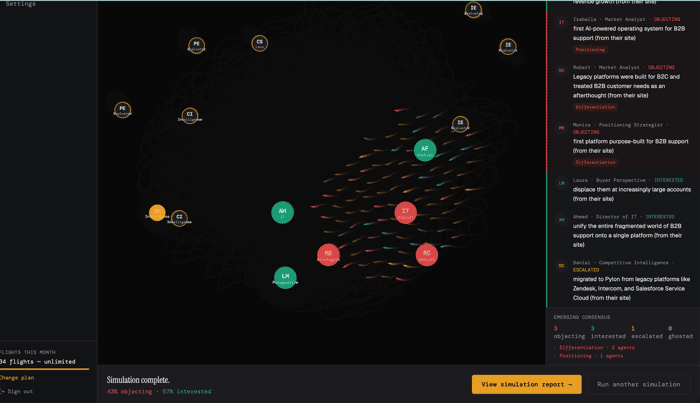
You paste any high-stakes document — cold email, proposal, job offer, board deck, contract — and 20 AI analysts with distinct backgrounds, biases, and communication styles react in real time. They object, escalate, ghost, and argue with each other. The room deliberates and reaches a verdict. You get a full intelligence report before you send a word.
Three modes:
Outbound: simulate how your panel reacts before you send.
Inbound: understand what a document you received actually means and what it conceals.
Competitive: paste a competitor URL and get a full positioning teardown in 60 seconds. This is the one that surprises people most. Funding, target market, where they win, where they are silent, market gaps, and room for growth. 60 seconds. The technical foundation nobody talks about
Every simulation writes anonymized data to a corpus document type, stakeholder reactions, objection categories, rewrite deltas, and real-world outcomes. After 50,000 flights, we have a closed loop between document content, stakeholder reactions, and real outcomes. No competitor has this data. It cannot be purchased.
Today, our agents run on expert prompt engineering. The corpus is what eventually trains a genuinely predictive model. We are building toward that inflection point from day one.
Gong has call recordings after deals happen. We have predictions before they do, validated by what actually happened.
The build launched today. The first simulation is free; no credit card required.
Numbers so far: 34 flights run in testing. Mixed document types: resumes, job offers, competitive analyses, and proposals. The data is real, and it is already telling us, in ways we did not expect, how different document types perform across stakeholder panels.
What I am trying to figure out
ICP sharpness. The product works across cold emails, proposals, job offers, board decks, and competitive intelligence. That is genuinely broad. The question is whether to collapse into a single segment for the first 90 days or let the distribution tell us where the strongest signal is.
Would love to hear from anyone who has navigated that decision.
murlyn.ai first simulation free.
Happy to run anyone's last cold email or top competitor URL free. Drop it in the comments.

Simulating stakeholder reactions with AI before sending high-stakes docs is a really compelling idea — especially the “room you can’t see” insight, that hits hard. The corpus + feedback loop angle also feels like a strong long-term moat if you execute it well.
For ICP, you might get faster traction by narrowing to one use case first (like outbound sales emails or proposals) and owning that deeply before expanding.
This might sound interesting 👇
You have an idea
$19 entry
🏆 Tokyo trip + hotel
💰 $500
Round just opened 👉 tokyolore.com
Prize pool just opened at $0. Your odds are the best right now.
Cool idea! Predicting reactions is a great first step.
For builders who want to see real results, I’m running a Validation Arena to test if an idea will actually work in the market.
$19 to enter.
Winner gets a trip to Tokyo.
The pool just opened at $0, so your chance of winning is the best right now.
That is a fantastic Idea. I would love to see it in action. I like especially the agents with different backgrounds and biased based on their roles.
Hi Murlyn
are you interested in my post?
https://www.indiehackers.com/post/i-am-looking-for-a-freelancing-partner-1803cb10b9