I built a portfolio recovery tool because “I need my coins to come back” is the wrong math
A portfolio can be down 60%, while some individual positions are down 80%, 90%, or even 99%.
The natural reaction is:
“I just need these assets to get back to my entry price.”
But while building a portfolio tracker, I realized that's not actually the problem you need to solve.
Your portfolio doesn't care which asset makes the money back.
Break-even is one number.
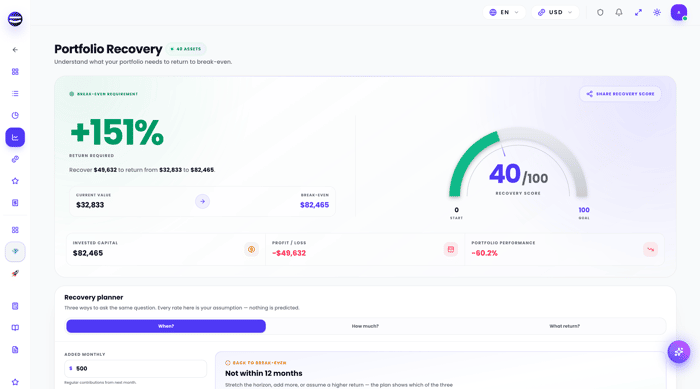
If you invested $82,465 and your portfolio is now worth $32,833, you're down $49,632.
You don't necessarily need every losing position to recover.
That $49,632 gap can theoretically be closed by:
- one strong position
- several positions recovering partially
- new monthly contributions
- growth in completely different assets
- or some combination of all of them
So I built Portfolio Recovery into CalculatorAI.
Instead of predicting prices or telling you what to buy, it works backwards from your actual portfolio.
It shows:
→ exactly how much you're missing to break even
→ the % return the portfolio needs from today
→ a 0–100 Recovery Score
→ which individual holdings could theoretically close the entire gap
→ which losses barely matter in dollar terms despite looking terrible in %
→ when you'd break even at an assumed return
→ how much you'd need to add each month
→ what annual return would be required to recover within a chosen timeframe
No price predictions. No trading signals.
You provide the assumptions. It just does the math.
One thing that surprised me while building it:
The asset with the biggest percentage loss is often not the biggest problem in the portfolio.
A $200 position down 90% matters far less to recovery than a $30,000 position down 20%.
Obvious once you see it in dollars, but portfolio apps constantly train us to stare at percentages.
I’m curious what other founders/investors think about this approach.
Would seeing a “recovery plan” actually change how you think about a portfolio that's deep underwater?

The strongest part is the shift from individual loss percentages to the portfolio-level recovery gap. That reframes what the user is actually trying to understand.
"I need my coins to come back" is sunk cost fallacy dressed as hope. Framing it as "recovery" instead of "revenge trading" is already a better mental model.
How do you handle the emotional side — do you show users why the math is wrong, or just the numbers?