I built a Risk Coach for traders because broker apps don't stop bad decisions
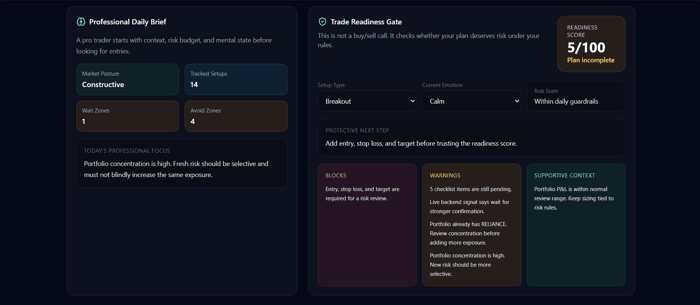
I've spent the last few months building SaveriX because I realized something:
Most trading apps help you execute trades.
Very few help you avoid the bad ones.
So instead of building another portfolio tracker or stock screener, I built a workflow that checks things traders usually ignore until it's too late:
Portfolio concentration risk
Holding-specific news that actually affects positions
Position sizing before every trade
Trade readiness (should you even take this trade?)
Daily risk limits & discipline tracking
A journal that learns from your trading mistakes
The goal isn't to predict the market.
The goal is to reduce avoidable trading mistakes.
I'm now looking for 10–20 serious traders who are willing to actually use it with their real workflow over the next couple of weeks.
I'm looking for people who will tell me:
What's confusing?
What's useless?
What would make you keep using it every day?
If you're an active trader and this sounds interesting, leave a comment and I'll happily give you access.
I'd rather have 10 brutally honest users than 1,000 visitors.

I would like to check your product and give honest feedback.
Thanks, I'd really appreciate that!
SaveriX is still in early access, so honest feedback is exactly what I'm looking for.
You can try it here: https://stock-advisor-ai-zpua.vercel.app
If anything feels confusing, unnecessary, or missing, I'd really love to hear it. Don't hold back—both positive and critical feedback will help improve the product.
If you have 2–3 minutes after trying it, I'd also appreciate it if you could fill out this short feedback form:
https://tally.so/r/zxO06a
Thanks again!
I like that you're focusing on the decisions traders regret rather than the information they already have.
Most trading tools compete to provide more data. You're trying to improve judgment at the moment a decision is made, which feels like a fundamentally different job. Helping someone avoid a bad trade can be far more valuable than helping them find another opportunity.
You captured the idea perfectly. I don't think retail traders suffer from a lack of charts or indicators anymore—they suffer from cognitive bias and emotional execution. The goal is to build something that challenges a decision before capital is at risk, not just another dashboard full of data.
That's an interesting way to put it.
Reading your reply made me think about the consequence of building around judgment instead of information. It looks like a subtle shift, but I don't think it stays subtle as the product evolves.
I don't think I can explain why I think that in a thread without leaving out the parts that actually matter.
If you're open to it, what's the best email to reach you on?
Thanks, I really appreciate that.
I'd love to hear your thoughts. You can reach me at anushka09092004@gmail.com
Looking forward to the discussion.
Thanks! I’ve just sent it over.
Looking forward to hearing your thoughts whenever you have a chance.
This positioning is really sharp - "avoid bad decisions" is psychologically stronger than "make better trades." Traders already think they can pick winners; what haunts them is the money they lost on easily avoidable mistakes. A few thoughts:
The "journal that learns from mistakes" angle is powerful. Most traders resist self-reflection because it's painful, but pairing it with risk frameworks makes it feel productive rather than punishing. That's a subtle but important UX distinction.
Your target of 10-20 serious traders over time is smart positioning too. Much easier to build a devoted userbase this way than chasing scale. One question: how are you differentiating from Risk Management modules in platforms like thinkorswim? The advantage seems to be pure focus on the decision layer before trade execution - that's defensible if you emphasize it.
Thanks! That's a great question.
I actually don't see SaveriX as competing with platforms like thinkorswim. Those platforms are built to help traders analyze markets and execute trades.
SaveriX is focused on the decision before execution.
It asks questions like:
Does this trade fit my own risk rules?
Am I overexposed to a single stock or sector?
Has anything materially changed for my existing holdings?
Am I taking this trade because of a valid setup or because of FOMO, revenge, or boredom?
Is my position size consistent with my risk budget?
My goal isn't to replace a broker or charting platform. It's to become the layer traders check before they press Buy or Sell.
Most traders don't lose money because they don't know how to place an order. They lose money because they place the wrong order.
That's the problem I'm trying to solve.