I built a self-hosted AI receptionist — you can call it today
Small appointment-based businesses lose potential customers whenever calls go unanswered.
Over the past few months, I’ve been building ReceptionTest AI: an affordable and customizable AI receptionist connected to real telephone infrastructure.
This is not a finished SaaS product yet. I currently configure each implementation individually, and I’m looking for honest feedback and one or two pilot businesses.
What it can do
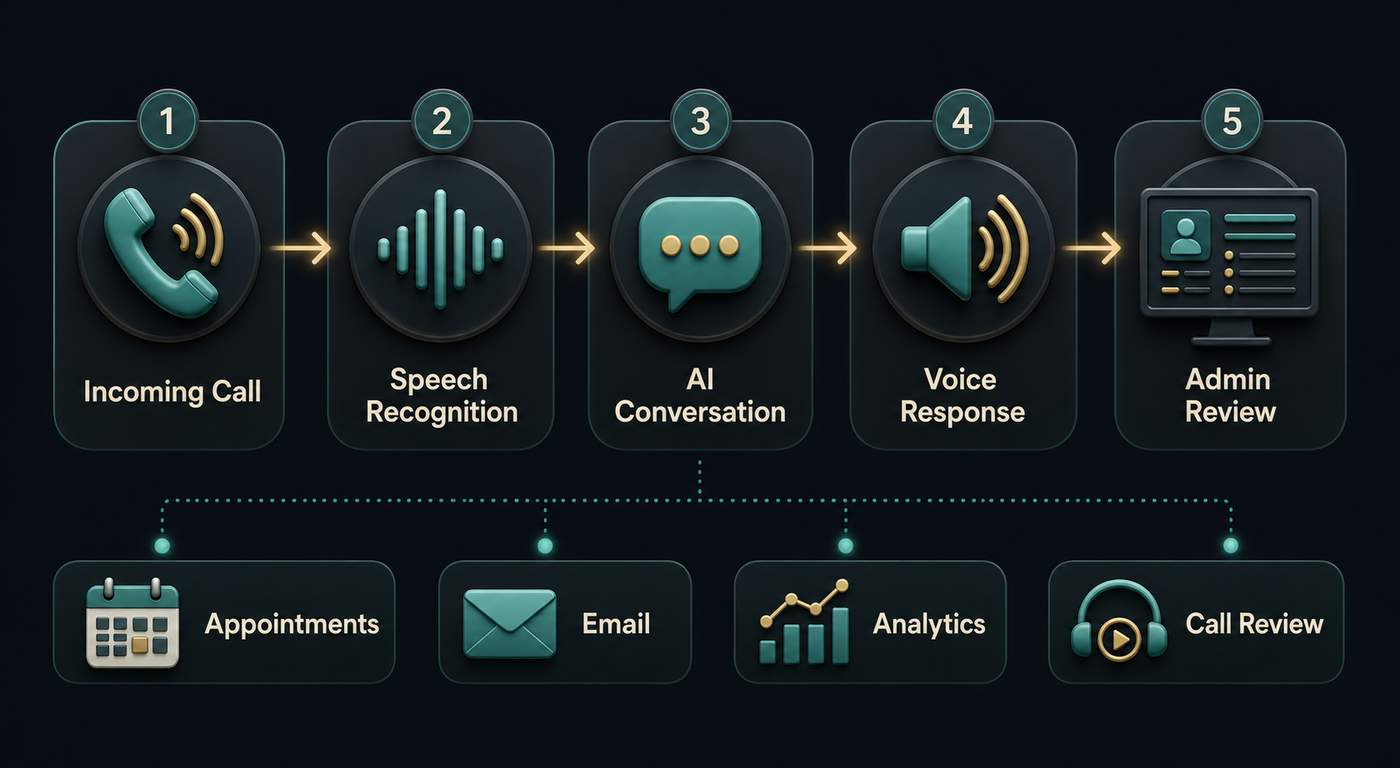
The receptionist can:
Answer real incoming telephone calls
Explain services, prices, duration, working hours and parking
Understand natural speech and handle interruptions
Check availability and guide callers through appointment booking
Send confirmation emails with secure appointment-management links
Recognize returning callers when appropriate
Record and transcribe calls after an opening disclosure
Store conversation, latency and audio-quality metrics
Provide recording playback and conversation review
Monitor calls, appointments, email delivery and agent health
Route an existing business number through the AI receptionist
Why I built my own infrastructure
I did not want to create another thin wrapper around an expensive managed voice-agent platform.
ReceptionTest AI uses a self-hosted telephony and orchestration layer. Speech recognition, language models and voice synthesis remain replaceable components rather than locking the entire product into one provider.
This gives me control over:
Call routing and telephone numbers
Conversation and booking logic
Voice and AI provider selection
Provider fallback behavior
Recordings and transcripts
Email delivery
Business-specific rules
Administration and monitoring
It also avoids much of the additional per-minute markup charged by managed voice-agent platforms.
Depending on the provider and configuration being compared, the underlying operating cost can be several times lower. This makes it possible to offer smaller businesses a more affordable solution without giving up control over the system.
Built to be controlled by each business
The system is not limited to one fixed prompt.
Through the administration interface, a business can manage its:
Business information
AI receptionist name
Services and descriptions
Prices and service duration
Staff members
Working hours
Appointment rules
Promotional messages
Administrators can also:
Review conversations and call recordings
Monitor appointments
Check email delivery
Inspect agent and service health
Review conversation and latency metrics
Update the information used by the receptionist during calls
This means clients do not need a developer every time they change a price, introduce a promotion or update their working hours.
More than a salon receptionist
The current public demonstration is configured for hair, beauty and wellness businesses, but the underlying system is not restricted to that industry.
I have also developed specialized Dental AI and Vet AI versions using the same core telephony and administration architecture.
Each version can have its own:
Services and terminology
Staff and schedules
Conversation rules
Appointment workflows
Email templates
Industry-specific boundaries and safety rules
Web and mobile interface
The shared foundation makes it possible to build a specialized receptionist for another appointment-based business without starting from scratch.
Review and accountability
Calls are not treated as a black box.
Authorized administrators can review recordings and transcripts, inspect response latency and audio-quality metrics, check appointment activity and monitor whether the voice agent and supporting services are operating correctly.
Call recording begins with an audio disclosure. Administrative access and public demo access are separated.
Try the live demonstration
The public demo is protected with call-duration, daily-usage and concurrency limits.
It operates as a sandbox and cannot create, modify or cancel real appointments.
Call the live US demo:
+1 412-790-1224
Product website:
https://beauty.receptiontestai.com/
Listen to a real test conversation:
https://beauty.receptiontestai.com/demo/audio/
Please do not share medical, payment or other sensitive information while testing the public demonstration.
What I’m looking for
I am currently looking for one or two hair, beauty or wellness businesses interested in testing a pilot implementation.
I would also appreciate honest feedback from other founders and developers, especially about:
Voice quality and naturalness
Response speed
Conversation flow
Appointment handling
Administration and call review
Features a business would require before using it
The best way to package and price the product
The product is currently delivered as a customized implementation rather than a self-service subscription.
My immediate goal is to validate it with real businesses before deciding how much of the setup and onboarding should become a standardized SaaS workflow.
Would you trust an AI receptionist to handle incoming calls for your business?


The customized-to-SaaS transition is probably the most interesting part here.
I’d be curious whether the pilots are revealing mostly different feature requests, or different expectations around how the product should actually be deployed.
That’s exactly the tension I’m exploring right now. So far, the core requirements are mostly shared: answering calls, grounded business information, appointment booking, transfers, notifications, and call review.
The bigger differences are in deployment expectations—phone routing, calendars, escalation rules, compliance, and how much control each business wants over services, staff, promotions, and the agent itself.
My current approach is to keep one shared voice engine and admin layer, while isolating each business’s knowledge, workflows, configuration, and integrations. That seems like a more realistic path toward SaaS than maintaining separate codebases.
I’d be happy to continue the conversation. You can reach me at darkotokanovic25@gmail.com. I’d also be interested to hear what you’re building and what part of this transition you’re exploring.
Thanks for reading. The live demo number is +1 412-790-1224. If you test it, please tell me what felt natural and what should be improved. I’m also looking for one or two pilot businesses.