I Built a Simple Tool to Convert Bar to Pascal Without the Guesswork
I Built a Simple Tool to Convert Bar to Pascal Without the Guesswork
If you work with engineering data, pressure specifications, or even basic physics problems, you've probably seen pressure written in different units.
One document might say 5 bar, another might use 500 kPa, while a technical calculation expects the value in Pa.
The conversion itself is simple, but when you're working with multiple values, manually calculating and checking all those zeros gets annoying.
That's one of the reasons I added a Bar to Pascal Converter to UnitMorph.
The conversion is actually very simple
The relationship between bar and pascal is:
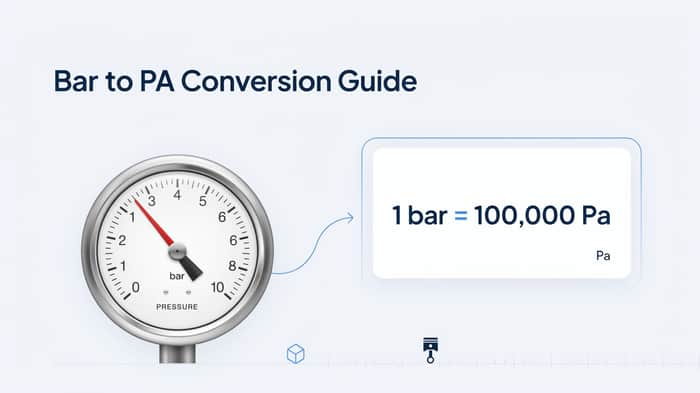
1 bar = 100,000 Pa
So the formula is:
Pascal = Bar × 100,000
For example:
5 bar × 100,000 = 500,000 Pa
So:
5 bar = 500,000 Pa
That's basically the entire calculation.
The challenge isn't really the mathematics. It's making sure you use the correct conversion factor and don't accidentally confuse pascals with kilopascals.
Why does 1 bar equal 100,000 Pa?
A pascal is the SI unit of pressure.
A bar is a larger pressure unit commonly encountered in practical applications such as compressors, hydraulic systems, pressure gauges, and industrial equipment.
Because the pascal is much smaller than the bar, one bar corresponds to a relatively large number of pascals:
1 bar = 100,000 Pa
The same value can also be written as:
1 bar = 100 kPa
or:
1 bar = 0.1 MPa
Nothing about the actual pressure changes. We're simply expressing the same measurement using a different unit.
A few useful conversions
Here's a quick reference for some common values:
| Bar | Pascal |
| ------: | -----------: |
| 0.1 bar | 10,000 Pa |
| 0.5 bar | 50,000 Pa |
| 1 bar | 100,000 Pa |
| 2 bar | 200,000 Pa |
| 3 bar | 300,000 Pa |
| 5 bar | 500,000 Pa |
| 10 bar | 1,000,000 Pa |
| 20 bar | 2,000,000 Pa |
Once you know the 100,000 conversion factor, you can calculate any other value yourself.
When this conversion is useful
This isn't just a classroom conversion.
You can run into bar-to-pascal conversions in:
- Engineering calculations
- Hydraulic systems
- Pneumatic equipment
- Compressor specifications
- Manufacturing
- Construction equipment
- Physics assignments
- Laboratory work
- Technical documentation
For example, an equipment specification might give you a pressure rating in bar, while your calculation requires SI units. Converting the value to pascals keeps the units consistent.
The easiest way to make a mistake
The most common mistake is confusing Pa and kPa.
Remember:
1 kPa = 1,000 Pa
Therefore:
100 kPa = 100,000 Pa
So if you have 1 bar, the correct results are:
1 bar = 100 kPa = 100,000 Pa
Not 100 Pa.
Another common problem is losing or adding a zero when doing the calculation manually. That's not a big deal for one calculation, but it can become frustrating when you're converting dozens of values.
I made a small converter for it
If you only need to convert one value, multiplying by 100,000 is probably faster than opening a website.
But if you're working with several measurements, I find a dedicated calculator more convenient.
I added a free Bar to Pascal Converter to UnitMorph for exactly this kind of quick calculation.
Enter the value in bar and the converter handles the calculation for you.
UnitMorph isn't limited to pressure conversions either. The project is built around making everyday unit conversions easier, with different calculators available from the UnitMorph website.
One thing I like about simple tools
There is a tendency to make even very small calculators unnecessarily complicated.
For a conversion like this, most people don't need a complicated dashboard or a long setup process. They just want to enter a value, get the answer, and move on.
That's the approach I'm taking with UnitMorph: keep individual conversion tools focused on the actual problem.
For bar to pascal, the underlying calculation is only:
Pa = bar × 100,000
The tool simply makes that calculation quicker and reduces the chance of a manual error.
Final result
If you remember only one thing from this post, remember:
1 bar = 100,000 Pa
And the conversion formula:
Pa = bar × 100,000
For occasional calculations, doing it manually is easy. If you need a quick online calculation, you can use the UnitMorph Bar to Pascal Converter.
I'm continuing to build UnitMorph around these small, practical conversion problems. If you work with units regularly, the UnitMorph collection may be useful for some of the other conversions you encounter.

The interesting part is how little the actual conversion requires. The value is really in removing the tiny opportunities for error when you're dealing with lots of technical values, especially the Pa vs kPa confusion. Simple tools can be useful when they stay this focused.