I built a simulated community with AI personas to validate+test ideas quickly, and i want to know what the IH community thinks
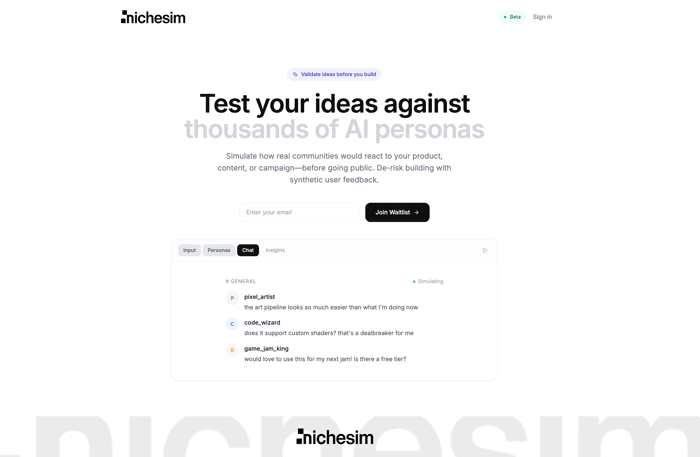
Been a while, IndieHackers!
After exiting copyscouts, building 3 more (and failing), I realised this:
Early idea validation and testing + community feedback is...
- Hard
- Time consuming
So I built NicheSim: an AI-powered community simulator that lets you test an idea, product, or piece of content inside a synthetic community before you ship it to real humans.
It’s basically: “What would a real Reddit/Discord/Slack channel do with this?” except you get it in minutes.
What NicheSim actually does
You describe a niche in plain English, like:
“solo founders doing B2B SaaS”
“web3 gaming people who’ve been rugged too many times”
“fitness creators selling coaching”
Then NicheSim:
- generates 5+ distinct personas (skeptic, early adopter, newbie, veteran, etc)
- creates multiple channels like a real community
- spins up 80+ messages that feel like ongoing chatter, not a single chatbot monologue
- lets you post into the community and watch 3–6 personas respond in real-time (streaming)
- adds a simple analysis layer (themes, sentiment, engagement, “what are people actually objecting to”)
The key thing: it’s not “one AI voice pretending to be everyone.” It’s a mix of personalities that disagree, misunderstand, nitpick, and occasionally say “nah” with zero explanation. Like real life.
Why I think this matters:
- Most “validation” is you getting emotionally attached to the first positive response you hear.
Real communities have: (to start)
- the person who’s instantly suspicious
- the beginner asking obvious questions
- the veteran who’s seen 12 versions of this
- the practical one who only cares about integration and exports
- the early adopter who wants to try it now
You need all of those reactions early, not after you’ve burned weeks building.
The realism stuff I cared about (because AI loves to sound like a blog post)
I spent a stupid amount of time forcing it to behave like an actual community:
-
Message length distribution (some replies are literally “this”, others are a paragraph)
-
Sentiment heterogeneity (not everything is positive, because reality isn’t)
-
Engagement patterns (70% of messages have no reactions because most people don’t react to everything)
-
Persona consistency stored in the DB, referenced every generation so the skeptic stays a skeptic - but can eventually be convinced
-
And when you post, it generates responses sequentially so personas can reply to each other, not just you. That’s what makes it feel like a thread, not a helpdesk.
The most interesting part is not “does the idea get praised.”
It’s:
- what the skeptic attacks first
- which questions repeat across personas
- what people assume you mean (usually incorrectly)
- which phrasing triggers confusion vs interest
If you build products, write content, run community-led growth, or just like poking holes in things:
Try NicheSim on something you’re about to ship.
Post your idea and see what the personas do.
Tell me what feels real and what feels off.
I’d love feedback on:
- what niches it performs best on
- where it breaks
- what you’d want exported
- whether the analysis is useful
- pricing expectations (I’m still experimenting here)
And selfishly: if you find it interesting, share it. I’m trying to see if this has “people tell other builders” energy or if it’s just me being obsessed with validation mechanics.

This is really interesting, j0x. I love how you include multiple personalities with real disagreements; simulating that level of heterogeneity is key for early validation.
In my experience building step-by-step MVP validation flows, I’ve seen that the biggest friction isn’t in the idea itself, but in how different types of users react to each micro-interaction. Your “Skeptic vs. Pioneer” approach captures that perfectly.
I’m curious: have you tested how these personalities respond to confusing or ambiguous messages? I think that’s where many products get early signals that would otherwise be missed.
This is fascinating, j0x. The idea of a 'skeptic' persona is crucial. In my 15 years of mentoring, I’ve seen that the biggest killer of startups isn't just a bad idea, it's the 'Circle of Lust' (as I call it in my book, Startup Inferno). That’s when a founder is so in love with their vision that they only hear the 'Early Adopter' persona and ignore the 'Veteran' who’s seen it all fail 12 times before.
I’d love to test NicheSim to see if it can simulate what I call 'Operational Friction.' Most AI personas are great at giving feedback on the idea, but real humans in a community eventually ask: 'How does this actually fit into my messy, complex workflow?' If your simulator can truly nitpick on the Clean Structure of a product—meaning, can it tell me if my solution is becoming a 'Frankenstein' of too many features?, then you have a winner.
I'm curious: does the 'Skeptic' persona ever attack the Unit Economics or the Pricing? That’s where the 'Startup Inferno' usually gets hottest.
Giving this a spin today. Great job on focusing on 'heterogeneity', uniformity is the death of honest validation.
Love this approach; simulating users before real users is clever.
How accurate are the AI personas vs. actual market data? I found that simulated users often miss the "will they pay" part, which is where most ideas die.
I built FounderOS to validate using real competition analysis, search trends, and monetization data instead of personas. Gets to GO/ITERATE/KILL in 3 mins.
Want to compare notes? I could validate your validation tool with mie, meta, but it's useful. 😅