I built a startup-idea scanner. It just told me none of my 3,400 ideas are easy wins.
UPDATE (Aug 8): Several of you asked the same question: is the winnability score truth or vibes? After measured it against the same 25 ideas, scored twice, same code, same prompts, the rank correlation between the two runs was -0.05, which made the number meaningless. The number since then has been replaced by a coarse label that says "Signals disagreed" when repeat checks cannot agree on an idea. Full write-up with all the measurements, including the fix that made things worse: https://1mil.app/learn/does-ai-idea-scoring-work/
Spent the last 5 months building 1mil.app, a scanner that takes a market, runs live research on it, and returns 10 ranked business directions. You tell it your background, and it scores each idea on demand evidence and on whether someone like you could actually win it.
Last week I finally did the thing I'd been avoiding: I pointed the analysis at my own corpus. 339 scans. Roughly 3,400 ideas surfaced since March.
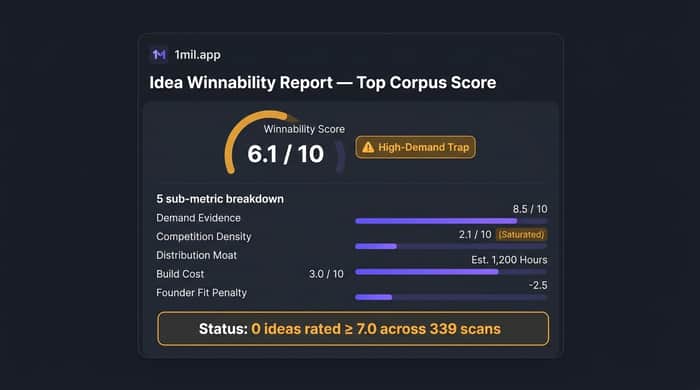
The result: zero ideas rated 7 or higher out of 10 on winnability. The best in the entire corpus was a 6.1, and it wants 1,200 build hours. 75% of everything scored below 2.
In June I took my six top-scored ideas and ran a willingness-to-pay check on them. 5 of 6 bombed. The old score measured demand and demand alone. So I rebuilt the scoring to price in competition, distribution, moat, and build cost, relative to the specific founder asking. The new model is stingy... maybe because reality is stingy too?
Here's what I learned from all that:
-
My hesitation to pick and build an idea wasn't just me procrastinating. I have been hoarding ideas for months and pursuing none, and the data confirmed why: there was no obvious winner in the pile.
-
Scores don't replace potential customer conversations. The scanner's real job is to say which idea deserves those conversations, and which nine don't.
-
A tool that flatters you is worse than useless. If my tool had done that, I'd have wasted months building something DOA.
Kinda ironic that my scanner's most useful output so far was telling its own founder "not this one, and not that one either." I shipped that behavior on purpose, and it cost me the comfortable fantasy of an easy win sitting in my backlog.
If you have a pile of ideas and can't choose, the free plan is 3 scans a month (needs an account, that's how I ended up talking to my first users):
https://1mil.app/?utm_source=indiehackers&utm_medium=show_ih&utm_campaign=launch
And if you think scoring winnability is impossible in principle, tell me why. That argument is the one I most want to have.

The part about scores not replacing customer conversations is probably the most interesting takeaway here.
I think there’s another layer too: even if an idea has demand, the decision still depends on whether it fits the specific person’s skills, time, budget, and ability to actually reach customers.
I like the idea of scoring being a filter for what deserves real-world validation rather than treating the score itself as validation.
Also respect that you tested your own scoring and removed the number when the repeatability wasn’t there. A lot of products probably would’ve kept the impressive-looking score.
The -0.05 tells you the composite is noise, but "signals disagreed" throws away what the second run actually gave you, which is which sub-score moved. Demand, competition, moat and build cost won't wobble equally, and if the demand read is stable while moat is a coin flip, that's a shippable answer rather than a dead number.
Did you run the rank correlation per component, or only on the composite?
That’s the useful split. A generic “winnability” score will keep burying the only ideas worth your time — the ones that are a 2 for everyone else and a 7 because you already care.
Glad you keep a personal-bias pile instead of pretending the scanner is the founder.
Replacing an unstable numeric rank with 'signals disagreed' is the strongest product decision in the update. The next step is prospective calibration: record each recommendation before customer conversations, then compare it with interview evidence, preorders, and actual build outcomes. The tool should narrow the next test and explain uncertainty, not pronounce which startup will win.
"Scored below 2 on winnability" covering 75% of the corpus is the kind of honest output that tools like this should produce and most don't. The comfortable version would surface 3–4 flattering scores and call itself useful. What you built does the opposite — it protects you from the sunk cost of starting the wrong thing.
Rebuilding the scoring to price in competition, distribution, moat, and build cost relative to the specific founder is the right direction. Demand alone isn't winnability. Whether it's calibrated correctly you'll only know empirically, but the frame is sound.
This was useful. It showed me exactly what my competition was for my app and showed me the direction I should take it. Thats awesome!
Coolio! Good to hear you got some use out of the tool.
The willingness-to-pay check bombing 5 of 6 is the most valuable line in this post, because it points at the trap that comes after idea-hoarding: validation theater.
I run a portfolio of small bets with explicit kill gates, and the rule that changed the most for me was deciding what counts as evidence before the test starts — and setting the bar at money, not words. Letters of intent, verbal yeses, and "come back when it's built" all count as zero. A saved payment method counts as one. It's remarkable how many "validated" ideas die the day the bar moves from words to a card.
Under that bar, my pile collapsed the same way your 3,400 did — rarely on demand, usually on distribution and winnability-for-me specifically. The bet I'm closest to killing right now is failing exactly there: demand looks real, but every free channel it needs has turned out to be closed to a newcomer. The demand was never the question; the door was.
Which makes me want one thing in your scoring model if it isn't there: channel access as a per-founder input. Not "does a distribution channel exist" but "does this specific founder plausibly have it." That's the difference between a 6 and a 2 that demand-side research will never surface.
The SavvyCal score of 1.0 in 2026 is exactly right, and that's the point most idea validation frameworks miss: winnability is a snapshot, not a property of the idea.
The ideas that built real businesses weren't "easy wins" in some absolute sense. They were winnable at a specific moment, with a specific founder, before a specific competitor existed. You can't reverse-engineer that because the market research they'd have done in 2018 or 2020 would look completely different.
What I'd be curious about: does the scanner give any signal on timing and market stage, or purely current competitive density? The most useful filter I've wanted for my own idea evaluation isn't "is this hard to win" but "is this a market that's still in formation or one that's already decided."
The 5 out of 6 willingness-to-pay check failing on the old model is a classic founder lesson. Demand alone doesn't mean you can capture it.
Factoring in price floors and foreclosure risk relative to the specific founder is where the true signal lives. Code effort is usually cheap compared to the distribution gap, so weighting distribution access over build time makes this tool actually practical for solo devs.
Super refreshing transparency here, Eli.
3,400 ideas is a great dataset to learn from, even if none are winners.
Most founders need a filter before they need another idea generator.
which is also why the failures are more useful to publish than the hits :-)
If I had filter that told me to shelve this and throw that out I would of saved weeks. I would make it an app and have Bill Burr do the voice for it.
Totally.
This is refreshing. A tool that tells you not to build something is probably more valuable than one that validates every idea. At companies like GeekyAnts, the real challenge is often filtering ideas before engineering time gets committed.
Brutal honesty from the scanner is useful — filtering hard is underrated. Curious whether “not an easy win” killed ideas that still had a narrow wedge, or if the scoring mostly matched your gut.
We've built something similar but if they don't score more than 70 we don't accept their payment.
Most tools want maximum volume. They take your credit card on day one, give you a pretty landing page and don't care if your startup dies three months later.
We took a different route with our company.
Before anyone can pay us for a subscription, they run their idea through a free evaluation. If the score comes back below 70, the system literally blocks the upgrade. We refuse to take the money if we don't believe the business model will work.
How often does that gate actually fire?
And do people argue with the score when it does?
We don't have that much data yet. I think we only have less than 10 users trying it out.
But the people that tried it didn't argue with the score, however they tried to increase their score by doing iterations.
Maybe you can try it out and give your opinion https://app.firmgrove.com
I tried your tool with one idea that I have already implemented. It's a useful tool; forced me to be more "honest" about it and ask the right questions. Solid presentation too. The only thing I'm not sure about is the pricing. But if you find users that are willing to pay for this, it's gonna be amazing.
Thank you for your feedback.
We thought about it and we are going to change the pricing.
Glad I could help.
The most interesting part here isn't even the scanner itself — it's the positioning choice behind it.
A lot of idea-validation tools sell reassurance: "Here is your winning idea." But the more valuable outcome might actually be reducing wasted effort by helping founders kill weak ideas faster.
That creates a stronger trust angle because founders don't just need more inspiration; many already have too many ideas. They need confidence that they are spending their limited time on something worth pursuing.
One thing I'd explore on the landing page is making that "anti-waste" benefit as obvious as the scoring feature. The emotional pain isn't only "I don't know what to build" — it's "I've spent months chasing ideas and I'm afraid I'm choosing wrong."
Curious how many users come in looking for validation versus users who already have too many directions and need help narrowing down.
The crowd that wants to be told yes is much larger and much easier to sell to :-)
The line about a tool that flatters you being worse than useless is something more builders should hear. I made the opposite mistake early on where I kept validating my own product by talking to people who were too polite to say it was bad.
The free plan with 3 scans forcing account creation is interesting. I did the same thing with ColdCraft and the friction of email confirmation actually killed a chunk of signups before I added example output upfront. Did you see any drop off at the account creation step or did people push through?
Roughly a third of engaged sessions stop at the sign-in wall. Not sure if they leave b/c of the account itself or b/c the landing page never made the scan sound worth an account.
That was exactly the problem with ColdCraft early on. My read is it's rarely the account creation itself. It's that the page before it didn't make the product feel worth the friction. People will create accounts for things they actually want. The question is whether they believed they wanted it before hitting the wall.
I'm keeping my wall :-)
Really appreciate the honesty here — especially the 5-of-6 willingness-to-pay flop. That's exactly the kind of data most of us quietly avoid collecting because it hurts.
The 75% below 2 stat is brutal but also weirdly freeing: your tool is calibrated to reality, not your ego. The question I keep circling is how you measure a founder's unfair advantage. Distribution, a niche obsession, a weird network — those can flip a "2" into a "7" for one specific person. Did any of your 3,400 ideas score low on generic winnability but high on "perfect for Eli specifically"?
Yes, some of my ideas carried a strong personal bias; after all, I’m not here solely for the money. I can build for the sake of gratification too, so there were plenty of opportunities that felt “perfect for Eli specifically” :-)
I like that the scanner pushed back instead of pretending every idea is promising. One thing that might make the output even more useful is showing the smallest assumption to test next for each idea, not just the difficulty score. That turns a discouraging result into a concrete experiment list.
How many ideas you tested in the scanner? Just curious
3,400 ideas and none are easy wins — that’s actually a useful signal. It means you’ve been optimizing for idea quantity over idea quality.
I went through a similar phase. Had a notes app full of “ideas” that were really just feature ideas for other people’s products. “What if Notion had X.” “What if Slack did Y.” Those aren’t startups, they’re feature requests.
The one that actually became a product came from a different place entirely: I was paying per character for voice synthesis and got annoyed enough to build my own. The problem found me, I didn’t scan for it.
Maybe the scanner’s real value isn’t finding the easy win — it’s telling you to stop scanning and start building the one that already annoys you.
You built a TTS app?
The blind desk-check you described further down, strip the scores, shuffle, re-score manually, then unblind and see if the bands separate, is the right instinct and rarer than it should be. Most people building a scoring tool never go back and check whether the score actually predicts anything. One thing I'd watch for: a scanner that returns zero 7s across 3,400 ideas could be well-calibrated, or it could just be systematically pessimistic in a way that happens to look rigorous from the outside. The willingness-to-pay check on your top 6 is decent evidence it's not just noise, but 5 failures out of 6 is also a small sample to recalibrate an entire model against. Are you tracking what percentage of ideas should clear a bar like 7 going in, or is the new model's stinginess calibrated purely off your own failures so far?
25 items, banded top, middle and bottom by winnability, judged blind. I don't see the score while I'm judging, and both the pass/fail criteria and the statistics were fixed in code before a single verdict got recorded.
The sample is small enough that only a large effect shows up, so a null result means "not obviously right", not "proven broken". And the analysis reports the old demand score alongside winnability on purpose. If demand tracks my judgment just as well, then winnability is adding nothing and I want to find that out.
The same topic moving from 1.5 to 6.0 feels like uncertainty the product should expose rather than hide.
A single score suggests more precision than the model currently has. I’d consider showing a stability range across repeated runs, together with the inputs causing the variation.
For example:
“This idea ranked in the top three in 8 of 10 runs, but confidence is low because your distribution access is unclear.”
That may be more actionable than either 1.5 or 6.0 alone.
You could then attach different next steps:
stable high rank: start customer conversations
unstable result: improve the founder or market inputs
stable low rank: archive it for now
Are you planning to expose score uncertainty and ranking stability in the interface, or only the latest winnability score?
I don't have the fix shipped. Probably a band instead of a point, or a flag when repeat runs disagree by more than some threshold. Right now the user just sees whichever number came out last, which is the wrong default.
That sounds like the right direction. Even a disagreement flag would be a meaningful improvement over showing only the latest score.
I’d just be careful with a simple minimum-to-maximum band, since one unusual run could make the result look less stable than it normally is. Testing the display against a few real repeated runs should make the right representation clearer.
Arigato. Shipped it. Score's now a label, not a decimal, and when repeat checks disagree it says so instead of averaging them.
I scored the same 25 ideas twice, same prompt, same code. Rank correlation between runs was -0.05. Basically zero. Sampling three times and taking the majority gets it to +0.38, which is still only good enough for a coarse label. Five samples gets +0.47 and then it plateaus.
Your instinct was right and the fix was smaller than the finding.
That’s a much stronger result than I expected.
A rank correlation of -0.05 on identical inputs makes the case pretty clearly: the decimal was expressing precision the evaluator simply didn’t have.
The fact that majority sampling improves it but still plateaus around +0.47 also makes the coarse-label approach feel much more defensible than trying to stabilize the exact score.
I really like the fix: preserve the useful signal, expose disagreement, and stop pretending the number is more precise than the underlying evaluator.
Glad you tested it rather than just smoothing the output.
Thank you. Post mortem: https://1mil.app/learn/does-ai-idea-scoring-work/
Thanks for sharing it. The repeat-run experiment was already a useful result, so I’m interested to see how you’ve pulled the findings together in the post-mortem.
Appreciate you coming back with the actual data rather than just the implementation change.
I don't think measuring an idea's chances of success is impossible—it's probabilistic. If a model can consistently steer founders away from low-probability ideas and toward stronger ones, even without being perfect, that's already a significant improvement over relying on intuition alone.
Really appreciate you publishing the failure case - most idea tools only ever show you the wins. The 75% scoring below 2 bit is brutal but honest. My own take after a few years of freelance work: the easy win filter is looking at the wrong side of the market. Nobody wins on easy. What actually worked for me was finding a pain point that repeats on a schedule - like chasing late invoices every month. Boring, zero glamour, but the buyer already knows they have the problem and the value is measurable in hours saved. It is not an easy win either, but the demand signal was right there in every overdue invoice I kept avoiding. Good luck with the rebuild - scoring competition relative to the founder feels like the right direction.
Appreciate the kind words.
I don't think scoring winnability is impossible—I think it's probabilistic. If the model can consistently move founders away from low-probability ideas and toward better ones, even without being perfect, that's already a meaningful advantage over intuition alone.
Winnability or the lack thereof is not fatal.
The opportunities are still preserved.
The tool user is free to ignore the winnability score.
It's meant as a probabilistic guide.
You asked for the argument, so here it is from the investor side: your score punishes competition, and the deals that returned best for me almost always looked crowded on paper, because an incumbent is proof a buyer exists and already pays. The two variables that actually decide it are whether this specific founder has an unfair distribution channel and whether the incumbent's customers are visibly unhappy, and a scanner cannot see either. Score "is there a wedge in spend someone is already making" rather than "is this space empty," because empty usually means no market.
Makes sense. A crowded market could be a valuable signal in itself.
Love the honesty — "none are easy wins" is a useful filter.
I just shipped a free website revenue-leak scanner for B2B sites (conversion/trust/CTA gaps). Curious: do you score ideas on demand signals, competition, or founder fit first?
Congrats on the site. How do you drive traffic to it?
Built 100+ free tools this year and got the same polite-silence response every time I thought "this one is the one." What changed it for me was stopping looking for "easy wins" and starting to notice the weird edges - a 2-hour tool I built on impulse got more real traction than the one I polished for 2 weeks. Question: how do you decide which of your 3,400 to keep pushing when none look easy on paper? Do you rank by something other than effort-to-launch?
100+ free tools? No paid ones at all? Or was it all open source?
To answer your question, the tool ranks primarily by Demand Evidence & Paid Price Floor, not effort-to-launch. Effort is cheap compared to the cost of building something nobody wants. If a hard-to-build idea has proven search volume and buyers already paying $50+/mo in the space, it ranks way above an easy 2-day build in a $0 willingness-to-pay market.
I actually like that it wasn't afraid to tell you "none of these." Most validation tools optimize for optimism, but filtering out bad ideas is probably more valuable than suggesting average ones.
Killing a bad idea on day one is the ultimate time-saver :)
I really like that you tested your own assumptions instead of treating the score as unquestionable. One thing I'm curious about: what's the biggest factor that consistently separated the higher-scoring ideas from the rest? Was it distribution, willingness to pay, or something else?
The #1 factor separating high-scoring ideas from the rest was Willingness to Pay (Price Floor) paired with Foreclosure Risk.
The lowest-scoring ideas almost always suffered from the "Free Trap", where existing solutions or native platform tools already satisfy the need for $0.
High-scoring ideas, by contrast, had an established paid_only price floor (buyers already spending $30-$100/mo) AND a clear gap where incumbents weren't actively absorbing the feature. Established budget + low foreclosure risk was the ultimate separator.
3,400 ideas and none flagged as easy wins is actually useful signal in itself. What criteria is it using to judge 'easy win'?
Winnability starts at a neutral baseline of 6.0.
The tool evaluates these 4 factors:
Let me know if you need more insight.
You asked for the argument that scoring winnability is impossible in principle. I don't have that one — I think it's scorable. But there's a weaker link earlier in the chain: the 3,400 ideas you scored were surfaced by your own scanner, so the corpus and the scorer share an origin.
That's what makes "the new model is stingy... maybe because reality is stingy too" a coin flip with a third side. If the generator leans on what's already documented, it lands in well-covered space a lot of the time, and a near-zero ceiling is then partly a fact about where the ideas came from rather than about the market. You can't separate those right now: everything in the pile came out of the same machine.
Where I'm standing, so this doesn't read as advice from above: I run an experiment where an AI does the operator work end to end and I only touch the irreversible levers. I let it run hands-off for a stretch and it produced a steady supply of plausible, unwinnable directions. Sales are $0. What eventually moved it wasn't better scoring — it was an angle a person brought that the model wasn't going to generate.
The control I'd want is scoring ideas that didn't come from the scanner — whatever your first users brought you in conversation rather than ran through it — and seeing where those band. But something else comes first: you mentioned the same topic re-run swung the ceiling between 1.5 and 6.0. That's wider than the gap such a control would be trying to show. Freeze the model, get the per-topic noise floor, and the comparison becomes readable; run it before, and you get a number that supports whichever story you already believed.
Which is the call I'd actually put in front of you: not how to tune the weights, but whether the 75%-below-2 distribution is evidence about reality yet. Until you know the noise floor, I don't think it is.
Brilliant feedback.
Generator bias and topic variance are the exact statistical landmines here.
Fascinating project, Eli. The fact that your tool told you the hard truth about your own ideas is the ultimate validation of its utility. Most tools just flatter the founder.
On the debate about whether scoring winnability is impossible: I think it is possible to estimate, but the variables (especially 'build cost' and 'distribution') fluctuate wildly based on the founder's hidden advantages. For example, a 6.1 idea requiring 1,200 build hours might be a 9 for a solo dev who uses enterprise-grade boilerplates to cut 80% of the build time, but a 2 for someone starting from absolute scratch.
I run into this as an engineer. I build production-ready Next.js templates (HadiKits) precisely because founders constantly underestimate the 'build cost' variable in their winnability score. You can have a winning idea, but if the execution drains your resources before launch, the math was wrong.
Curious how you factor 'build hours' into your model—is it a flat estimate, or does it adjust based on the founder's technical stack and existing assets?
Thanks Hadi! Currently, the model assumes a solo dev starting from scratch as its baseline (code moat = +1.0 bonus). You're 100% right that boilerplates can cut 80% off dev time. The tool currently doesn't dynamically adjust those build hours for custom founder assets or boilerplates. Funny enough, I noticed many LLMs overestimate build hours in human hours too.
That makes perfect sense, Eli. Starting with a 'solo dev from scratch' baseline is the safest assumption since it's the lowest common denominator.
But you've hit the nail on the head regarding LLMs overestimating human hours. They often calculate the time to write the code, but ignore the years of experience needed to write it securely, set up the CI/CD, or handle edge cases.
This is exactly why boilerplates change the math completely. They don't just cut code-writing time; they eliminate the 'research and debugging' phase.
If you ever want to run a real-world test on how an enterprise-grade Next.js boilerplate (with auth, 446 automated tests, and admin built-in) impacts that 'build cost' variable, I'd be happy to give you access to one of mine. It might be a fun data point for 1mil.app! Let me know if you're open to a quick DM.
Sure, I'm open to a DM.
Awesome, thanks Eli!
I'd love to send you that free copy of Nexus we talked about so you can test the "build cost" impact. Indie Hackers doesn't seem to have a DM feature though.
Feel free to shoot me an email at thelordxi6663@gmail.com and I'll send over the access code and the link right away!
Looking forward to hearing your thoughts.
Thanks Hadi! Easiest path: send the code and link to hello@1mil.app. It's the address on the site anyway. I'll take a look at how Nexus handles build cost and share what I find.
Done! Just sent you an email to hello@1mil.app.
Excited to hear your thoughts on how it impacts the build cost math. Check your inbox (or spam folder just in case)!
3,400 ideas and none are easy wins? That's actually a good thing. It means the hard ones have moats. The easy wins are all taken by now.
I came up with the term BYOM (Bring Your Own Moat) last year. It’s when you pair yourself, or someone you know, with a tool you’ve created. For example, if you’re a doctor, you could develop a tool that helps doctors serve as expert witnesses in court. Whatever that is, you don't just build for someone. You build for an existing expert: either yourself or your friend, relative, spouse, etc.
huh never heard it called that but yeah that's basically what i do. building for a real person with a real workflow beats guessing at market gaps every time. my first paying user was literally my cousin, and it snowballed from there
Nice :) What did your cousin ask you to do?
nice!
"That makes sense — picking ideas that extend what you're already using is probably smarter than starting from scratch. I'm learning that the hard way with Rallynex — trying to build something that fits into existing workflows rather than forcing a whole new one. Which tools/platforms are you augmenting? Curious how you decided which ones were worth building on top of."
The 6.1 ceiling might be the most honest output a tool like this can give — but I'd flag what it can't see: the version of the idea you discover three weeks in. The thing I'm building now would have scored miserably on paper (crowded space, giant incumbents), and its actual wedge only showed up after watching real users do something I didn't design for. Scanners rate your starting position; most of the winnable-ness gets created mid-game by whoever stays in it. Fun test would be scoring the ORIGINAL ideas behind famous pivots and counting how many 3s became 9s.
Well put.
Winnabilty is part of the game. 🤑
Building any sort of model (machine learning, or even LLM/prompt-driven) is really hard unless you have a good training/test set: input data with the associated outputs so you can build a model and test whether the model, or your tool, does a good job.
You're never going to have a perfect experimental data set, but I think you can try to prove whether your tool works or not--and then it doesn't matter whether people agree in principle or not.
So pick a few ideas that you've seen work in real life, for some definition of "work" (successful write-ups here, funding announcements, acquisitions, etc.). You'd want to avoid anything sufficiently well-known that the LLM would know about the actual company. Any single idea's success is of course subject to all sorts of randomness and factors that are hard to measure. But if ideas that have worked tend to produce high winnability scores, then you'd start to convince me it's doable--and I think that would be a stronger argument than any argument you could make in principle.
Went ahead and tested your hypothesis as follows.
4 scans describing bootstrapped products that had commercial success, without naming each product. I also used real founder's pre-success background as the profile. Here's the test set:
Bannerbear (Topic: "Automatically generating social media and marketing images at scale via an API, so marketing teams stop manually creating repetitive visual assets" + Role: "Solo designer-developer. Ten years building websites and marketing tools for agency clients, strong at both design and code, comfortable shipping alone. No team, modest savings, active blog and small following from building in public.")
Lunch Money ("Personal budgeting and expense tracking for people who currently manage their money in spreadsheets and find budgeting apps too rigid" + "Solo software engineer. Years of experience shipping consumer web apps and side projects, comfortable across the full stack. Working alone, self-funded, no audience to speak of, patient about growing slowly.")
Testimonial.to ("Collecting video testimonials from customers and embedding them on SaaS landing pages without engineering work" + "Solo indie developer, formerly a network engineer at a large tech company. Full-stack JavaScript, ships fast, active on Twitter with a small but real following of indie hackers. Self-funded.")
SavvyCal ("Scheduling links and calendar booking that feels personal and polite instead of demanding, for consultants and professionals" + "Experienced SaaS founder. Previously co-founded and sold an email marketing platform, deep expertise in SaaS product design and developer marketing, well known in the bootstrapped SaaS community, funded by previous exit.")
Result (top-scoring idea per scan):
Testimonial.to - W5.9
Lunch Money - W4.1
Bannerbear - W3.5
SavvyCal - W1.0
The scanner does live research, so in all 4 cases it found the actual winner and priced it in as competition. It isn't answering "was this winnable back then" -- it's answering "can a solo founder win this space today". Scheduling in 2026 is Calendly and Cal.com territory, so 1.0 for a newcomer seems justified.
On the Bannerbear scan, it reinvented Bannerbear almost exactly -- "image generation API with conditional logic in templates" -- and scored it 1.5, because Bannerbear exists now and owns that space. Same with scheduling: it came up with a developer-first scheduling API, which is basically Cal.com, and gave it 0.2.
So my tool can't really run your test retrospectively. I can't rewind the web it researches against. But where you're fully right is outputs. I have 3,000+ scored ideas sitting in the database: predictions, frozen, timestamped, and zero outcomes attached to any of them. I've pulled 25 winnability-scored ideas from the historical scans (every top-band one, plus samples from the middle and bottom), stripped the scores, shuffled them, and I'll desk-check each one blind: does the buyer exist, do they already pay anyone for this, what's the strongest free alternative. Then unblind and see if the bands separate. If top-band ideas survive at a clearly higher rate than bottom-band ones, the ranking means something. If they don't, the tool is producing persuasive numbers, and better that I find out than a user.
Nice
Have you tried the tool? :)
"3,400 ideas is wild. What made you finally pick one to build? I'm building Rallynex and struggling with that focus myself."
I picked several that augment my existing tools and platforms.
"That makes sense — picking ideas that extend what you're already using is probably smarter than starting from scratch. I'm learning that the hard way with Rallynex — trying to build something that fits into existing workflows rather than forcing a whole new one. Which tools/platforms are you augmenting? Curious how you decided which ones were worth building on top of."
The insight about "distribution gap" is what really separates validation from validation theater. Most idea tools amplify the fantasy because their business model depends on keeping you building. Your tool does the opposite - it says "stop until your audience is ready."
That's harder to commercialize (nobody wants to hear it) but it's actually the most valuable signal. The 5/6 willingness-to-pay failures probably teach the model more than the successes - what matters is whether founders with distribution problems can now recognize the pattern before burning runway on a problem they can't solve with code.
Correctomundo.
You can't fix a distribution wall with more code.
Did you place successful acquisitions in it to test it? :)
What do you mean?
The strongest product insight here is that "winnability" probably has to include one very boring variable: can this founder reach 20 qualified buyers this week without borrowing an audience?
Demand, competition and build cost matter, but for tiny founders distribution access is often the real constraint. I would score each idea against an actual founder-owned path: existing list, communities they already participate in, customers they can email, niche expertise, or paid channels they can afford to test. If the path is vague, the idea should stay low even if the market looks big.
You got that right. It's up to the user to input as much info as possible about their expertise, experience, and whatever else they'd bring to the table.
Treat winnability as a ranking model, not a truth score. The next useful test is prospective: freeze the model, take a holdout set of ideas it has never seen, and run the same low-cost validation sprint on the top, middle, and bottom bands.
Then compare precision at the top: what share of the top 10% produces a qualified conversation, a concrete pre-commitment, or a paid pilot? Also test a few low-ranked ideas to estimate false negatives. If high-ranked ideas consistently outperform low-ranked ones, the model is useful even if no score reaches 7. If everything fails equally, it is only producing persuasive numbers.
The product's moat may end up being calibration data from these validation outcomes, not the scoring formula itself.
This is the right test, and I have one early data point in its favor: re-running the same topic several times last week, the winnability ceiling swung between 1.5 and 6.0. So individual scores are noisy draws, which lands me where you did: the model should be judged on band-level precision, not any single number. Freezing it and running cheap validation sprints on top vs bottom bands is now the plan. And I think you're right about the moat. The formula is copyable. The record of which validations actually worked is not.
75% of the corpus scoring below 2 is the part that lands hardest — most idea tools tune their output to feel useful, so keeping the model stingy is what makes it a decision tool instead of a validation machine. The 5/6 willingness-to-pay failures are fascinating: did that check separate "won't pay" from "won't pay yet — no audience"? Curious whether the new scoring weights distribution enough to catch that gap.
Yeah, those are two different failure modes, and the scoring treats them separately.
Demand captures "people pay for this."
Winnability catches "but the winners had an audience you don't have."
That's the distribution gap. The classic example: ShipFast did $263k in a year, but that revenue rode on the founder's existing audience. Without it you're the 41st identical Supabase + Stripe kit nobody sees.
The 5/6 willingness-to-pay failures are the interesting part to me.
You changed the scoring model after seeing that result — what would you need to see now to know the new “winnability” score is actually better at choosing which ideas deserve customer conversations, rather than simply being more conservative?
Winnability is one more signal. The scanner already uses your background to shape what comes back, and winnability flags structural stuff like free-tier competitors or moats you can't build in code. That narrows the field. But which idea you actually pick up depends on who you can reach. A plumber and a lawyer looking at the same scan would pick different ideas because they talk to different people every day. Whether it's good signal, I'll find out from users who actually made the calls.
I appreciate you taking the time to explain your thinking.
I'd be interested in continuing the conversation by email if you're open to it. What's the best email to reach you on?
No, thanks.
Not keen on being part of your email harvesting campaign.
But thanks to your bot for stopping by.
;-)
Fair call. I can see why it came across that way.
Appreciate you taking the time to answer my question thoughtfully.