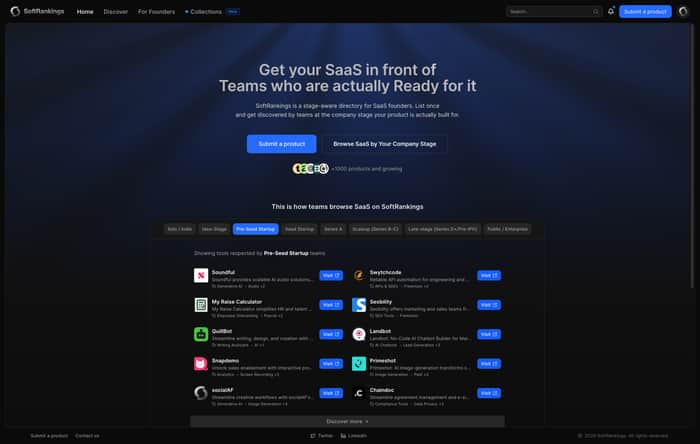
I built a tool directory that doesn't pretend every founder has the same needs
The Problem I Saw
Every time a founder asked me "what CRM should I use?" I'd mentally run
through a checklist: Are they solo? Pre-seed? Series A? Because Pipedrive
at pre-seed is perfect. Pipedrive at Series A is a nightmare.
But all the tool directories (Product Hunt, G2, Capterra) ignore this.
They show you the "top CRM" globally—which is usually built for mid-market
teams with 200 people.
So I did the thing: built SoftRankings.
What It Is
A SaaS directory organized by company stage (Solo/Indie → Seed → Series A
→ Enterprise). Every product is scored across 6 dimensions:
- Complexity (can you get value in 30 min or does it take a week?)
- Pricing (is the pricing founder-friendly or enterprise-y?)
- Integrations (does it work with your other tools?)
- Team Size (is this for solo or for 50 people?)
- GTM Motion (self-serve or sales-led?)
- Adoption Pattern (bottom-up or org-wide rollout?)
Different stages weight these differently. Solo/Indie founders care most
about Complexity + Pricing. Series A cares about Integrations + Team Size.
Why This Matters
When you shop by stage first, you immediately eliminate 70% of the noise.
You see tools built for people like you, not hypothetically the "best" tool.
Current State
1,000+ products live. I score them manually with the SSIE engine (AI +
founder feedback). Founders can claim their product profile and see
analytics broken down by stage.
Launched Jan 1, 2026. Growing steadily.
What I'm Learning
Biggest surprise: Founders didn't realize stage-fit was the primary filter
they were looking for. They kept saying "just show me what pre-seed founders
use"—and that's now the core feature.
Next
Building out the dashboard so founders can see where their product actually
fits (not where they think it fits). That data is gold.
Would love feedback. Hit the site, check your stage, lmk if it's useful.

Strong idea. The stage-based filtering solves a real problem and removes most of the noise.
What stands out is the positioning — “tools for your stage” is much clearer than generic rankings. The scoring system also makes sense and adds structure.
Main risk is scaling and trust. Manual scoring won’t hold long-term, and users will need proof that rankings are accurate.
Big opportunity is to double down on stage-fit as the core feature and make the value obvious сразу.
Overall: solid and useful product with clear differentiation.
You nailed the two things that matter. Positioning clarity is everything, and "tools for your stage" beats any ranking system because it actually maps to how founders think. And yeah, manual scoring is a leverage problem we're aware of—that's the path to either agentic evaluation or building the data infrastructure to make scoring defensible long-term.
This is exactly the kind of approach that makes sense. A solo founder selling on Shopify doesn't need the same stack as a Series A ecommerce team — the tooling needs are fundamentally different at each stage. I've been building Ecom Calc Tools, a set of free calculators for ecommerce fees, profit margins, ROI, ROAS, CAC, CLV, and churn across platforms like Amazon, eBay, Etsy, Shopify, and TikTok Shop. It's designed for quick checks and side-by-side comparisons, which is really what a solo or early-stage seller needs before investing in heavier analytics tools. Would love to see how something like this fits into a stage-based directory!
Exactly. A solo seller on Etsy needs to know if a sale is actually profitable before they scale. They don't need a 6-month implementation or a $500/mo analytics platform. They need a quick calculation that answers "should I take this order" in 30 seconds.
Stage-fit really is the missing filter. “What’s the best CRM?” is basically a trick question without knowing headcount, motion, and budget, and founders waste months wrestling with tools that were never built for their stage in the first place.
I like that you didn’t just make another directory, you picked a strong opinion and built around it. The six dimensions give it teeth too – especially Complexity and Pricing for solo/indie. Curious what’s surprised you most so far from the SSIE scoring and founder feedback: are most tools actually misaligned with the stage they think they serve?
This is a really solid framing — “stage” changes the job-to-be-done more than most people admit. One idea: consider letting tools have a primary stage fit, but also show secondary fits with a short rationale (and maybe different setup templates per stage). For multi-stage tools like Notion/Linear, the value often comes from how you implement them at each stage, not just that they’re usable. A quick ‘why this fits this stage’ blurb + suggested setup would make the rankings even more actionable.
@IndieBuilderVadym351 We have implemented The stage fit analysis section in the product detail page. If it's something else you are asking for, I am open to your feedbacks.
I like the “stage-fit” idea. It’s more useful than another generic “best tools” list.
Most founders aren’t really asking “what’s the best CRM?” They’re asking “what’s the best CRM for my current team size, budget, and level of process?”
One thing I’d find useful is a short explanation next to each recommendation: why this tool fits solo/indie founders, seed teams, or Series A teams. That would make the ranking feel more actionable.
This is a genuine feedback. Thank you so much @xnfigo
We do have a more elaborative section in the product detail page showing why a product is fit for the particular stages.
Connect with me on LinkedIn. I am open to have quality conversation.
this is actually pretty great , now the projects have a wide range of band width across many catogires .
This resonates a lot. The same stage-fit problem exists in marketing tooling — solo founders get recommended the same platforms as Series A teams and end up paying for complexity they'll never use.
Built Amppilot - AI Marketing Platform for Startups (amppilot.com) scratching that exact itch for marketing. Love what you're doing with SoftRankings.
That's a fair point about the stage-fit problem. It's tough when you're just starting out and get overwhelmed by tools designed for much larger teams with different needs.
Hey! @Amppilot_founder12. I'd love to have your product listed on SoftRankings. Could you start submitting amppilot?
The stage-based framing makes a lot of sense, especially the Pipedrive example. The part I keep wondering about is upkeep: a product that fits Seed today often repositions toward mid-market a year later, so its ideal stage quietly drifts. How are you deciding and re-checking each product stage over time, manual review, founder self-reporting, or inferred from signals like pricing tiers? That maintenance loop feels like the real moat for a directory built on this idea.
The maintenance loop is definitely the tricky part here. It would be interesting to see how the categorization shifts over time since companies rarely stay at the same growth stage forever.
Love the stage-based filtering approach. I was exactly this founder on the phone with tool reps asking 'what do solo founders use' versus Series A. The 6 dimensions framework is smart too because different stages truly do weight those factors completely differently. Are you seeing usage patterns where founders stick with their stage category as they grow, or do they jump around? Curious if that's becoming a retention/expansion signal.
The 6 dimensions framework really highlights how priorities shift during growth. Tracking whether founders stick with their initial category or need to pivot as they scale could provide some fascinating insights.
That's precise, it doesnt genralise and also gets deeper in requirement of seperate type of founders, great
This is a smart approach because the "best" tool for an enterprise team is usually just expensive bloat for a solo founder. Focusing on stage-fit solves a massive pain point that those bigger directories ignore, and I’m definitely going to check it out for my own stack.
Interesting approach. I think you're solving a problem that many founders feel but rarely articulate.
Most directories optimize for popularity, reviews, or market share, but the "best" tool is often the wrong tool if it's built for a completely different stage of company growth. A solo founder and a Series A team can have very different requirements even when evaluating the same category.
What stood out to me is the stage-fit concept. As someone working in GTM and lead generation, I've seen teams adopt tools that looked great on paper but created unnecessary complexity because they weren't aligned with the company's current stage.
Curious to see how the founder feedback data evolves over time. It could become a valuable signal for helping companies understand where they actually fit in the market versus where they think they fit.
Congrats on the launch and traction so far.
i just submitted my product . its called OnboardHive waitlist is open for agencies
Do check your email @santhosh_gowda. OnboardHive is now live on SoftRankings.
Link: https://softrankings.com/products/onboardhive
You can now Claim your Product.
Received it mate! Thanks for submitting!
The stage-fit framing really lands. We see the exact same thing in hosting — a solo dev and a 50-person team both ask "what should I use?" and the honest answer is completely different, yet most comparison pages hand them the same "best" pick that's really built for the mid-market. Curious how you handle products that genuinely fit two stages for different reasons — do you let one rank in multiple stage buckets, or force a single primary fit?
This resonates. I'm building a niche security tool right now and the hardest part isn't the tech — it's figuring out who actually needs it at what stage. A store owner who just got served a $25k demand letter has completely different needs than one proactively checking compliance.
Your stage-based filtering makes sense because the "best tool" is meaningless without context. Curious — how do you handle products that genuinely serve multiple stages but with different use cases at each?
the stage-based angle actually solves a real annoyance. half the "best CRM" lists are useless to me because they're ranking for a 50 person sales team and i'm one guy. quick q, who scores the 6 dimensions? if it's you by hand that's a ton of work to keep current, and if it's pulled from somewhere i'd wonder how you catch a tool that's great at seed but kinda bloated by series A. asking because complexity is the score i'd trust most, idk.
Nice work! this is exactly the kind of product that would have saved me so much time early on.
I love that you treated stage as the primary filter instead of pretending one size fits all. The six dimensions feel thoughtful and practical, and weighting them by stage is a clear winner. Manual scoring plus founder feedback sounds like a great way to keep quality high while the AI learns.
Two quick suggestions:
Make the stage-weighting explanation super visible on product pages so founders immediately trust the recommendation.
Add a tiny “how founders like you actually use it” section with 2–3 real examples per stage to turn the abstract fit into concrete workflows.
Excited to see the dashboard analytics, that will be gold for both founders and founders of tools. I checked my stage and already found a few options I hadn’t considered. Keep it up.
Stage-fit is a strong lens. I see the same thing with AI token/API tools: a solo builder often needs cheap access and one compatible key first, while a team starts caring about per-project spend, model-route visibility, fallback behavior, and clean ledgers. That's why I keep positioning Tokens Forge around the job, not just the category: cheaper AI tokens for builders, with usage clarity when the workflow grows. A directory that captures that "what stage are you really in?" context is much more useful than another popularity list.
Love the "stage over popularity" approach. It reminds me of how AI has a similar context problem today.
ChatGPT, Claude, and Gemini are all powerful, but they rarely remember your project between sessions. Better filtering for tools and better memory for AI both reduce the same thing: unnecessary repetition. Great build!
The stage-fit frame is smart. Here's why it works psychologically: founders don't just want the 'best' tool. They want the tool that founders like them use.
A solo founder at pre-seed choosing a CRM isn't comparing features. They're asking 'what do other solo founders use?' because that gives them social proof that the tool won't fail them at their size.
Stage is a proxy for trust. That's why 'show me what pre-seed founders use' was the most requested feature — it's not about filtering, it's about confidence.
Your scoring is the moat. Keep it independent from paid placement and you'll own this category.
Thanks mate! we intend to do keep the scoring independent from paid placements and gaming cheats
The stage based framing is the part most directories miss. The same tool flips from perfect to overkill depending on team size, and a flat top ten list hides that completely. The Complexity dimension (value in 30 min vs a week) is the one I would personally sort by, since most pre-seed founders are time poor, not feature poor. One question: do you decide the stage scoring manually, or is it user sourced? That is usually where directories either stay sharp or drift.
The stage-fit framing is the actual product, the directory is just the wrapper. The thing I'd protect is the scoring data and the founder feedback loop, because that's the part Product Hunt and G2 can't copy and it's also what vendors will pay for later. Be careful with monetization though: the second companies can pay to rank, you lose the trust that makes 'show me what pre-seed founders use' worth anything, so keep paid placement and ranking completely separate.
I like the premise.
Most directories optimize for volume, but buyers usually care about context more than quantity.
Curious, what's the biggest pattern you've noticed about how founders actually choose between similar tools?
The stage-based filtering is the right call. Most tool directories are built for the tool vendors, not the buyers — so they optimize for breadth and star ratings instead of fit.
I ran into the same mismatch from the other side while building Uniclip (a Chrome extension for web clipping and batch data capture). The tools I needed at "building in isolation" stage were completely different from what I needed once I started thinking about distribution and community. Generic directories kept surfacing enterprise-tier options.
One question on the curation model: how do you handle tools that are genuinely good at multiple stages? Do you list them once and tag them, or duplicate the entry per stage? I'd imagine the edge cases around that get messy fast.
The stage based angle makes sense because a tool that's perfect for a solo founder is often a mess at Series A, and the big directories flatten all of that. Something like my WODrounds, a small one time CrossFit timer, gets bucketed next to full gym platforms even though the buyer is nothing alike. How are you sourcing the solo friendly tools, since the best ones for indies are often built by people who never bother submitting anywhere?
As a solo founder, I’m so tired of tool directories pushing enterprise solutions that don’t fit. The stage-based filtering (Solo/Indie first) is exactly what we need.
Checking out the site now. Nice one!
The 'what CRM should I use' question with zero context is one of the most useless questions in founder communities - because the answer is entirely stage-dependent. This solves that. Nice work.
Stage is a much better first filter than a global best-tools list, but I’m curious where it starts to break down.
Two pre-seed companies can still have completely different needs depending on sales motion, technical maturity, and workflow complexity. Have you found cases where operating model mattered more than company stage when ranking a tool?
The stage-aware angle is genuinely smart. The problem with most directories isn't the tools listed, it's that the recommendation is context-free. 'best CRM' means nothing without knowing if you're one person or 50. curious how you're handling tools that work across multiple stages. Do they appear in each relevant category or just the primary one?
Man, this hits. I wasted two weeks trying to force-fit a complex tool early on just because it was #1 on Product Hunt, only to realize it was built for a team of 50. "What do pre-seed founders actually use" is exactly how my brain thinks when I'm looking for software. Keeping an eye on this.
This is a really interesting approach. Most directories optimize for popularity, but founders rarely choose tools based on popularity alone. A solo founder and a Series A startup have completely different constraints, so filtering by company stage makes a lot of sense.
how do you keep a product's score current as it evolves? Linear at seed in 2024 is a different tool than Linear at seed today. Tools don't just move up-market, they change what stage they fit.
Is the SSIE engine re-scoring on a cadence, or does it drift until a founder flags it?
Stage-fit as the primary filter is the right call. I have watched founders bolt on enterprise CRMs at seed because they topped some generic list, then burn six months ripping them back out. The bigger unlock is showing people when to switch tools as they grow, not just what fits today.
I think this is a much better approach than generic “top tools” lists.
The best tool for a solo founder is often completely different from what a Series A team needs.
I'm curious — have you noticed any surprising tools that consistently rank well across multiple company stages?
Great idea
the stage-fit filter is the insight that should have existed from day one on G2 and Product Hunt but never did.
"just show me what pre-seed founders use" is such a cleaner mental model than sorting through 500 reviews from enterprise teams that have nothing in common with your situation.
one question — how are you handling tools that genuinely work across multiple stages? some products like Notion or Linear get used from solo all the way to Series A with very different setups. do they appear in multiple stage buckets or do you pick the primary fit?
stage based filtering makes sense. most tools lists are just seo pages, not decision tools.
this feels closer to how founders actually choose
ran into this building my own PM tooling. tools that make sense at 50 people are a trap for week-1 solo. it's not a preference thing - stage changes the whole problem. the filter should be stage first.
To all Founders, I'd love to have you submit your products to SoftRankings. We are currently working on Founder Dashboards. Our pages have started getting cited on LLMs like Gemini, Chat Gpt, Perplexity, Claude. We further plan to extend the product detail pages by adding Pricing and FAQ sections where founders get to add details about their products that helps LLMs match intent signals from user and get your product detail page cited from SoftRankings. This is a SaaS ecosystem built by a Founder for the founders. We have eliminated chances of Gaming to increase likeness and portray Fake signals.
Love this!
SoftRankings feels genuinely built for founders, not just for rankings. The stage-based approach, founder dashboards, and focus on real intent signals make a lot of sense. I’d be happy to submit my product and see how it fits.
This is interesting — how are you handling API costs?
The specificity move. Most tools try to be everything — you're picking a lane.
What's your hypothesis on which founder segment becomes your fastest-growing cohort?
The ones who find you by accident, or the ones actively searching for "tools made for X"?
Love this idea. Stage-fit is massively underrated. I've seen founders adopt enterprise-grade tools too early and end up paying for complexity they don't need. Organizing software around company maturity rather than popularity feels much closer to how founders actually make decisions. Curious to see how accurate the SSIE engine becomes over time, especially as founder feedback compounds. Great work, Ayush.
The stage-based filtering is the part that stands out to me. A lot of directions assume the best tool for a 50-person team is also the best tool for a solo founder, which usually isn't true. Have you noticed any categories where the recommendations change the most between solo founders and Series A companies?
The stage-fit filter is the right call. I have answered 'what CRM should I use' for founders for years, and the answer flips completely between solo and Series A, your Pipedrive example is dead on. My real worry is upkeep: tools change pricing and positioning constantly, so the manual scoring is both your product and the thing that rots fastest, how are you keeping scores current without it eating all your time?
I like the positioning here. Most directories feel like giant lists where a bootstrapped founder, agency owner, and enterprise team all get the exact same recommendations.
The "different founders have different constraints" angle feels much more useful.
I built a tool directory that doesn't pretend every founder has the same needs. The best tool depends on your stage, budget, and goals—not just what's trending.
Smart angle, i can totally relate to your post.
I agree
Stage-fit is a really useful lens. I’d make the weighting model very visible on each product page, because that’s what turns this from another directory into something founders can actually trust.
Nicely done.
What I'd be careful with is that a reply can sometimes feel like validation while leaving the original question unresolved.
That's usually where things start getting interesting.
Because the visible outcome changes before it's clear what actually changed.
Love this approach! Treating company stage as the primary filter is such a game-changer compared to traditional directories. Finding a tool that matches your current complexity and budget limits saves so much trial-and-error time.
Interesting insight. Stage-fit seems more important than feature lists for early-stage teams.