I built a tool that converts SVG files into 3D letter fabrication files — built solo, free tier available
Hey IH,
I'm a graphic designer who kept running into the same problem:
clients wanted dimensional letters for signage or installations,
and every time I had to either hire a 3D modeler or spend hours
in Blender.
So I built FacLet3D.
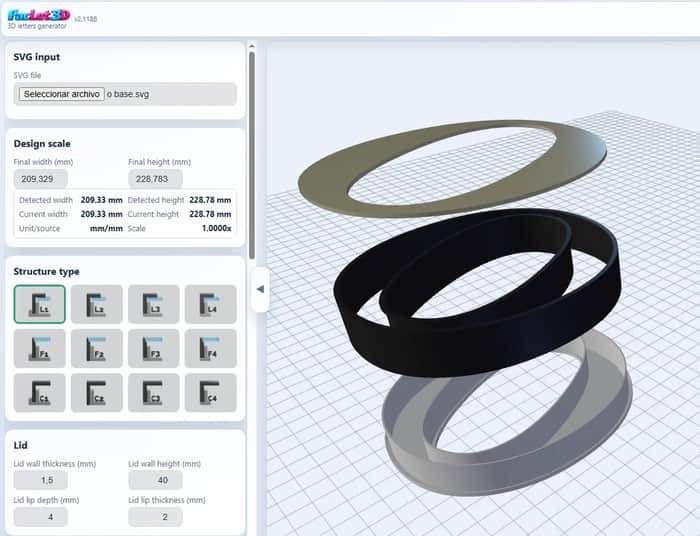
You upload any SVG — a typeface, a logo, any vector shape — and
the app generates STL files for the shell and base, plus a DXF
for the acrylic face. Wall thickness, base structure, tolerances —
all configurable. Live 3D preview in the browser.
Built it completely solo. No team, no funding, no marketing budget.
The hard parts:
- Parsing arbitrary SVG paths with compound shapes and holes
- Generating watertight STL geometry from messy user input
- Building a credit system that makes sense for the use case
Where I'm at:
- Product is live and working
- Free tier available
- Now figuring out how to reach the people who actually need this
(signage makers, print shops, designers)
Would love feedback from anyone who's gone through the
distribution problem with a niche B2B tool.

I know how hard it is to reach niche B2B customers, that's a tough one. I actually know a few signage makers, print shops, and designers who'd probably be happy to answer your questions about distribution.
This is actually a solid tool — especially for signage / fabrication workflows.
One thing though — the current name + domain feels a bit “tool-like” / temporary.
For something like this, where people might rely on it for production work, a cleaner, more brandable name could make a big difference in perceived reliability.
Thanks a lot for the feedback, I really appreciate it.
You’re absolutely right about the importance of a strong, reliable name — especially for something used in production workflows.
In this case, facelet3D was actually just a testing phase / working name. The project has now moved forward and is live under its final branding and domain: PROLED3D.COM, which better reflects the direction and long-term vision.
Thanks again for pointing that out — it’s definitely a key aspect.
This is a good example of a product where distribution matters more than positioning.
Your users already know the pain — they just don’t know you exist.
I’d probably skip broad channels and go very direct:
→ print shops / signage makers (cold outreach with a quick demo file)
→ niche communities (where people already discuss fabrication workflows)
Even 5–10 active users here could compound fast if the output is reliable.
Curious — have you tried putting this directly in front of a few shops yet, or still testing broader discovery?
Yeah, I mostly agree with that approach.
Right now the app has 55 active users in just 19 days online, so there’s already some early validation. It’s getting good traction among colleagues here in Argentina (where I’m based), but the ecosystem is relatively small and there aren’t really strong or large communities.
My main focus now is reaching the North American / English-speaking market, where tools like this basically have no direct competition. That’s where I see the real scaling potential.
I haven’t done strong direct outreach to shops abroad yet — so far it’s been more about organic traction and early feedback. The next step is exactly that: going more direct with specific shops, using real demo files and concrete use cases.
I’d actually push back on that a bit.
Distribution will get you users — but not the right kind of adoption for something like this.
In fabrication workflows, people don’t switch tools just because they see them.
They switch when something feels:
→ more reliable
→ more “standard”
→ like something they can trust in production
Right now “PROLED3D” still reads a bit like:
a functional tool, not a default choice.
So even if you get in front of shops, you’ll get:
→ curiosity
→ maybe trial
but not necessarily long-term usage or referrals
That’s where positioning + brand actually matter more than it seems.
Because in this space, the winner usually becomes:
“the tool people default to” — not just one they discovered.
If you’re serious about the North American market,
the question isn’t just:
“how do I reach them”
it’s:
“does this feel like something they’d trust in production from day one?”
If not, distribution alone won’t carry it.
If you want, I can show you how I’d tighten that so it actually lands as a default tool, not just another option.
..."If you want, I can show you how I’d tighten that so it actually lands as a default tool, not just another option."
Classic ChatGPT response. At least read what you copy and paste. Anyway, thanks for your time, Mr. GPT.
Fair call — that did read like GPT 😅
What I actually meant:
Right now it feels like something I’d try,
not something I’d standardize in a shop.
That gap usually isn’t features — it’s how it comes across at first glance.
If you can make it feel like:
“this is what serious shops use”
instead of
“this is a cool tool I found”
you’ll see a big difference in adoption.