I built a tool to find people already talking about problems your product solves
I spent too many hours trying to find my first users.
Like many indie hackers, I started with the usual approach:
- Search keywords.
- Browse communities.
- Read hundreds of posts.
- Try to guess who might need my product.
But I noticed something interesting:
The best potential users were not searching for products.
They were already talking about their problems.
They were posting things like:
"Is there a tool that can do this?"
"How are you solving this problem?"
"I tried X, but it doesn't work."
Those conversations are basically customer research gold — but finding them manually is painful.
That’s why I built Agenmatic.
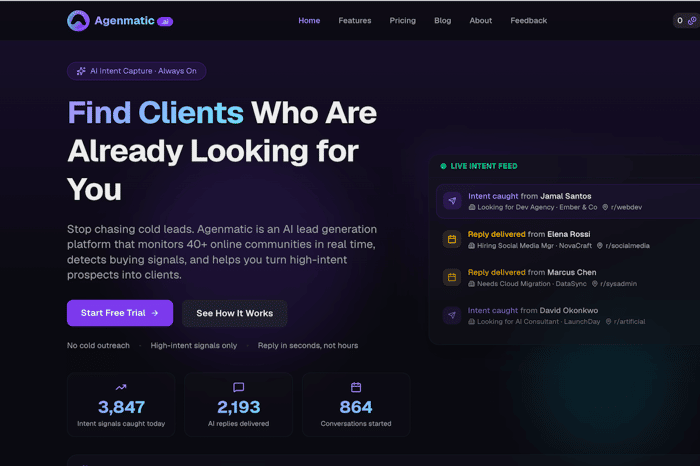
Agenmatic is an AI agent designed to help founders discover people who are already discussing problems related to their products.
Instead of asking:
"Who might need my product?"
You can start with:
"Who is already experiencing this problem?"
By analyzing online discussions and identifying potential customer signals, Agenmatic helps indie hackers and founders discover relevant conversations faster and spend more time talking with potential users.
I'm looking for a few indie hackers to try the early version and share honest feedback.
I'll provide free credits for beta testers.
If you're building a SaaS, AI tool, or side project:
How do you currently find your first users?

This is pretty relevant to what I’m working on. I’m building around AI video, and one thing I’ve noticed is that searching for people talking about “AI video generators” is often too broad. The much stronger signal is someone saying they can’t keep a character consistent, need a longer continuous shot, or are frustrated by regenerating an entire video because one part went wrong.
I’d be curious how Agenmatic handles those implicit pain points when the person never mentions the product category at all. That seems much more valuable than keyword matching for finding early users.
This is actually the approach I'm trying to take with my own product.
We're building a visual website review tool for freelancers/agencies — clients can click directly on a live/staging website and leave feedback on the exact element instead of sending screenshots or scattered messages.
The difficult part isn't finding "web designers". It's finding the people who are actively dealing with client revisions right now.
Would be really interested to see how well Agenmatic can distinguish someone casually discussing a problem from someone who is actually likely to try a solution.
The best signal is usually someone describing a workaround they're unhappy with, not someone naming a category of tool. Worth training it to weight complaints over feature requests.
The hard part is ranking intent, not finding mentions. A useful score should combine explicit problem language, urgency, current workaround, buyer fit, recency, and whether a respectful response is appropriate under the community rules. Then learn from outcomes: reply, qualified conversation, and sale by signal type. That prevents the system from optimizing for noisy mention volume or spammy engagement.
This is exactly what I've been realizing lately. The people who convert best aren't necessarily the ones searching for a product — they're already complaining about the problem somewhere.
I've been experimenting with Reddit for a small desktop AI project, and problem-first conversations have been much more interesting than dropping a product link.
Curious how you're identifying the right conversations without getting buried in irrelevant ones?
Hey, thanks for building this. I’m an indie hacker working on a couple of early products (one is a Barcelona bar itinerary tool, the other helps with Instagram photo selection). Would love to try the free credits you mentioned and give honest feedback.
Great idea. Finding conversations where people already describe the problem is much more valuable than guessing what they need. I’d also pair this with SEO research and competitor/backlink analysis to validate demand. I use SERPSpur for those workflows.
Nice approach. Distribution gets easier when you start from existing problems instead of trying to convince random people they need something.
Disclosure: I run three products, and I've spent the last month doing by hand what Agenmatic automates.
Finding the threads was never the hard part. About 35 Reddit comments in four weeks - on-topic, disclosed, one of them the first comment on a post from someone saying outright they wanted to buy. Result: 2 karma and zero replies, ever. Comments of the same quality on Indie Hackers produced five real conversations. Same person, overlapping weeks.
The variable is whether a platform lets a new account be heard at all. You can pick the thread. You can't buy the standing, and that's what your month-two churn will be about.
So the feature I'd want: score the account, not just the thread. "This sub needs 30 karma, you have 2" beats a tenth match, and it's a public number you can look up.
The right framing for this is the difference between push and pull outreach. Most founders do push: pick targets, manufacture a reason to reach out, send a message. What you're describing is pull: find the people who are already in the problem and show up in their conversation.
The compounding insight is that the response you send to a pull signal is structurally different from a cold message. When someone has publicly stated "I tried X and it doesn't work," a reply that says "I built something that handles this, here's the specific part it solves" reads completely differently than unsolicited outreach. The social proof is already in the thread. The credibility comes from being in the right place at the right moment, not from the message itself.
The failure mode I've seen with tools like this isn't the discovery layer — it's what happens next. Founders who get a perfect signal still send generic "Hey, I noticed you mentioned X, we solve that" messages. The signal just tells you who to talk to. You still have to say something worth reading.
Building Genie 007, we ran into this exact thing. The detection part worked early. The response quality was the bottleneck for months. Does Agenmatic help with the message side at all, or does it stop at surfacing the thread and leave the response to the founder?
Built something adjacent (evidence side, not outreach side) so I'll share the two things that bit me hardest, since you'll probably hit both.
One: mention frequency lies to you. Early on I had ~300 posts that all matched "people asking for a tool" patterns, and it took embarrassingly long to notice they were 300 different requests that each appeared once. Volume on a theme feels like demand, but it's only real when independent people keep describing the same problem. If Agenmatic can separate "this exact complaint keeps recurring across different authors" from "lots of vaguely related one-offs", that's the difference between customer research gold and a pile of tabs.
Two: keep the person's literal words visible, not a summary. Every summarization layer I added shifted the emphasis a little, and a founder replying based on the paraphrase gets the tone subtly wrong — which reads as spam even when it isn't. The exact sentence someone wrote is the thing that tells you whether your product actually fits.
Curious how you're handling the first one — dedupe/clustering across threads, or is each surfaced thread treated independently?
I would be careful not to optimize this around volume. For first-user discovery, the most useful output is probably a small queue with context: why this person looks relevant, what pain they expressed, whether a reply would be welcome, and what the next non-pushy action is. Otherwise founders may just get faster at interrupting people. The product feels strongest if it helps them become more specific and patient, not just louder.
This solves the 'outbound' discovery brilliantly
But here is the strategic layer I am not seeing in the thread: while yoa are helping founders hunt for leads on Reddit, how do those same founders find Agenmatic itself?
The real moat is not just finding the conversation it is owning the search terms around that problem. If you rank for the exact pain points you are tracking, the inbound traffic outlasts any manual outreach.
Smart build, Aidenyum. Curious to see where you take this.
The angle nobody's touched yet: even if Agenmatic nails the discovery (the right threads, the right signal), you still need a human to read each one, decide if it's worth a reply, and then actually remember to follow up if the thread goes somewhere. I've watched founders get a list of 15 promising threads and let 12 of them go cold within a week, not because the leads were wrong, but because there was no system tracking which ones needed a reply, which ones already got one, and which ones turned into a real conversation worth revisiting. Discovery solves "who do I talk to." It doesn't solve "did I actually follow through." Are you thinking about that layer at all, or is Agenmatic staying scoped to surfacing the threads and leaving the follow-through to the founder?
You highlight the real filter.
The explicit tool request is a crowded race. The unspoken frustration is the untapped gold.
Catching that implicit pain without clean keywords is the difficult task. That distinction decides if Agenmatic is a keyword monitor or a true intent engine. That is where the real product value lives.
Meer
Agreed, and it is worth noting those two problems need different muscles. Spotting the implicit pain is a language problem. Not losing track of it once found is a memory problem. Most tools that are good at one are mediocre at the other. I would rather see Agenmatic nail the first and stay honest that someone still needs a system for the second, than try to be both and do neither well.
On the "how do you find first users" question: the tactic works, but I'd push on which conversations you go after. The "is there a tool for X" posts are the obvious signal, and that's the problem, every competitor is watching the same keywords, so you're the 6th founder replying in the thread. The higher-converting signal is people describing the problem without knowing a tool exists, or complaining about a named competitor, because nobody else is in those replies. Those are harder to catch since there's no clean keyword. Does Agenmatic surface the "problem described, no solution asked for" conversations, or mostly the explicit "recommend me a tool" ones? That first bucket is where the actual edge is.
This would've saved me a lot of manual scrolling through Reddit
and Facebook groups trying to find people already discussing the
exact problem my product solves. How does it handle telling apart
someone genuinely venting about a problem vs. someone just using
the keywords in passing?
The discovery problem you're solving is real, but it's only half the funnel. I've been finding my first users manually, no tool, by answering questions in exactly the way you described, someone typing "is there a tool for this." The harder part hasn't been finding those posts. It's that replying to a stranger's problem with a solution and a link reads as spam even when the intent match is perfect. What's actually worked for me is showing up without linking anywhere first, building enough of a track record in a community that when I do mention what I'm building, it's not the first thing they've seen from me. A tool that surfaces the right conversation doesn't shortcut that trust-building step, it just tells you where to start doing it. I'd be curious whether people using Agenmatic convert better when they reply, or just find more candidates faster.
This will help people to validate their idea and to understand their market aswell.
I always feel customer research is one of those things everyone knows they should do, but very few enjoy doing manually. Interesting approach.
Two structural things worth thinking about, neither of them about detection quality.
First, the failure mode lives on the action side, not the discovery side. There is a post on the front page right now from a founder who got banned on Reddit four times in his first month leaving on-topic comments with no links at all, because filters read account age and velocity rather than intent. A tool whose job is to increase the number of threads a founder replies to is, by construction, manufacturing exactly the pattern those filters punish, and the founder will blame the tool for the ban. That argues for deliberately capping output instead of maximizing it: five threads a week where a reply is genuinely welcome beats fifty, and a hard cap makes your precision problem much easier to solve at the same time.
Second, the retention math concerns me more than the competition does. "Find my first users" is an acutely painful job for roughly six to eight weeks, and then it resolves one way or the other, either traction or quitting. So this is a structurally churny wedge unless there is a second job the same listening layer does in month four: monitoring complaints about competitors, sourcing content from how people actually phrase the problem, or feeding support and roadmap. Deciding which one that is now will change what you build next.
What does week-4 retention look like against week-1 for the beta founders? And are you measuring anything downstream of a surfaced thread, like replies sent and replies that got a response, or only threads surfaced? Discovery counts are easy to push up and tell you almost nothing about whether the product worked.
One calibration risk I’d watch is optimizing for “this post looks relevant” instead of “a helpful reply here is actually welcome.”
I’d separate two scores:
Problem signal: how much evidence is there that this person is experiencing the problem?
Engagement fit: is this a conversation where a founder can naturally contribute without turning it into outreach?
The second score could consider whether the person explicitly asked for tools or advice, how recent the pain is, whether they describe an active workaround, and whether the community/thread context makes product discussion appropriate.
Then I’d collect downstream labels beyond “relevant / irrelevant”:
founder opened the thread
founder commented
original poster replied
conversation continued
trial or customer conversation eventually started
A match can be semantically perfect and still be a bad lead if the social context makes any product mention unwelcome.
I’d probably optimize the top 10 for conversations that earn a response, not simply posts that look relevant.
Are you planning to let downstream conversation outcomes influence the ranking, or only the initial relevance feedback?
The best signal is usually someone describing a workaround they're unhappy with, not someone naming a category of tool. Worth training it to weight complaints over feature requests.
The real challenge with this kind of tool isn't finding the threads, it's knowing how to jump in without triggering the 'spam radar.' Most people just copy-paste a pitch as soon as the tool alerts them, which usually kills the lead instantly. Instead of looking for new mentions, try filtering for the ones where the person is asking for a comparison or complaining about a specific technical bottleneck. If you can provide a zero-fluff answer to their technical question without mentioning your tool at all, the conversion rate on your bio link will be infinitely higher than a cold outreach reply.
This is genius.
As a solo founder I spend hours trying to find where people are talking about AI tools and content problems.
How accurate is it for finding real buyer intent vs just random mentions?
Would love to try this.
Searching from "who might need this" to who is searching for the solution of the problem" is a meaningful shift. You have a solid saas which solves the almost all the saas owners face in the beginning. Many of the saas shut down because they do not reach the users who would pay for the saas.
I would also suggest that you submit the saas on many different directories and platforms for SEO and getting backlinks. Listifying.com can help you with this.
That shift from "who might need this?" to "who is already describing the problem?" is exactly how we think about community research. For Speechara.Ai, the strongest signal is not someone mentioning transcription, but someone describing a workaround for a multilingual meeting or a missed detail. We now look for a concrete pain, what they tried, and whether the workaround is recurring before mentioning the product. How are you weighting recurring pain versus one-off frustration?
Right now it is mostly manual, I onboard the first founders one at a time and pay attention to what they are already complaining about in build in public threads before I ever mention what I am building. The pattern you describe matches what I keep running into, the strongest leads never search for a solution, they just describe the annoying workaround they are living with. Curious how Agenmatic tells the difference between someone venting once and someone with a recurring problem worth solving, that distinction seems like the hard part.
This is one of those ideas that sounds simple but solves a real pain point. Most founders spend weeks building a product and then wonder where to find customers. Starting with people who are already discussing the problem flips the process entirely. You're not creating demand—you're finding existing demand. That's a much smarter approach than blasting cold DMs or relying solely on ads. Curious to know what data sources you're using and how you filter out low-intent conversations.
I've been doing this manually for DictaFlow, and the biggest mistake is mixing up topic relevance with intent. A post about voice AI is usually just noise. But someone saying built-in dictation keeps failing in Outlook is dealing with a real problem. I'd score freshness, clear frustration, and signs of a workaround or tool switch on their own, then show founders why each result matched. That explanation matters more than another keyword hit.
The ranking and explanation layer may matter more than discovery itself. For each match, I’d show the exact sentence that triggered it, source, recency, and confidence, then let beta users mark it relevant or irrelevant. That creates useful labeled data and makes the result auditable. I’d also track precision in the top 10 and reply rate—not just conversations found—because a large feed with many false positives simply moves the manual work downstream. How are you measuring false positives today?
The shift from 'who might need this' to 'who is already experiencing this' is exactly right. I've been finding my first users by commenting helpfully in founder communities — same principle, just manual. Curious how Agenmatic handles low-volume niches where the signal is sparse.
Had a look at your landingpage, it looks really clean but i am left with a few questions. First, which communities are you monitoring. You are saying Reddit, HackerNews, Indehackers + more. The + more here is interesting. Hackernews and indiehackers arent that usefull unless you are building a product for other founders / engineers. Reddit is usefull but you have a ton of competition here so from the landingpage i am not sure what makes your tool different from the competition
The shift from “who might need this?” to “who is already experiencing the problem?” is the interesting bet here.
From the founders testing Agenmatic so far, are you seeing evidence that the conversations it surfaces actually lead to more meaningful first-user conversations than the prospecting methods they were using before?
I think you're solving a real problem. One thing I've noticed while looking for beta users is that the hardest part isn't finding people—it's finding people who are actively feeling the pain today.
Searching communities manually works, but it's incredibly time-consuming and easy to miss relevant conversations. If Agenmatic can reliably surface those intent signals instead of just matching keywords, I think that's where the real value is.
I'd be interested in trying the beta and seeing how well it distinguishes genuine buying intent from general discussion. That seems like the hardest part of the problem.
The interesting thing about this product is that the value isn't really "finding people" — it's finding people who have already raised their hand by talking about a problem.
That distinction matters because founders usually don't struggle with a lack of possible leads; they struggle with knowing which conversations actually signal buying intent.
I’d be curious how you’re positioning that difference on the homepage. The strongest opportunity I see is making the intent angle impossible to miss, because that’s what separates this from another lead database or monitoring tool.
I noticed a couple of other messaging points that could affect conversion too — happy to share thoughts if useful.
I'd love to try it out and be part of the beta testing.
RRKBXYHT After you try it out, I’d really appreciate it if you could share your feedback.
This is such a smart idea. If you can collect all these scattered ideas, analyze them, and find the patterns, you might uncover some really valuable opportunities. That’s where the hidden gems are.
This is exactly a problem I’m facing right now.
I spend a lot of time searching Reddit and communities for people who are already talking about problems my product solves. Finding real user intent is the hardest part.
I’d love to try Agenmatic and share feedback. Thanks for building this!
4SLG8PZE Looking forward to your feedback.
This comment was deleted 2 months ago