I built a WhatsApp AI bot for doctors in Peru — launched 3 weeks ago, 0 paying customers, and stuck waiting for Meta to approve my app
I'm Jordy — solo dev from Chimbote, a small city in northern
Peru you've probably never heard of.
Here's the problem I kept seeing:
Patient: "Can I get an appointment tomorrow?"
Doctor types back manually: "What time works for you?"
Patient: "3pm?"
Doctor: "Let me check... actually 3pm is taken, how about 4?"
Patient ghosts. Appointment lost.
That's happening 30+ times a day in every small clinic
in Latin America. All on WhatsApp. All manual.
I decided to fix it.
What I built
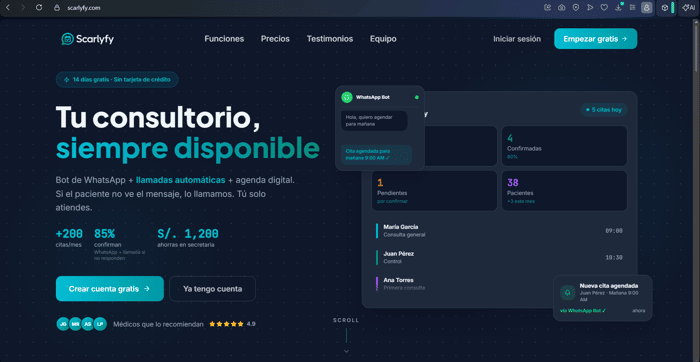
Scarlyfy is a WhatsApp AI bot + digital calendar for
independent doctors and small clinics in Latin America.
The bot runs 24/7:
→ Patient texts → bot checks availability → books the slot
→ Sends automatic reminders before the appointment
→ If the patient doesn't confirm via WhatsApp, the system
automatically calls them via phone (powered by Twilio)
→ Doctor gets a clean dashboard — zero manual work
No-show rates drop. No humans needed.
Tech stack: FastAPI + React + PostgreSQL.
AI via OpenAI. WhatsApp via Meta Business API.
Calls via Twilio.
The painful part nobody warned me about
To send messages via WhatsApp officially, Meta has to
approve your app first.
I submitted on May 13th. It's now day 15.
Estimated wait: 10 days.
There's no way to contact human support while it's
pending — only if it gets rejected. So I'm just
sitting here, product ready, waiting in silence.
That's my only blocker right now.
Honest status
✅ Landing live: scarlyfy.com
✅ Full backend (auth, multi-tenant, appointments, webhooks)
✅ 14-day free trial ready
✅ Starting at $22/month
❌ Meta review pending (day 15)
❌ 0 paying customers
What building this taught me
The code was the easy part. The real challenges:
- Third-party approvals you can't control or rush
- Doctors don't speak "SaaS" — they want
"will this save me time?" not "what's your stack?" - In LATAM, most clinics still use a paper notebook.
You're not competing with software. You're competing
with habits.
My ask
Has anyone here gone through Meta's WhatsApp Business API
review? How long did it actually take?
If you know doctors or clinics in LATAM drowning in
WhatsApp messages — I'd love to connect.
→ scarlyfy.com — 14 days free, no credit card needed

The Meta approval bottleneck is brutal — you're essentially
building on a platform that can pause your entire business
with one decision.
Curious: have you explored whether your target users
(doctors) would use a web-based version as a stopgap
while waiting for Meta? Sometimes the "worse" channel
gets you your first paying customers faster.
The 0 paying customers after 3 weeks is actually useful
data. Is the blocker purely the Meta approval, or have
you also been unable to do sales conversations in the
meantime?
Hi Jordy, Your Scarlyfy launch has a real, visible constraint—Meta approval—and a clear next milestone beyond simply saying you are building. I’m building Build Before 2030: a manually reviewed public record where makers claim a Founding 100 number, set one measurable 30-day milestone, and later add proof of what shipped. The first cohort is free. Scarlyfy feels like a strong fit. Interested? https://buildbefore2030.com
The Meta approval wait is genuinely brutal - you're doing the right thing by using the downtime productively.
One thought on differentiation while you're waiting: WhatsApp supports image URLs in messages, and that opens up a feature most bots don't have - personalized visual confirmation messages. For medical use cases, this could be a personalized appointment card generated on the fly (patient name, time, doctor, clinic logo) that looks like a proper document rather than a text string.
The way it works: generate an image URL dynamically with the appointment details embedded, send it alongside the text confirmation. The patient gets something they can screenshot and show at reception. Adds perceived value without much complexity.
We built @OKZest for this kind of URL-based image generation - originally for email, but it works anywhere that accepts an image URL, including WhatsApp. Might be worth a look if you want a visual layer on top of your bot.
Using a Twilio voice escalation layer as a deterministic fallback for unconfirmed appointments is excellent system architecture. Most WhatsApp integrations stop at egress delivery, creating an unhandled exception when a patient goes dark.
One post-production metric to monitor closely is the precision of your LLM intent classification. Ambiguous inputs like "3pm?" versus "maybe 3?" require distinct confidence thresholds, misclassifications here will directly degrade your downstream booking conversion rates.
What does your fallback logic look like when semantic ambiguity drops the intent classification confidence below your activation threshold?
3 weeks + 0 paying while waiting on meta is that special kind of limbo where you refresh the dashboard at 2am. been there, it sucks. but honestly it's probably not your real problem.
in LatAm health nobody switches because the tech works, they switch because some clinic owner they respect already did it. so the meta wait is kinda free time. go be the bot by hand for like 2-3 clinics in chimbote, you on whatsapp a week each. boring and unscalable, which is exactly why it'll work.
those first few aren't really beta testers, they're more like founding partners. lock in their rate, give them an actual say. (that's basically the thing i'm building groundwork around, so this trust-first b2b stuff is my whole world rn. happy to compare notes)
Jordy, the Meta review is out of your hands so I would stop refreshing it and treat these 10 days as free runway to kill your other risk: you do not actually know yet if a clinic will pay. Zero customers right now is a data gap, not a product problem.
Three things you can do this week without sending a single WhatsApp message:
Pick 15 to 20 clinics near you in Chimbote and message the doctor or front desk yourself, not the bot. Lead with the pain, not the stack: "how many appointments do you lose a week to no-shows and back and forth on WhatsApp?" Their number becomes your pitch.
Turn scarlyfy into a "reserve your spot, we onboard you the day Meta approves us" page and collect an email plus one question (clinic size, rough no-show count). Even 10 to 15 real signups means launch day is warm instead of cold.
Ask the warmest two or three for a soft commit now: a card on file for the trial, or just "yes, I will start the day it is live." A yes before you can even send is exactly the validation you are missing.
On your habits point, you nailed it. You are competing with a paper notebook, so the demo that wins is "watch it book an appointment while you keep using your notebook," not a feature list.
Full disclosure, I build a small tool for this exact pre-launch step, a waitlist plus a short validation survey, called Lighthouse. But a carrd page and a Google Form cover the same ground here, so do not let tooling slow you down. The point is to walk out of the Meta wait holding a list of clinics who already said yes.
Hola, the Meta Business Verification queue for medical-adjacent use cases in Peru and Argentina runs 4-6 weeks in 2026, not the 14 days the docs imply. Two things that have moved approvals faster for builders I know in the region: a real .pe domain registered to a verifiable clinic partner before submission, and the chatbot use-case template set to "appointment scheduling" not "AI assistant", because the latter triggers manual review. The doctors will sign up after the green checkmark, not before. Solid signal that the code-vs-distribution ratio is exactly inverted from what most LATAM founders expect.
Three weeks is too early to read the signal, but the part to fix today is the demo loop. WhatsApp B2B in LATAM converts when the doctor sees their own patient flow happen inside the bot in under 60 seconds, not when they read about the product. Run 10 in-person 15-minute sessions in clinics this week, watch which questions they ask, and you will know what to charge for by Friday. Source, I spent 18 months selling SaaS in Asuncion clinics, the loop is identical.
The Meta approval wait is brutal, especially when you can't really do anything while it processes. I'm hitting a similar gatekeeper problem with a Chrome extension on Google's side, they classify the Drive scope I need as "restricted", which means a paid CASA security audit (~$500/year recurring) to remove the "this app isn't verified" warning users see on first install. Until I pay it, every install carries that friction.
The platform's review process becomes part of your product launch whether you like it or not...
Since you're stuck waiting anyway, are there doctors in Chimbote you can onboard manually, outside the bot, just to see if the workflow you've designed actually saves them time? 2 or 3 real users using it would tell you a lot about willingness to pay.
The Meta review silence is the worst part — product ready, zero control. Use the wait to warm up clinics so you're not starting from zero when it clears. Good luck.
Interesting problem space.
Have you considered charging based on appointments booked or no-shows prevented rather than a fixed subscription? For many small clinics, tying pricing directly to value created could make adoption easier.
Really relates to the third-party approval problem. I hit the same wall with Meta Business API for a client pipeline. 15+ days is normal unfortunately, some people report 3-4 weeks. Your positioning is sharp though: "competing with habits, not software" is exactly right for LATAM markets. How are you reaching doctors right now while waiting for approval?
You are already using Twilio for the calls, and Twilio is an official WhatsApp BSP. You may be able to launch through Twilio's WhatsApp sender now instead of waiting on direct Meta Business API approval. That could remove your only stated blocker today, so it is worth an hour to check before you sit idle another week.
I would also push back on calling Meta your only blocker. The real one is right in your honest status: 0 paying customers. The wait is actually a gift. Nothing stops you from pre-selling pilots now, even running the first two or three clinics concierge-style on a normal WhatsApp number while the API clears. Close paying customers before the integration is perfect.
On habits, you named the hard part and then under-priced the fix. Clinics on paper notebooks do not buy software, they buy someone who shows up and sets it up for them. Sell the install, not the app. Sit with one doctor for a day, migrate the notebook, get no-shows down in week one, and let that clinic become your case study and referral engine. At 22 dollars a month you cannot afford that hand-holding, so charge more and do less but better.
am money mule agent
I help hackers, politicians , billionaires to transfer millions of dollars illegally (money). You can hack directly in to my crypto wallet or bank account and I will transfer to any account you will provide to receive the funds with 24hrs. i have work with top politicians, billionaires, individuals, businesses, companies, etc in the world to transfer money successfully. All transactions when successful and smoothly.
I have a company which is legally registered and have it bank accounts at USA , UK 🇬🇧. And have verified crypto wallet binance wallet than can receive the following
Fiat Deposit & Withdrawal Limits
2M USD Daily
Crypto Deposit Limit
Unlimited
Crypto Withdrawal Limit
8M USDT Daily
P2P Transaction Limits
Unlimited
WhatsApp me : +1 (667) 283-7737
Hey, fellow AI builder here. I'm also in the AI space (TTS) and hit the same wall early on. What worked for me was shifting from "build features" to "find where users already hang out." Have you tried posting in medical/health tech communities? Sometimes the distribution is more important than the product at this stage.
The Meta approval wall is brutal
no ETA, no human to ping, product ready but stuck.
Been there with third-party dependencies that gate your entire go-to-market.
One thing that helped in similar situations: onboard your first users anyway on a waitlist or manual flow, so you're not starting from zero when approval lands. Doctors who said "yes" in week 1 rarely say yes again in week 4.
How are you handling the multi-tenant side — one WhatsApp number per clinic or shared?
I feel this is a spectacular idea really love it
Same boat — launched, real users showing up, zero revenue so far. The thing that's helped me most this week was instrumenting where people actually drop off instead of guessing. Found out my users were getting a flat, non-committal output that gave them no reason to convert. Out of curiosity, do you know where your doctors fall off — is it before they try the bot, or after they've used it and just don't pull out a card? That distinction changed everything about what I worked on.
Really impressive work Jordy! Building for LATAM
doctors is a smart niche — you're right that you're
competing with habits, not software.
On the Meta review — from my experience it usually
takes 2-4 weeks for the first review. A few tips:
2-3 real messages before submission
data handling specifically
Business Manager notifications, not email
While waiting — you could start outreach to doctors
directly via email or LinkedIn, showing a demo video.
Don't wait for Meta to start getting customers!
Good luck — the product looks solid
the 'competing with habits, not software' line is the sharpest insight here. we run an AI coach on WhatsApp too (different niche — AI skills) and the adoption difference vs a web app is night and day. people just reply like they'd text a friend.
one tactical thought: $22/mo is solid for LATAM but you might get more traction framing it as cost-per-recovered-appointment. if a no-show costs them $15-20 in lost revenue, you only need to save 1-2/month. makes the ROI conversation trivial.
re: Meta — the silence is genuinely brutal. no timeline, no status page. hang in there.
Muy buen problema detectado bro. Yo también soy de Perú, te recomiendo usar Kapso en caso quieras ejecutar rápido para que muestres algo a posibles clientes mientras sale lo de la aprobación de Meta. Tiene un plan free y es muy bueno.
Fascinating execution on targeting a real pain point in LATAM healthcare. Your point about competing with habits rather than software is spot-on—that's often the harder sell. The Meta approval bottleneck is a real challenge for API-dependent products. Have you considered workarounds (SMS fallback, direct dashboard access) while waiting for WhatsApp approval? Also interested in your unit economics—how does the 24/7 automation with Twilio calling impact your cost structure? Rooting for the Meta approval to come through soon.
The approval delay is frustrating, but it may also be useful time for validation before the full workflow is available.
Since the pain point is clear, I would consider offering a simple manual or semi-manual pilot to a few clinics while waiting for Meta. That could test whether doctors are willing to pay, which part of the workflow matters most, and whether the main value is booking, reminders, or reducing no-shows.
The point about competing with habits rather than software is important. A lightweight on boarding process may matter as much as the technology, especially if clinics are still using notebooks and WhatsApp manually.
the meta/whatsapp business api approval queue is the silent killer of latam-targeted bots. the workflow value sounds real - doctor appointment friction on whatsapp is huge in your market. while you wait, two things worth doing: (1) get a couple doctors to install you on the personal whatsapp api / cloud api numbers so you have actual installs to point at when meta reviews, and (2) start collecting "would pay if working" letters from doctors who already saw the demo. neither moves your meta queue but both buy you proof on day one of approval. the meta delay isn't a "no", it's a "wait" - hold the line.
For the Meta review specifically - medical-adjacent apps tend to get extra scrutiny and longer queues. A few builders I've seen get unstuck tried reframing their support ticket as a "business verification" question rather than an app review inquiry. Different support queue, sometimes faster to get a human response. Worth trying while you wait.
Also the 0 paying customers framing is worth questioning. Nobody can pay if they can't access the product yet - the gate is the blocker, not the market.
Different angle from yazhijazi (whose free-tool wedge is good): for LATAM doctors, the landing isn't the conversion tool, it's the confirmation tool. They don't sign up cold from a website. They sign up because another doctor they trust already runs it.
Practical move: pick three Chimbote clinics, install Scarlyfy free for two months in exchange for one named testimonial each plus a 90-second WhatsApp video from the doctor saying "this saved me X no-shows last month." Drop those three videos into the hero. Cold doctors won't read your features, they'll watch the second video and message the doctor in it.
The page copy is solid. The 0-paying-customer thing is fixed at the social-proof layer, not the page layer.
Side note for when you do tune the hero: subhead "Bot de WhatsApp + llamadas automáticas + agenda digital" reads as a feature stack. Could test naming the outcome instead, something like "30 citas confirmadas al mes sin que tú escribas un mensaje." Names what the doctor feels in his calendar, not what's under the hood.
If you ever want a deeper hero pass on the Spanish page, the €25 written audit format lives at pandologie.com/roast/example/. Otherwise the social-proof play above is the cheaper fix.
Familiar territory — I'm 2 days into a launch sprint for a finance-education app and also at 0 signups so far. The pattern I'm noticing in research is that single-purpose B2B tools (like yours for doctors) usually need a wedge that's free and shareable BEFORE the paid product hits. We built a free take-home pay calculator that lives at the same domain as the app — it's the wedge, not the product. Have you tried something similar for the doctor audience — a free QuickRef tool, drug-interaction checker, anything they'd use even if they don't buy the bot? Curious if Peru's regulatory environment lets you do that.
This is a nice idea to solve. But did you check if there are other similar apps doing same? How are you differentiating ?
The WhatsApp API integration is underrated for B2B conversion — we've used it in a CRM we shipped for a property portal and it doubled inquiry-to-response rates. The 0 paying customers issue at week 3 is almost always a positioning or outreach problem, not a product problem. Are you reaching out to doctors directly or waiting for inbound? Happy to share what worked for us.
The Meta approval wait is genuinely brutal. You've built the whole thing, you have a real problem, real users lined up — and then you just sit there refreshing a status page.
The LATAM insight is the most interesting part of this post to me. "Competing with habits, not software" is something most Western SaaS thinking completely misses. A paper notebook has zero switching cost for the doctor. Your real sales job is convincing them the 10 minutes it takes to learn the tool is worth it — not that your features are better than the competition's.
One thing worth trying while you wait: can you demo the bot on a test number and record a 60-second video showing the full patient conversation flow? Doctors don't want to read about it. If they can watch a patient text in and see an appointment get booked automatically, that's the whole pitch.
Hope the approval comes through soon.
while you're waiting on Meta, the 15 days of silence is actually not wasted time if you use it right. can you get 3-5 doctors to commit to the free trial the moment approval comes through, not just interest but a specific date and time they'll start. that list makes the launch moment real and gives you actual feedback faster than waiting to see who signs up organically after approval
Hi Jordy, I would suggest while waiting for meta approval to use waha API to validate your project.
Hey ! Building almost the exact same
thing for India — WhatsApp AI bot for
interview scheduling in HR.
Facing similar challenges around the
WhatsApp API problem.
Would love to connect and share learnings —
we're solving the same problem in different
markets!
The waiting game with Meta's approval process is brutal, especially when you've got a working product ready to go. I've dealt with similar third-party API delays before and it's frustrating how there's zero transparency or way to expedite. Your point about competing with habits rather than software really resonates. Have you considered building in public about the waiting experience itself or maybe starting outreach to clinics now so you have a pipeline ready when approval comes through?
this is so cool love the idea wishing you the best
ran into this on another platform - you finish the product but the approval gate isn't yours. Meta's WhatsApp healthcare queue is brutal. the bot works, the docs are waiting - just stuck in a queue you can't move.
That insight about competing with habits rather than software is one of the most underrated challenges in any market where digital tools are still the exception — the sales pitch isn't about features, it's about convincing someone to change their daily routine, which is a completely different conversation. While waiting for Meta, it might be worth asking a willing clinic to go through the full booking flow manually (you or someone playing the role of the bot) just to get them used to the experience and capture any friction points. Even getting 1-2 clinics to trial it that way gives you real usage data and potentially your first paying customer before approval comes through. Have you been doing in-person demos with doctors, or mainly trying to reach them remotely?
While Meta is pending, I would not wait to validate. Treat WhatsApp as the final delivery channel and sell the workflow manually for 5 clinics this week: take their appointment rules in a shared calendar, have them forward patient messages to you or a test number, and send confirmations/reminders yourself for a few days. The thing to validate is not the bot, it is whether the doctor will change the appointment habit and pay when fewer slots get lost.
If 3 doctors will let you shadow the current WhatsApp flow and one will prepay or sign a simple LOI before the API is approved, you have a real wedge. If they only say "cool" after a demo, I would fix the sales promise before touching more code.
Wow Keep Going thats brillant !
This really resonates — "you're not competing with software, you're competing with habits" is one of the most underrated insights in B2B SaaS, especially when targeting small operators who've been running the same workflow for years.
The Meta approval bottleneck is brutal. One thing worth trying while you wait: can you offer a "lite" version that works over SMS or email instead of WhatsApp? It won't be the full product, but it lets you start collecting real usage data and testimonials without being gated by a third party. Paid customers also tend to move Meta reviews along faster when you can show active business use.
I'm building something adjacent — an AI operating system for solopreneurs that automates follow-ups and client management. The exact same friction you're describing (people knowing they need it, but not changing behavior) is what I'm trying to solve too. Would love to stay in touch as we both figure this out.
What's been the reaction from doctors you've demoed it to? Do they get it immediately, or does it take a few minutes to click?
"You're not competing with software. You're competing with habits."
That line probably deserves to be framed.
The product sounds useful. If I were in your shoes, I'd spend the waiting period building a list of clinics ready to test the moment Meta approves. That way approval becomes a launch day rather than the start of customer acquisition.
Your product is meaningful. However, I believe the customer range might be small. You can try the market with a bigger range. For example, from the clinic in Peru to clinic worldwide?
Thanks for posting. I enjoy these threads about the real-world headaches with big company APIs and how their sandboxes actually perform. Have you considered going Linux direct and skipping the Meta sandbox altogether? I haven’t done much with Meta’s APIs myself — just tried setting up a Facebook page to promote my own projects — but it felt so restrictive that I stopped and went in a different direction.
I think the biggest positive signal here is that you picked a very specific audience instead of trying to target everyone.
The Meta approval delay is frustrating, but it's probably a temporary problem. Understanding whether doctors actually want the product is much more important long term.
What has been the most common feedback from your early users so far?
The Meta API approval bottleneck is so frustrating when you've got everything else ready to go! Your insight about competing with habits rather than software really resonates - I've seen so many technically solid products struggle because they underestimate that change management aspect. The Twilio integration for voice fallback is clever, especially for the demographic where WhatsApp confirmations might get missed. Hoping your approval comes through soon so you can actually test those conversion numbers in the wild.
This is useful context. I'm a UX/UI designer + full-stack dev researching WhatsApp-first ops tools for small businesses in South Africa, and your point about competing with habits instead of software really stands out.
When you spoke to doctors/clinics, what felt like the bigger blocker: trusting automation with patients, changing their existing WhatsApp workflow, or proving that missed appointments/no-shows cost enough to pay for the tool?
The Meta review bottleneck is brutal — especially when the product is ready and you're in "ship or die" mode. One thing I've seen work in similar situations: use the waiting time to do manual outreach to 10-15 clinics and offer them a personal onboarding call. Doctors in LATAM respond much better to direct conversations than landing pages. You also get invaluable feedback on your positioning — because you're right, "will this save me time?" is the frame that closes, not the feature list. The paper notebook competition point is underrated. You're not replacing software, you're replacing a behavior. That's harder but also stickier once you win.
Have you thought about getting some help with promoting and marketing?
I’m using the Meta API with my application and it was approved within a week after submission. Just ensure you provide as much detail as possible and that the number you’re submitting isn’t already in use on WhatsApp. I mistakenly thought configuring my number on another phone was a required step for approval but it wasn’t. After removing my number from WhatsApp my request was approved.
waiting on meta business api approval is a special kind of hell lol. it's crazy how a giant corporate gatekeeper can completely freeze a solo builder's velocity even when the full backend and multitenant logic are 100% ready to deploy.
stuck on day 15 is brutal. while you're trapped in their review queue, have you considered onboarding 1 or 2 friendly local doctors using the whatsapp business sandbox environment or just routing temporary test flows through a regular twilio number?
getting real-world usage logs and seeing how patients interact with the openai appointment slots early might give you a huge head start before meta finally wakes up and approves the live app.
Two things from running an MSP for two decades and watching a lot of clinical software adoption: 1) Meta approval will land. 10 to 25 days is the normal band. The faster path is making sure your phone number is tied to a verified Business Manager with at least one prior ad campaign, and that your template messages list a clean opt-in flow. If you get rejected, that is actually good news because then you can talk to a human. 2) Doctors are not your buyer. The receptionist or the clinic admin is. They are the one drowning in WhatsApp messages and the one who keeps her job longer when no-shows drop. Pitch to her. Use a 30-second WhatsApp voice note in Spanish from a current happy clinic admin as your cold open. Doctors trust other doctors, but admins trust other admins. While you wait on Meta, lock in 5 to 10 clinics on a verbal yes so the second you ship you can onboard live.
Meta approval is the real bottleneck nobody talks about. How long has your number been stuck in review? Mine took 3 weeks — the trick was submitting from a Business Manager account with at least one active ad campaign.
Strong founder-market fit and the pain is specifically observable. Three things worth pushing on.
Meta API dependency is structural risk, not just a current delay. Rate limits, periodic re-approvals, instant bans on violations, Meta restructured pricing twice unilaterally in two years. Every clinic depends on Meta not breaking you. Build a phone-call fallback that doesn't route through Meta as Plan B.
"Competing with habits not software" is sharp but you didn't follow through. Doctors don't have software budget — they have "stuff that saves time" budget. $22/month means break-even at $22 of recovered time. Lead the landing with "Dr. X recovered 12 appointments worth $1,400" not features.
The Meta wait is also a pre-sell opportunity. Cold outreach 50 clinics: "approval in 10 days, want to be first." Delay becomes scarcity hook.
The platform waiting game is brutal. I hit something similar with Google Play - they require 12 beta testers opted in for 14 consecutive days before unlocking production for new developer accounts. Took weeks to sort out.
What helped was reframing the wait as forced marketing time. Can't ship, so write. Forum posts, community replies, early user calls. By the time the gate opens you have a small audience already warmed up rather than starting cold.
On the 0 paying customers while waiting - that's the gate, not a signal. Nobody can pay if they can't access the product. Worth spending this time finding 5 doctors who are doing this manually right now and getting them on calls. When Meta approves, you'll have warm leads ready rather than needing to find them after launch.
This is a strong wedge because you are not selling “AI for clinics” in the abstract. You are solving one very specific operational leak: doctors losing appointments because WhatsApp scheduling is slow, manual, and full of back-and-forth.
For LATAM clinics, I think the clearest positioning is not the tech stack or even the AI. It is “never lose a patient conversation because the doctor was busy replying.” That is simple, practical, and tied directly to revenue.
One thing I’d pressure-test early is the brand frame. Scarlyfy is distinctive, but for doctors, clinics, and patients, the name has to feel trustworthy very quickly. This is healthcare-adjacent, appointment-related, and tied to patient communication, so the first impression matters more than in a normal SaaS tool.
Lyriso .com would fit this direction better as a softer, more care-oriented brand for patient scheduling and clinic communication. Same product, same WhatsApp workflow, but with a name that feels more trusted if you expand from appointment booking into reminders, follow-ups, patient intake, or small-clinic CRM.
Since you are still blocked by Meta and have not locked in paying customers yet, this is actually the right moment to think about the name before doctors, landing pages, and clinic conversations harden around Scarlyfy.
Jordy, the thing you said about competing with habits and not software is the most honest framing I've heard a founder use in a while.
Building Nail Check, a mobile app for nail technicians, I ran into the same wall. The competition wasn't another app. It was the paper booking system on the front desk that the owner had used for eleven years and trusted completely. You're not pitching features, you're pitching a change in daily routine, and that's a much harder sell.
GregoryScottHenson's point about the receptionist being your real buyer is worth sitting with. The doctor is busy and skeptical. The admin is the one who loses an hour every day to WhatsApp back-and-forth and knows exactly what that costs her.
On the Meta wait, use this time to get five clinics to a verbal yes. Walk them through the product on a screen share. Let them see the dashboard, the reminder flow, the booking confirmation. When approval lands you're onboarding, not prospecting.
This comment was deleted 3 months ago
This comment was deleted 3 months ago
This comment was deleted 3 months ago
This comment was deleted 3 months ago