I built an AI co-founder that tells you what's actually broken in your startup (not just validation theater)
Hey IH,
(Currently free during beta!)
I've been building products for years, and I kept running into the same problem: I'd launch something, get crickets, and have no idea if my positioning sucked, my site was confusing, or I was just in the wrong market.
So I'd do what we all do — ask for feedback in communities, run surveys, maybe pay for a teardown. But the advice was always either too generic ("improve your copy!") or too expensive ($500+ for a consultant to tell me my CTA button was the wrong color).
So I built Sensei.
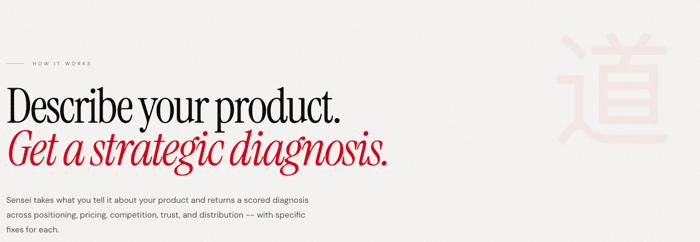
It's an AI-powered strategy tool that actually diagnoses what's wrong with your product and tells you how to fix it. Not vague advice — specific, actionable stuff.
Here's what it does:
- Validation scoring — Is your idea actually viable? Get a brutal honest assessment with dimension breakdowns (market opportunity, competitive position, execution, revenue potential)
- Site audit — Analyzes your landing page for conversion killers, trust signals, messaging clarity. Tells you exactly what's pushing visitors away.
- Competitor intel — See how you stack up, find gaps in the market, identify positioning opportunities
- Go-to-market strategy — Not a generic template. An actual plan based on YOUR product, market, and strengths.
- 30-day roadmap — Prioritized actions so you know what to work on first
The whole thing runs in about 90 seconds and gives you a "Product Health" score so you can track improvements over time.
Why I think this is different:
Most tools either give you data without interpretation or generic advice that applies to everyone. Sensei connects the dots — it understands your specific situation and gives recommendations that actually make sense for where you are.
Looking for beta users
I just launched and I'm looking for founders who want to put their product through the wringer. Would love your feedback on what's useful and what's missing.
If you're working on something and want a brutally honest second opinion, give it a shot: https://asksensei.dev
Happy to answer any questions about the build, the tech, or the product itself.

This is a solid idea, and honestly a pain point almost every founder here has felt at some point.
What stands out to me isn’t just the “AI audit” angle (a lot of tools claim that), but the attempt to connect diagnosis → prioritization → execution in one flow. That 30-day roadmap + product health scoring is interesting, because most tools stop at insight and leave founders stuck on “what do I actually do next?”
That said, I’d challenge a couple of things (in a constructive way):
How do you avoid “confident but wrong” outputs?
Early-stage products often have very limited data, so I’m curious how Sensei distinguishes between real signals vs assumptions.
What’s your source of truth for validation scoring?
Is it based on benchmarks, trained data, heuristics, or user inputs? Because “brutal honesty” only works if it’s consistently grounded.
Differentiation long-term
Tools like this can feel magical at first, but how do you make it something founders keep using weekly, not just a one-time audit?
Overall though, I like the direction — especially if it genuinely replaces the vague “improve your copy” feedback loop we all hate.
That's the idea - Sensei is grounded in truth. Making up benchmarks leads to an untrustworthy product. Sensei understands what good looks like based on industry standards and also learns through analysis.
Validation theater is a real problem, and harder to solve than it looks.
The tricky part: founders describe their product to a diagnostic tool the same way they'd pitch it to an investor. Optimistically. So the diagnosis starts from a biased input.
Does Sensei do anything to counteract this? Structured prompts that force more neutral descriptions, maybe?
Yes - structured prompts, grounded in truth. Right now, the problem that exists is that people think ChatGPT and other products are suited to handle anything you throw at it - but it isn't. There is a lot more work needed to get AI to be less agreeable and more real.
Congrats on shipping. I've seen so many founders do fake validation (asking friends, surveys with leading questions) then wonder why they still don't get clear actionable insights.
One thing I've learned building ValidateFirst: the hardest part isn't the diagnosis, it's getting founders to actually talk to strangers who might say "I wouldn't pay for this." Curious how you handle that psychological barrier?
Exactly. The way I am trying to push for - Sensei is collaborative and tries to hit home on hard truths. If that means joining different communities and reaching out to individuals - Sensei highlights it. Sensei is for the founder who wants to really know what comes after building.
Validation theater" is the perfect phrase for it — I've watched so many builders spend weeks on customer discovery frameworks while their project quietly dies on a Notion board.
▎ Curious how Sensei handles the gap after the diagnosis. In my experience, the hard part isn't knowing what's broken — it's that founders get the feedback, nod along, and then never act on it. The problem shifts from "I don't know what to fix" to "I don't have the structure to fix it."
▎ That's the gap I'm trying to close with MVP Builder — a 30-day structured sprint where builders get daily AI prompts calibrated to their exact project and skill level. Different problem, same root cause: solo builders need more than insight, they need a forcing function.
▎ What does your 30-day roadmap output look like in practice? Does it integrate with any task systems or is it a standalone deliverable?
I'm still working on including connections/integrations to help enrich Sensei's knowledge of any product. For example, I've already set up Stripe to help inform the analysis.
The roadmap is full of actionable insights - if this means driving traffic through posting on sites such as Indie Hackers, Hacker News, Reddit, etc., then Sensei tells you that is what you should do.
Ironically, I ran my own analysis on Sensei using Sensei - it was non-biased and helped me build this post to begin with!
"Validation theater" is such a perfect term. I've fallen into this trap too — asking friends for feedback, getting "looks great!" and then wondering why nobody signs up.
The hardest part about building diagnostic tools is that founders often don't know what category their problem falls into. They think it's a marketing problem when it's actually a positioning problem, or they think it's a product problem when the market just isn't there.
How do you handle the case where someone's idea is fundamentally flawed? Do you soften the blow or give it to them straight? Because honestly, the most valuable feedback I've ever gotten was someone telling me "nobody wants this" early enough that I could pivot.
Great question - Sensei gives it to them straight. I wanted it to be collaborative, yet straightforward.
Love the term 'validation theater.' It’s so easy to get polite feedback that feels good but doesn't move the needle on MRR.
I’m currently building a SaaS for technical proposals and the hardest part is getting that 'brutal honesty' before the market gives it to you via zero conversions. Having a tool that audits the landing page and the GTM strategy in 90 seconds sounds like a massive time-saver for solo founders. Checking out the site now!
This is a really interesting direction. The part about getting generic feedback vs actionable insight definitely resonates.
I’ve noticed something similar while building products with AI coding tools recently. It’s easier than ever to launch something quickly, but when things don’t work, it’s often hard to diagnose why. Is it positioning, messaging, product structure, or just the wrong market?
One thing I ran into personally is that AI can generate features and even full apps quickly, but it rarely creates deep product structure by itself. Sometimes the problem isn’t just the landing page or marketing — the product itself was built without a clear architecture or module logic, which makes the positioning fuzzy later.
So tools that try to diagnose the real issue are super interesting.
Curious about something:
when Sensei analyzes a startup, how does it separate “messaging problems” vs “product problems” vs “market problems”?
Because in my experience those three are usually tangled together.
There are different areas of analysis - We review what is happening based on the industry of a product, followed by identifying what is working for competitors and how one's product differentiates. It understands when the market is crowded and advises by leading with honesty.
This is a really interesting problem space. Did you find it hard to get the first 10 users, or did they come naturally from your existing network?
A few from my existing network. I have a few friends that I meet with a few times a month to showcase what we've been working on and share our products amongst our group, followed by trying to socialize through social media and sites like this.
This resonates — especially the part about getting generic feedback vs something actually actionable.
Feels like a lot of tools in this space try to cover everything at once, which sounds great but can get overwhelming in practice.
What usually helps more (at least from what I’ve seen) is when a few key issues are made really obvious upfront, so you immediately know where to focus.
Curious how people respond to the output so far.
The gap between 'working' and 'working reliably at scale' is most of the actual engineering work in any AI product. I've been living this for 72 hours straight — things that work once break in interesting ways when you run them 50 times in a row.
The part most people skip is validation before building. I built 7 products in 8 hours and then tried to figure out if anyone wanted them. Wrong order. Should have found one buyer first, then built the thing they'd actually pay for.
This is a really interesting concept 👏
One thing that could make it even stronger is how the value is presented — right now it might not be instantly clear to new users what makes it different.
You could improve that with a clearer headline or more structured layout.
Overall, solid idea 🔥
I like the idea of diagnosing what’s actually wrong instead of just giving general advice. A lot of founders hear things like “improve the copy” or “do more marketing,” which isn’t very actionable. If the tool can really point to specific issues (positioning vs messaging vs market fit), that could save founders a lot of time experimenting blindly.